


Connecting Africa’s Skilled Professionals

 ReConnect Africa is a unique website and online magazine for the African professional in the Diaspora. Packed with
essential information about careers, business and jobs, ReConnect Africa keeps you connected to the best of Africa.
ReConnect Africa is a unique website and online magazine for the African professional in the Diaspora. Packed with
essential information about careers, business and jobs, ReConnect Africa keeps you connected to the best of Africa.




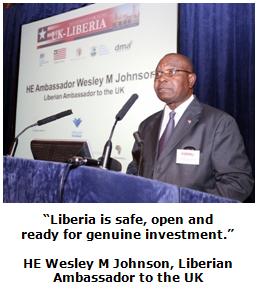 The 2012 UK-Liberia Investment Forum showcased the opportunities for investment in Liberia
Almost a decade after the civil war, the Republic of Liberia is continuing its transition from its post-conflict recovery phase with its government laying the foundations for faster growth and longer-term development.
A recent investment forum brought a delegation including the country’s Vice President, the Liberian Ambassador to the UK, senior ministers, representatives of parastatals and business and over 400 attendees to the City of London.
In his welcome address, Wesley M Johnson, the Liberian Ambassador to the UK, assured delegates that “Liberia is safe, open and ready for genuine investment.” With investment opportunities in agriculture, mining, infrastructure, oil, manufacturing, industry and tourism,” he said. “Liberia is the country of choice.”
The investment conference, the second held in London within 2 years, highlighted Liberia’s continued positive economic growth and its plans for diversification and private sector development.
In his opening address, the Vice President of Liberia, HE Joseph Boakai, set out the areas of progress and of continuing challenge.
“Liberia is blessed with a huge untapped potential and youthful human capital,” he said. “There are opportunities in agriculture, mining, forestry, construction, tourism, energy and transportation.”
He pointed out that agriculture contributes a significant percentage of the country’s GDP – over 70% - and that “Liberia can be the bread basket of the ECOWAS region of nearly 400 million people.”
The rubber industry, the country’s second largest foreign exchange cash crop, he said, offers many opportunities for investment in secondary rubber production for goods such as tyres and other items. Mining has long played a part in Liberia’s economy, constituting 30% of GDP and nearly 70% of the country’s foreign exchange earnings. The country has large reserves of iron ore and Liberia has shipped in excess of 1 million tons as of March 2012.
“The past six years were devoted to laying the foundations for the growth and development of our country,” Mr Boakai said. “We have accomplished that but a lot, however, still needs to be done.”
 “Our focus is now trained on specific areas for the economy; gaining access to finance, reducing the cost of doing business, building links and partnerships between young Liberian entrepreneurs and investors abroad for mentoring and support, and promoting education, jobs and skills training.”
The Vice-President stressed the importance of the government’s focus on jobs, skills and educational opportunities for the country’s youth. Young people make up 65% of the population and youth unemployment is a major priority. He also stressed the need to train young people for employment success, thereby enabling them to become productive.
“We are prepared to do business with credible companies that understand CSR and how to add value to the communities they are operating in,” he said. Making a passionate plea to investors, the VP said, “Liberia is open and ready for business. What are you waiting for?”
Since the end of the 14 year conflict in Liberia in 2003, the country has made huge strides. At the end of the conflict, the country’s infrastructure lay in ruins, its electricity generation reduced to virtually zero, and mining and agriculture in severe decline.
Since 2003, GDP growth has averaged over 7% annually and while challenges remain in employment creation, capacity building and the management of the country’s natural resources, the Liberian government is tackling these head-on.
The Chairman of Liberia’s National Investment Commission, Natty B. Davis, explained that his country’s government, along with its development partners, have allocated expenditure of more than half a billion US$ towards infrastructure investments over the next three years. Although the domestic market is made up of approximately 4 million consumers, Liberia offers a gateway to the ECOWAS region of 400 million.
“Liberia’s medium-term strategy,” he said, “is to deepen the growth of the domestic private sector to partner with the foreign direct investment that Liberia has been receiving.” The government is also focusing on improving the governance and management environment for the extractive industries and to build the basis for inclusive growth a strong domestic private sector to feed of the FDI.
“We are also seeking to create thousands of jobs in the sea and ground transport sector and upgrade the workforce through skills development in engineering and car mechanics,” he added.
With a focus on small to mid-sized entrepreneurs for land rehabilitation projects, value adding opportunities and resource pooling, the Liberian government is keen to secure broad based development across all sectors.
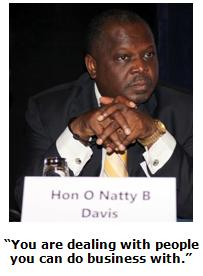
“You are dealing with people you can do business with,” he promised. “We have rules and procedures that enable you to come and work comfortably within the country.”
In his presentation, the Minister of Foreign Affairs, Augustine Ngafuan, described how Liberia had moved from being a failed stage and “the problem child of the region” to the situation today which he described as “changing from a pariah to a partner”.
 Describing the country’s strategy for economic diplomacy, he said: “The emphasis of our foreign relations has been to seek tangible win/win opportunities for Liberia; to transform our country, bring in credible investors and reduce the army of jobless young men.”
Touching on the issue of security in the country, the former Finance Minister outlined the steps the government is taking to retrain the army and police and to prepare Liberians to take over the current UN peace keeping operations. Pointing out that unemployed young men with a history of fighting in the civil war could be exploited into creating a crisis, the Minister emphasised that the government is taking tangible steps through a robust reconciliation initiative to bring Liberians to be at peace with themselves.
Liberia’s President Ellen Sirleaf Johnson, as Chair of the Manu River Union, is committed to ensuring that Liberia’s territory is not used to destabilise its neighbours, said Mr. Ngafuan. The improved security situation has also led to the recent partial re-opening of Liberia’s border with the Ivory Coast.
In his presentation to delegates, HE Amara Konneh, the Minister of Finance, outlined the country’s development strategy. The 18 year strategy, Vision 2030, is known as ‘Liberia Rising’ and sets out a long-term agenda for the country.
The strategy focuses on economic transformation designed to transform Liberia into a middle income country by 2030 and fix the issues around exclusion, marginalisation of certain groups, land ownership and decentralisation. The strategy places a strong emphasis on reconciliation and national healing, with a national reconciliation taskforce being one of the priorities in the national budget.
Under its agenda for transformation, the Minister explained, the country is strengthening the areas of peace, security and the rule of law, rebuilding its army to take over from UNMIL in 2014 and investing aggressively in courts and training judges to enable access to justice through the courts as the first resort.
The economic transformation agenda is targeting infrastructure and energy transformation, improving ICT connectivity and looking for manufacturing firms to come to Liberia to help create jobs faster.
Liberia’s human development strategy is focused on health and education. “We have invested a lot in the past six years,” said the Minister, “and we want to invest now in quality.” This priority is reflected in the budget which has allocated US$72 million to education and US$67 million to health, including the training of nurses and health professionals.
The Minister pointed to areas such as HIV/AIDS, gender mainstreaming and unemployment as the other key priority areas under the national strategy.
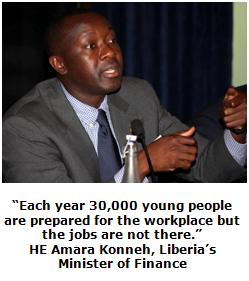
“Each year 30,000 young people are prepared for the workplace but the jobs are not there,” he said, underscoring the need for an expanded private sector to address this issue.
The conference also provided a platform for presentations from development institutions such as the IFC with the Liberian Resident Representative, Frank Ajilore, outlining the improvements the partnership with the World Bank’s private sector body has brought to the country. An improvement made to the country’s investment climate has enabled, for example, the business registration process in Liberia to move from 90 days to 48 hours, while assistance with drafting a commercial code for Liberia, now signed into law, has addressed concerns around the expropriation of assets in the country.
Ecobank Liberia, the biggest bank in the country and with over 40% of market share, is another growing success story in Liberia, said the bank’s Managing Director, Kola Adeleke. With over 200,000 customers, the bank has demonstrated its commitment to staying in Liberia and working with government to develop the country’s economy.
ArcelorMittal, the world’s largest steel company and the largest foreign investor in Liberia, has been in Liberia since 2005. In his presentation to delegates, the company’s head of Government & Community Relations, Joseph Mathews, laid out the company’s plans for expansion of its iron ore mining operations, currently in excess of 2 million tons of exports.









 Keep yourself updated with our FREE newsletters now!