


Connecting Africa’s Skilled Professionals

 ReConnect Africa is a unique website and online magazine for the African professional in the Diaspora. Packed with
essential information about careers, business and jobs, ReConnect Africa keeps you connected to the best of Africa.
ReConnect Africa is a unique website and online magazine for the African professional in the Diaspora. Packed with
essential information about careers, business and jobs, ReConnect Africa keeps you connected to the best of Africa.




Careers coach and author, Alan Jones, offers a clear strategy and practical guidance on how to apply the principles of networking to your job search campaign.
 Careers coach and author, Alan Jones, offers a clear strategy and practical guidance on how to apply the principles of networking to your job search campaign
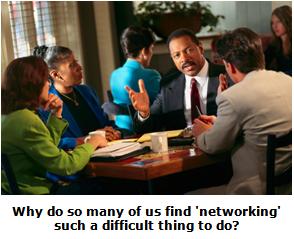
It's well understood that many jobs are found through people we know rather than by responding to an advertisement, but why do so many of us find 'networking' such a difficult thing to do?
Probably because we have no 'route map' - no clear sense of how to go about doing it. Possibly because we don't believe we know anyone influential enough to ' give me a job'. This is to misunderstand the meaning of networking in the context of a job search. Job search networking is much more to do with the gathering of information and once we give ourselves up to that idea, then things become a lot easier.
The best way to stay unemployed is to be invisible and isolated. If you don't let people know that you are in the market and seeking work then information will not flow your way. It is crucial then to make opportunities to maintain a connectedness with others and build a network through which information can travel.
If you are unemployed this may mean that you undertake voluntary work, join clubs and societies, in essence, you must try to build new networks and not rely solely on the people you know well. The great value of building new networks arose out of the research undertaken by Mark Granovetter of Stanford University, who coined the memorable term 'the strength of weak ties'. He discovered that we are more likely to get a job through our acquaintances ('weak ties' ) than through close friends or members of our 'inner circle' ( 'strong ties' ).
The old saying 'It's not what you know, it's who you know' is an incomplete and therefore misleading comment on networking to secure advancement as it leads us to believe that only the people in powerful positions can help us 'get a job', whereas all the evidence points in the opposite direction i.e that people we don't know very well at all and who may not be in any way 'senior', 'powerful' or 'influential', are far more likely to be linked to someone who is. So, it's not necessarily who you know - it's who they know.
This research is of particular significance if you are seeking to change career and move into another sphere of activity. Your 'strong ties' will most likely be familiar with what you currently do and quite possibly work within your present line of business. They are then less likely to be privy to information that could help you achieve your career transition.
Good networking is productive networking but for many job hunters it stalls at the beginning because it's natural not to start something until we have clarity about what we want our 'end product' or 'objective' to be - hence the common refrain ' I can't start networking until I've decided what job I want'.
There is of course some truth in the saying that ' If you don't know where you are going you'll end up somewhere else'. And yet, for many job hunters who have embraced and given themselves up to the 'Network To Get Work' approach, that 'somewhere else' has proven to be a particularly pleasant place to be, whereas others who had clarity on where they were heading, ended up drinking from a poisoned chalice.
It's crucial to understand that information from a contact doesn't always appear in the form of a 'vacancy', 'lead', or a 'referral'. It can of course be any or all of those but it can also come in the form of 'advice' across a breadth of issues encountered during the course of a job search campaign. For example, a contact may have interviewed people for jobs in which case you can seek their advice about what they look for or what questions they ask.
Others may have been job hunting themselves in the recent past, so why not tap into their experiences - how much better it is to learn from the mistakes made by others, or from the opportunities that came their way. Once you find a way to open up a dialogue in this way, then good things tend to happen, things which you could not have foreseen or planned.
Luck has always had a huge role to play in networking. Being in the right place at the right time, making that call or taking that journey will many times turn out to be fortuitous actions on your part. And it's having the confidence to take the actions without trying to predict the outcome which is the key to success.
 |
You can read more about this topic in the e-book by Alan Jones 'Network to Get Work' available via: https://www.smashwords.com/books/view/167471
|










 Keep yourself updated with our FREE newsletters now!