


Connecting Africa’s Skilled Professionals

 ReConnect Africa is a unique website and online magazine for the African professional in the Diaspora. Packed with
essential information about careers, business and jobs, ReConnect Africa keeps you connected to the best of Africa.
ReConnect Africa is a unique website and online magazine for the African professional in the Diaspora. Packed with
essential information about careers, business and jobs, ReConnect Africa keeps you connected to the best of Africa.


A 3-day visit to the UK by the President of Gabon provided the opportunity to showcase the country’s strategy to become an emerging country by 2025.
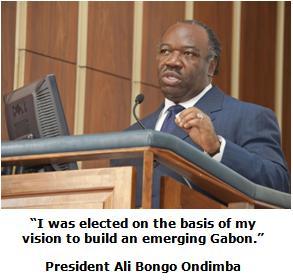 A 3-day visit to the UK by the President of Gabon provided the opportunity to showcase the country's strategy to become an emerging country by 2025
A three-day visit to the United Kingdom, which included discussions with Prime Minister David Cameron at Downing street and an address to Chatham House, gave Gabon's President Ali Bongo Ondimba, the opportunity to spell out Gabon's development strategy and to call on Africans to participate fully in the continent's development.
Gabon has entered an era of change spurred by ambitious political reforms introduced by President Ali Bongo Ondimba. Following a long period of dependency on the export of raw materials, Gabon is now determined to diversify its economy. The reform of environmental management in Gabon will enable the extraction and processing of raw materials in a rational, sustainable and environmentally-friendly way.
Gabon is hoping to become an emerging country by 2025 through a sustainable development strategy called Emerging Gabon. This strategy is based on three pillars:
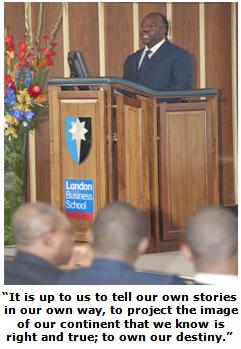
The President's visit culminated in his delivery of the keynote address at the London Business School's Africa Day before an audience of MBA students and business executives.
Addressing the theme of the conference "Africa, Taking Ownership: Successes & Challenges", the President made a number of observations.
"Through what lens do you look at Africa? What is your perception of Africa today? Do you see Africa as 'the dark continent' of old, with famine, wars, poverty, tribal conflict and corruption? An Africa whose relationship with the world is anchored in pity fed by images of round-bellied children with flies around their big eyes, the proliferation of which has fed the generous provision of aid to which the Continent is perceived to be addicted?
Or do you see the same Africa as I do: A continent that is emerging into its rightful position in the world, with enormous potential. A continent whose time has come, leading global economic growth rates at an average of 5.5%, with the fastest growing middle-income population in the world. A continent conceiving and leveraging technological innovations like mobile money transfer, to deliver new areas of growth while it remains home to most of the world's natural resources.
A continent that has 17 nations ahead of India in the most recent "East of Doing Business" report. A continent consisting of 54 separate nations, one of which has the highest percentage of female representation in parliament in the world, at 56% in Rwanda. A continent that is now delivering on its economic potential, to complement its long held cultural and environmental wealth.
This debate around perceptions of Africa has been raging for many years, but it perhaps avoids a more fundamental question: how do we, as Africans, see ourselves, our countries and our continent?
Do we spend too much of our time worrying about, reacting to and trying to change the perceptions of others, while neglecting the need to fundamentally alter the reality of Africa. Do we hesitate to seize the opportunities that we are presented with today to build the Africa that we as Africans want? To take ownership of our future, rather than relying on the actions of others?
We will not change perceptions, and neither will we achieve our ambitions simply by seeking to tell nice stories. Perceptions are so difficult to change, because they are exactly that – perception, not reality.
I do not want to brand Africa; I want to change Africa. The change of perception will follow naturally. Most importantly we need to influence the perception we have of ourselves. We need to instill the confidence to dream, the drive to plan and invest, the capacity and strength to be true to ourselves and believe that we can define our future, mindful of the challenges, but fully aware of the rewards.
It is up to us to tell our own stories in our own way, to project the image of our continent that we know is right, and true, to own our destiny.
We need to sit confidently at the negotiation table, sure of our value proposition and of our strength, having learned from the past, taking into account the present and able to be decisive about a vision for the future."
"The need for Africa to take ownership of our collective destiny has never been greater because the opportunities we have surpass those at any moment in the past. It is our responsibility to ensure that the policies and decisions that we implement today allow us to create a sustainable future for our continent.
We do not want a short-term economic boom. We need to seize the opportunity to generate decades of progressive growth, while maintaining social and environmental capital. As African leaders this responsibility falls on our shoulders. It is us who will be judged in 20 years time and it is us who must deliver.
Africa is home to more than 1 billion people, with more than 60% under 30 years of age. 60% of this population now has access to mobile phones and therefore Internet. In the age of social media and globalisation, this creates a very vocal, informed population, eager to express its voice, and determined to be given opportunities to imagine the world in which it wants to live.
We, as governments, cannot offer them half-baked solutions. They will not accept them, and they will make sure their voice is heard.
Do not misunderstand me. I do not adhere to the culture of blame that some use to project responsibility on others and make excuses for Africa's performance. I believe that we need to build a successful Africa and that by doing so we will earn the respect of the world. International opinion should never be the yardstick by which we measure our success. A new generation of young, enlightened leaders is emerging across the continent. Our democracies are catching up and growing stronger. Despite the challenges we face, we are in a position to develop new models that will enable the development and the rapid growth required to position Africa at the forefront of the global economy.
As elected leaders, our ultimate role is to serve our people and our country. When I say country, I do not refer to an abstract historically defined notion. I refer to the vast natural environment that our countries are blessed with and which form an intrinsic part of our cultural heritage and national identity."
"Alongside a young population, our middle classes are growing too, as well as their disposable incomes. By 2020 McKinsey projects that 52% of African households will have surplus income to spend. Africa will have more middle-class households than India very soon. Our populace is urbanizing too – 40% of the population now lives in cities - almost as urbanized as China - and today we have 52 cities with a population greater than 1 million – the same as Europe.
By 2040 we may have the largest workforce in the world - 1.1 billion people - and one of the largest markets for consumer goods. These statistics present clear opportunities for industry, especially manufacturers and service industry companies. It also creates the need for a new approach to our land use and to the social contract we are proposing to our citizens, learning from the Arab Spring and ongoing social issues in Europe driven by economic decline.
About 60% of the world's virgin arable land is in Africa. Africa is home to the world largest reserves of diamond, bauxite and cobalt. Africa produces 78% of world platinum and 57% of Manganese. The exploitation of these resources offers great potential to create employment for our people, as well as value for our countries.
These are the resources the world needs today, so it is our responsibility to leverage on them in order to create value for all, while planning the spatial development of our countries in order to safeguard the harmony between man and nature.
As the world is increasingly looking at Africa, at our resources, and as our children are now more than ever empowered to build our economies, it is crucially important that Africa takes her own destiny in hand.
We have a unique opportunity to do so, and we need to be very conscious of the terms of the choice. Do we want to be forever beholden to others, struggling to catch up and with no hope of ever achieving the independence that engenders self respect? Or do we have the courage to define our own criteria of success, our own criteria of self-esteem?"
"Gabon's environment is still pristine. 88% of my country is covered with rainforest, with incredible biodiversity. It is equally rich in mineral resources. Furthermore, my Bantu culture drives my appreciation of the intimate link between nature and mankind.
You will understand my dilemma: should I pursue development and sacrifice the natural heritage and wealth of my country, or do I believe that we can find a new way and achieve both?
Let me reassure you – there is no dilemma in my mind. Gabon is resolutely charting her way forward, conceiving new approaches to the reconciliation of two seemingly opposite imperatives – environmental protection and socio-economic growth for our people. Indeed we are inventing new ways of collaboration between the State and the private sector in order to do so.
In 2010, we introduced laws to ban exports of raw timber. We wanted to challenge a view of Africa solely as a source of cheap natural resources, but equally importantly, we wanted to expand opportunities for far-sighted investors, not limit them. In tandem, we have created Special Economic Zones, with concrete advantages for business, including tax exemption on profits for 10 years, and total exemptions on VAT and import duties on equipment for new companies. These zones would amount to very little if we didn't at the same time develop a skilled workforce, and the infrastructure, including energy supplies and open ports and railways, to enable industry to operate efficiently and to export finished or semi-finished goods.
Likewise, our economic growth plans would be in vain if we pursued this at the expense of our natural environment. As I mentioned earlier, 88% of Gabon is covered by equatorial rain forest - a source of rich biodiversity and the second largest natural carbon sink in the world after the Amazon rainforest. Over 20% of our forests are protected and a further 45% are managed sustainably for forestry.
For our own sakes – not just the Gabonese people, but all of humanity - we cannot afford to pursue a development path that would jeopardise this precious asset. This is why I have placed the environment at the heart of our national development strategy, making Green Gabon a centrepiece of Emerging Gabon.
 Respect for the environment is a key consideration for my government when evaluating proposals from industry. We will not endanger the unique biodiversity of our country for short-term gains; and so we expect our partners to adhere to the highest international environmental standards when operating in Gabon. This is what I call giving direction.
A new Sustainable Development Code will ensure that impacts on climate, biodiversity and community capital are fully accounted for and offset in all development projects in Gabon.
I think this epitomises the ownership that we in Gabon are taking of our future. Once our system is finalised, projects will be able to compensate negative impacts on climate, biodiversity and community well being through carbon, biodiversity and community capital credits, that they either create themselves or that they purchase from the registry.
We plan to launch our carbon exchange in the coming months. In addition, we intend to develop innovative financing mechanisms such as green bonds, in order to stimulate generation of sustainable development credits and to manage the risk of volatility in the long-term valuation of these credits, in light of the failure of the international community to arrive at a legally binding agreement on forest carbon.
This approach is ground breaking and creates a compelling opportunity for the Gabonese Republic and international investors. This approach is also in line with some of the challenges that my country, our continent and indeed the whole world are facing today.
This innovative approach is Gabon's attempt at inventing new ways of doing business, new ways of choosing our destiny, new ways of taking our future into our own hands, with the help of like-minded international partners. Conserving our natural environment, but not limiting economic opportunities for our people; that is a challenge that is particularly poignant in Africa; a challenge fit for the 21st century."
"I am not standing here in front of you as a representative of Africa. I am 'only' the elected President of Gabon, so allow me to focus on what my country is doing and how we articulate and implement this new model of development.
I was elected on the basis of my vision to build an Emerging Gabon. Our national development strategy to attain emergent country status by 2025 assigns priority to conserving our natural environment, while seeking to develop competitive manufacturing and service sector industries. Growth in these sectors will underpin our national low carbon development path and give practical life to our vision for an Emerging Gabon.
This is an ambitious objective. But we are realistic about our limitations as a government. We cannot achieve our vision for Gabon unless civil society and the private sector participate actively. My government will play its full part, but our contribution will amount to very little without the full participation of the private sector. In order to attract investors, we need to build a clear investment case, a business plan of sorts for our country.
By demonstrating a clear vision and a clear commitment to stick to this vision, we can reduce the perceived risk for our private sector partners, and establish a clear win-win situation.
In this respect, the role of the Government is to guarantee the security and predictability of the business environment, whilst ensuring that the interests of its citizens are guaranteed and that sound environmental standards are applied.
Hereby, government can become a real lever for change in the country. By playing its full role as partner, my government intends to give clear direction to our investors, by identifying, creating and promoting opportunities for you to come and work with us to implement a new vision for harmonious growth.
Gabon is in a unique position today. We are rich in minerals, oil and gas, and yet our natural environment is still relatively pristine. We have internationally recognised experts at the frontline of environmental debates and we have the political will to find solutions and to engage in the necessary reforms to implement these solutions.
Gabon has the potential to pilot real innovation and to re-define how governments and the private sector collaborate to create sustainable growth.
We want to innovate through strategy and policy, but more importantly we want to create the long term potential for our people to innovate. To allow them to compete, not just with each other, or with their neighbours on the African continent, but globally. I firmly believe that these ideas are the bedrock of a development model for the Third Millennium - a model that the entire world recognises as necessary, but is struggling to conceive and implement.
Africa is well placed to lead the pack – isn't that the definition of taking our future in our own hands?"







 Keep yourself updated with our FREE newsletters now!