


Connecting Africa’s Skilled Professionals

 ReConnect Africa is a unique website and online magazine for the African professional in the Diaspora. Packed with
essential information about careers, business and jobs, ReConnect Africa keeps you connected to the best of Africa.
ReConnect Africa is a unique website and online magazine for the African professional in the Diaspora. Packed with
essential information about careers, business and jobs, ReConnect Africa keeps you connected to the best of Africa.




As more companies develop Corporate Responsibility strategies, gaps in the profession remain, according to a new US study.
 As More Companies Develop Corporate Responsibility Strategies, Gaps in the Profession Remain
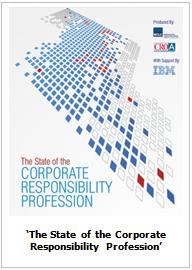
The U.S. Chamber of Commerce Business Civic Leadership Center (BCLC), the U.S. Chamber's resource and voice for businesses' social and philanthropic interests, and the Corporate Responsibility Officers Association (CROA) have released a breakthrough business report called 'The State of the Corporate Responsibility Profession.'
The CROA and its members transform ideas into action, advancing corporate responsibility (CR), the profession, and their careers. As the single largest independent CR professional society, CROA supports the concept that to excel, organizations need to embrace all CR disciplines: sustainability, governance, social responsibility, and philanthropy. Their mission is to promote the practice and profession of corporate responsibility in service of good business.
Among the nine different key findings from the research, BCLC and CROA found that the characteristics that define a mature profession, such as an educational curriculum and a career pipeline, currently are lacking in the corporate responsibility (CR) profession. BCLC and CROA also found that while few of the CR leaders in companies today entered the field deliberately, they have paved the way for "generation 2.0" CR practitioners.
"Corporate responsibility as we know it today has only existed for the past few decades," said BCLC Founder and Executive Director Stephen Jordan. "While the CR field is more intertwined than ever in smart business strategy, it stands at a critical crossroads in its development into a mature profession."
BCLC and CROA surveyed various stakeholders, including academics, practitioners and recognized thought leaders for the study. The results serve as a benchmark for where the CR profession stands in 2012 as well as provides recommendations on how to mature the field's set of knowledge, skills and attributes.
The majority of survey respondents agreed on the following:
A mature profession has certain characteristics: recognition by society; an accepted body of knowledge, applied research related to that body of knowledge; a recognized professional society; an ethics code; and a professional credential. These characteristics are currently lacking or underdeveloped for the corporate responsibility (CR) profession, indicating the need for focused attention and effort to fully mature it.
To date, few have entered this profession via a deliberate career path; however we are at the dawn of Generation 2.0 for the CR profession. In Generation 1.0, people got these jobs without formal training or experience in the field, often coming from related but narrower disciplines like environmental health and safety or corporate philanthropy. Generation 1.5, which began during the last decade, was marked by lateral transfers – corporate responsibility officers (CROs) from one company taking the same or similar job at another – recognizing that this role encompasses a transferable skill set. Recently, Generation 2.0 leaders have emerged, with formal education and work experience in the field prior to obtaining manager- or executive- level positions. Nevertheless, people seeking to advance in this field still have to make their own way without the benefit of a clear career path. Moreover, Generation 1.0 leaders are not always focused on clearing that path.
Some see CR rising in response to recent events and sun-setting as a formal function once it is "embedded" throughout companies and management decision-making, similar to how eCommerce Officers sprung up at the beginning of the Internet-boom and then faded away. However, the overwhelming consensus of people interviewed for this study was that the CRO would follow a path more like that of the CFO: while finance is embedded in decision-making at all levels of the company, a formal officer and function persists.
A mature academic field has certain characteristics currently lacking for the field of CR: pipeline of educators; program specialties and sub-specialties; academic research and publishing; graduate level programs; and a core curriculum. Regardless of whether CR persists as a distinct function or not, without educators and a curriculum future business leaders will not have the conceptual frameworks, hard data and proven practices they need. Putting these pieces in place will help advance the field and embed CR into business-thinking.
Improving the role of business in society is predicated on improving the effectiveness of management's discipline; the ability of business leaders to integrate CR principles and stakeholder approaches into mainstream strategy. This will link CR initiatives directly to business goals and create the ability to measure a company's resulting performance.
The majority of CROs interviewed were of two minds about the future of their profession: they like their jobs but are uncertain about the future of their profession. As a result, some have adopted a "wait and see" attitude while others wanted to take deliberate action to help mature the field but aren't sure what steps to take. There is no clear consensus on how to move the profession forward, as evidenced by the lack of agreement around whether or not there is a need for credentialing in this field.
"Dealing with the tough issues -- creating sustained economic growth, preserving resources for future generations, increasing respect for human dignity -- requires complex decision making," says Richard Crespin, executive director of the CROA. "This report lays out a roadmap for embedding that kind of critical thinking into the leadership curriculum for business people everywhere."
The report concludes that "the CR profession is stuck in a chicken-and-egg conundrum: before employers establish a CR career path, CR needs a defined curriculum; before educational institutions invest in a defined curriculum, they need to see a clear demand for CR professionals. CROs need to be more engaged in shaping the future of their profession through deliberate, collective action.
The State of the Corporate Responsibility Profession study is available on BCLC's website: www.bclc.uschamber.com










 Keep yourself updated with our FREE newsletters now!