


Connecting Africa’s Skilled Professionals

 ReConnect Africa is a unique website and online magazine for the African professional in the Diaspora. Packed with
essential information about careers, business and jobs, ReConnect Africa keeps you connected to the best of Africa.
ReConnect Africa is a unique website and online magazine for the African professional in the Diaspora. Packed with
essential information about careers, business and jobs, ReConnect Africa keeps you connected to the best of Africa.




 With remittances to Africa from the Diaspora providing huge financial flows (for some governments the figure is between 10 and 40% of GDP) and with total estimates ranging from $20 to $40 billion a year, finding safe, economical and easy ways to send money home has never been more important.
Proving that it isn't only the multinational money transfer companies that can fill this need, Fadugu, a company set up in 2007, has been successfully assisting people to send money to Sierra Leone.
With its new services now also offering fast and simple money transfer services to Ghana and Nigeria, ReConnect Africa spoke to Sierra Leonean Leah Mansaray, the founder and CEO of Fadugu, about the company's incredible success to date.
ReConnect Africa (RCA): What made you decide to set up Fadugu?
Leah Mansaray: As a Sierra Leonean migrant living in the UK, I send money back home to friends and family quite frequently. So it must have been about 7 years ago when, whilst visiting in Syracuse, New York, I tried sending money back home. It was the first time the lack of money transfer choice became obvious to me. The only available money transfer was charging as much as 12% of the transfer amount while, at that time, it would have cost me as little as 5% from the UK.
I thought: this can't be right! So I started to research the remittance industry with a focus on Africa and specifically my home country, Sierra Leone. I found out that as much as 70% of formal transfers to Africa go through one particular money transfer service provider, as opposed to the 20% market share it has in other parts of the world where it operates and where the market is much more competitive.
I found out that not only is the money transfer market dominated by one player, but that their fees when sending to most sub-Saharan African countries were, relatively speaking, much higher - a reflection of their near monopolistic share of the African market.
With my background in software development, I decided to explore different models to see how we could use technology to serve the African market better through fairer pricing and with an application that would be accessible to anyone living abroad with access to the internet. So the story of Fadugu started.
RCA: What are the main challenges for people in getting money back to Africa when they live and work in the UK?
Leah Mansaray: Up until recently, migrants sending money home from the UK had much more choice of money transfer service providers. However, since the introduction of the new payments directive that came into effect on the 1st of November 2009, this is no longer the case. Smaller niche service players providing great service to specific migrant corridors have since had to cease operations as most could no longer meet the new EU payments directive.
 This means that we have moved to a situation where you have a few large-sized money transfer providers who are working to consolidate the money transfer service even more.
RCA: What are some of the dangers in the methods currently used by people to send money home?
Leah Mansaray: To sometimes avoid transfer fees, people send money home through friends and family travelling back home.
The natural danger with this lies in having to trust another individual with the safe delivery of your funds. This is why using regulated and registered institutions offering fair transfer fees should be a preferred choice.
RCA: What sets Fadugu and its services apart from the competition?
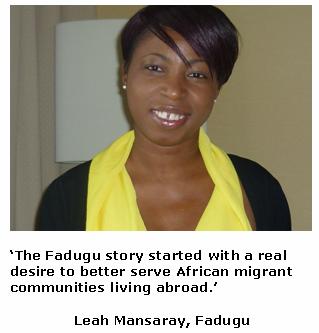
Leah Mansaray: The Fadugu story started with a real desire to better serve African migrant communities living abroad.
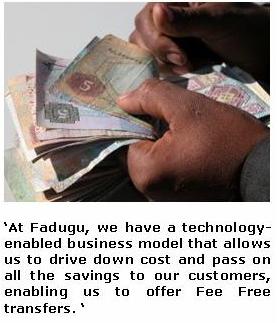
We have a technology-enabled business model that allows us to drive down costs and pass on all the savings to our customers, enabling us to offer Fee Free transfers.
RCA: What are the main benefits of using Fadugu's services?
Leah Mansaray: Most importantly, we offer all our customers Fee Free transfers into all the countries where we operate. Our aim is simple; to disrupt the current money transfer market with our Fee Free model.
 Our approach is to work with other local money transfer partners to offer extensive cash pick-up locations. Working with local domestic mobile money transfer operators means that, in those recipient countries, our customers will be able to send money directly to any mobile phone in that country.
The relationship with our international banking partner, HSBC, allows us to offer direct bank transfer as a payout option and competitive exchange rates.
RCA: What other products do you plan to launch in the future?
Leah Mansaray: We have a number of things coming up:
These are just some of the things we are working on to offer our customers a wholesome money transfer service that meets the specific needs of the African migrant community.
RCA: What's the best advice you can offer someone who wants to send money back home?
Leah Mansaray: Everyone should try and shop around for the money transfer partner that most closely meets their needs; don't just use the money transfer provider that appears to shout the loudest or the one that can be seen on every street corner.
There are useful online resource portals such as the sendmoneyhome.org website that provides detailed information on different money transfer operators and it is a good place to start when looking to make comparisons.
Also, it is important to send money back home through formal channels, not least because of the indirect benefit it has on our economies back home in terms of generating foreign exchange reserves for our home countries. This, in turn, affects the country's exchange rate, ultimately impacting on what our families back home pay for their goods and services.
Find out more about Fadugu's services by visiting: www.fadugu.com











 Keep yourself updated with our FREE newsletters now!