


Connecting Africa’s Skilled Professionals

 ReConnect Africa is a unique website and online magazine for the African professional in the Diaspora. Packed with
essential information about careers, business and jobs, ReConnect Africa keeps you connected to the best of Africa.
ReConnect Africa is a unique website and online magazine for the African professional in the Diaspora. Packed with
essential information about careers, business and jobs, ReConnect Africa keeps you connected to the best of Africa.




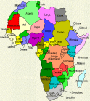 EU Earmarks Euros 53 Million for Africa
EU Earmarks Euros 53 Million for Africa
The European Commission announced it has earmarked more than Euro 53 million for expanded humanitarian aid to vulnerable people in nine African nations struggling with food shortages. The funds, channelled through the Commission's Humanitarian Aid department (ECHO), are targeted at people in Somalia, Ethiopia, Kenya, Uganda, Chad, Burkina Faso, Niger, Mali and Mauritania.
Kenya Set to Introduce New Cash Centres
The Central Bank of Kenya is set to ease the transportation of money in the country through new cash centres countrywide. Although officials say the rollout is yet to be mapped out, CBK is working with Sweden's central bank on the project. Sveriges Riksbank, as the Swedish bank is officially known, is the oldest central bank in the world. If the Riksbank model is applied, commercial banks will foot the cost of the cash handling centres.
Rwanda named "top reformer" in the World Bank's 'Doing Business 2010' report
Rwanda has become the first Sub-Saharan African economy to be named "top reformer" in a World Bank study that tracks the ease of doing business in 183 countries around the world. The 'Doing Business 2010' report sees Rwanda jump from 143rd to 67th place in the rankings, with Liberia also being named among the "top ten reformers". Other African countries noted for improving their ease of doing business rankings include Burkina Faso, Liberia, Mali, Sierra Leone, Zambia and Cape Verde. According to the ICF, the fact that so many African countries have improved their 'Doing Business 2010' report rankings is testament to the commitment of their respective governments who are taking steps to address business fundamentals. Progress is being made in many African countries to reduce bureaucracy, regulation, and red-tape and to improve poor infrastructure, in order to improve the continent's business environment and support economic growth.
Europe Gives R1.3bn Jobs and Skills Boost to Africa
The European Commission and the United Kingdom's Department for International Development (DFID) have allocated about R1.3-billion for South Africa's economic support and employment creation programme, it was announced at SA-EU Summit held in Cape Town last week. According to the UK Government, the purpose of the programme is to assist the economic sector departments of the South African government to accelerate South Africa's economic growth rate and provide more and better jobs for poor people. The European Commission and the DFID are providing €100-million and £18-million respectively to the programme, to support the South African government's work in three clusters – economic, employment and infrastructure – and to stimulate innovative ways of accelerating growth and creating job opportunities in the country, the Department of Trade and Industry (DTI) said in a statement last week. Government departments in the economic sectors will have access to additional funds to promote skills development and initiate programmes that expand the capacity of the productive economy. The programme is also expected to stimulate joint planning, implementation and co-ordination across government departments and with civil society and the private sector.
UK Doubles Funds to Rebuild Congo's Road Network
The UK is to double its funding for a road-building in the Democratic Republic of Congo to improve access to some of the world's most remote regions, UK Minister for Trade and Development Gareth Thomas has said. The DRC has one of the least developed roads networks in the world - 95% of the DRC's 152,400 km of roads are effectively just paths, making it difficult to get food, medicine and trade routes open. Only one out of ten of the provincial capitals are easily accessible by road. This severely hampers development prospects and has been cited as a reason the country is so poor. Of the 60 million citizens, around 45 million live on less than 50p a day. One in seven children die before their fifth birthday, and every day nearly 100 Congolese mothers die in childbirth. During his visit to the country, Africa Minister Gareth Thomas announced the Department for International Development would double its funding for road building programmes from £38 million to £76 million. The road building programme will bring together the Department for International Development (DFID), the Government of the DRC, the World Bank and other donors to build, and maintain, the country's roads. This is key to helping to promote trade and investment, as well as security. The 'Pro-Routes' roads programme will support the DRC Government to open and maintain between 2,500 km and 3,000 km of priority roads and provide better access to social services and markets. It will also help the Government of the DRC to run its own road-building and maintenance programme, and also help it to establish a 'second generation road fund', through tax on petrol and diesel sales. The 'Pro-Routes' roads programme will also boost the ability of private sector businesses to carry out road maintenance; and develop a forward-thinking road sector strategy which will ensure the continuation of the roads programme, and also set up a wide-ranging environmental and social strategy which will ensure the natural forest of the DRC, and the population, is protected. Better roads mean small-scale farmers can get their produce to market before it rots or spoils, and also brings down prices in the area by increasing competition from traders, thereby helping the local population. The DRC is heavily reliant on imports, even on items which it grows or supplies from within its own borders, because exports can be brought in more cheaply.
New Zimbabwe Law to Entice Investors
Zimbabwe's President Robert Mugabe has urged foreign mining companies to invest in the southern African country and sought to allay fears that such businesses could be expropriated. Mugabe told a mining conference in Harare that the government would soon pass a new law to govern the sector, which would address concerns raised by an earlier draft. Under the previously proposed bill, foreign mining companies could not hold more than 49% of a business and had to sell any stake above that to Zimbabweans. Following the collapse of commercial agriculture, mining is the top foreign currency earner, with gold alone bringing in a third of total export earnings. Mugabe said the law would seek a balance between attracting investors and empowerment of Zimbabweans. Zimbabwe has the world's second-biggest platinum reserves after South Africa and large deposits of diamonds, coal, and nickel. Mugabe said the sector needed foreign investors because it was capital intensive, and promised to implement stable polices.
British Soccer Fans Boost 2010 Ticket Sales
With England recently securing its place in next year’s Soccer World Cup, thousands of English fans have already made their bookings for the tournament. The UK, together with Germany, is one of South Africa's strongest tourist markets, with close to 500,000 British tourists visiting the country last year. By June this year, British soccer fans had bought a total of 42,000 tickets for next year's event, the second-highest sale outside of South Africa, according to Fifa. The US had the highest sales with 73,000 tickets sold and Germany with 30,000. In all, 630,000 tickets in 188 countries were sold by June. South Africa is already a popular destination for UK sports fans. During June, arrival numbers from the UK received a significant boost from the British and Irish Lions tour, with 56% more tourists arriving in the country compared with the same month last year.
Ghana Inspires Cadbury Dairy Milk's Innovative Advertising of Fairtrade
Cadbury's commitment to Ghana has been strengthened with a Ghanaian-inspired TV, radio and billboard campaign which celebrates the talents of local artists, musicians and dancers, and uses an innovative record-release to raise additional funds for cocoa growing communities. This follows the recent Fairtrade certification of Cadbury Dairy Milk across the UK and Ireland, and builds on the work of the Cadbury Cocoa Partnership, a 10-year initiative launched in 2008, investing £45 million in securing the economic, social and environmental sustainability of cocoa farmers in Ghana, India, Indonesia and the Caribbean. The TV production was filmed in Ghana, where Cadbury has a 101 year history of sourcing cocoa. The campaign draws on elements of traditional Ghanaian culture as well as modern Ghanaian pop-culture. In particular, Cadbury has worked with Ghana's leading hip life star, Tinny, to produce a track and music video called 'Zingolo', which means 'Enjoy it' in Ga, one of the languages of Ghana. Cadbury's share of profits from the sale of the single will go to the charity CARE International, one of the Cadbury Cocoa Partners, to fund education programmes in cocoa growing communities in Ghana. Cadbury also commissioned a local Ghanaian artist, Casper Teshie, to execute the artwork for its print campaign. Taking inspiration from Ghanaian walls traditionally covered in signwriting, he painted murals on walls in Kof Town. These murals then formed the press ads, bringing cocoa beans to life to celebrate Fairtrade certification with Cadbury.
Investing in African Social Responsibility
Investors in the Johannesburg Stock Exchange (JSE) are a step closer to accessing a fast developing global investment theme – responsible investment – as the exchange has started to disseminate live values of its Socially Responsible Investment (SRI) Index to the trading screens of thousands of investors worldwide. The SRI index is a South African benchmark for corporate citizenship, and has as its constituents JSE-listed companies with high standards of environmental, economic and social performance as well as good governance. Until now, only close of day values of the SRI index have been available, and the JSE hopes the new development will prompt the creation of instruments based on the index, to be traded on the exchange. According to the JSE, responsible investing, a significant investment theme in many developed countries, is also growing in South Africa. Institutional interest in responsible investing came of age in 2008 when South Africa's largest pension fund, the Government Employees Pension Fund (GEPF), placed its weight behind the index and required institutions managing GEPF funds to support responsible investing. Like the FTSE/JSE Top40 index or any other JSE index, it is now be possible to track the performance of the index at any time during the trading day. This makes it more attractive for a market maker to create products such as exchange traded funds (ETFs), unit trusts or tracker funds based on the index. The SRI Index is calculated by the JSE, and constituents are drawn from the companies that meet the SRI criteria as well as set liquidity ratios. It acts as a tool for investors to select certified good corporate citizens and a benchmark for companies looking to improve corporate responsibility.
IBM Opens Second Africa Innovation Centre
Multinational IT giant IBM has opened an Africa Innovation Centre in Cape Town to foster the development of information technology and business skills, and to expand its customers and business partners in the region. The centre, which joins a growing worldwide network of 47 centres, will help local businesses develop and deploy new technologies that support key digital infrastructure opportunities in government, banking, insurance, retail, and travel and transportation industries. Based in Century City to the north of Cape Town, the centre will provide local customers, business partners, start-up companies, independent software vendors, IT professionals and the academic community with access to training workshops, consulting services, a broad technical infrastructure, and hands-on assistance to help solve business challenges and bring new technologies to market. The centre supports IBM's efforts to help grow the burgeoning local IT market, and is a key addition to its two-year market expansion investment in sub-Saharan Africa. As the second IBM Africa Innovation Centre established in Sub-Saharan Africa, the Cape Town centre will help connect businesses and academics with the Johannesburg centre, which opened last year, and additional local IBM initiatives.
Stanbank secures $1bn Chinese Loan
Standard Bank has further strengthened its relationship with China, with the signing of a US$1-billion loan facility with four major Chinese banks: the Industrial and Commercial Bank of China (Macau), Bank of China, China Development Bank, and China CITIC Bank. The club deal, believed to be the largest of its kind for a South African financial institution in the Chinese market, was self-arranged by Standard Bank and is a "debut term loan" for the bank's fund raising in the Asian market. The deal will serve as a platform for future cooperation between Standard Bank and these banks across a range of different banking products and geographies to support Chinese companies going global into emerging markets. According to news agency Reuters, Standard Bank expects to seal a dozen major lending deals in Africa with its China partner next year, as resource-hungry Chinese firms begin returning to the continent.
Kenya to Introduce Banking Laws to Raise Access
Kenya aims to introduce laws to govern "branchless banking" and help bring mobile financial services to the majority of the country’s people who don't have the formal means to borrow or save, Finance Minister Uhuru Kenyatta said. Kenya's poorest people remain "unbanked" because they mainly live in remote areas and lack transport to travel long distances to the nearest bank branch. Proposed changes to the Banking Act, which is now before Parliament and may be passed this year, will allow commercial banks to recruit "agents" to set up front-teller services in convenient locations such as supermarkets, kiosks and pharmacies. They may be equipped with machines, similar to the devices that accept credit or debit cards, to complete transactions. About one third of the East African nation’s population doesn't have a bank account and can't get credit from lenders, according to Kenyatta. Another 27% can only access money via informal channels such as family and friends.
Gateway Communications goes live on SEACOM
Two years after committing to the SEACOM project, Gateway Communications is live on the submarine fibre optic cable connecting Africa to Europe, Asia and the rest of the world. Gateway Communications was the first company to invest in SEACOM, which is bringing 1.28 Tbit/s of capacity to the continent. As the foundation customer, Gateway's investment in SEACOM is another example of its ongoing commitment to infrastructure build in Africa, allowing more innovative products and ensuring that Gateway provides the highest level of quality, speed and reliability at the most competitive prices. SEACOM, privately funded and three-quarters African owned, is expected to provide bandwidth on an open access basis, allowing all operators to have equal access to the cable. SEACOM has created an artificial price ceiling to ensure wholesalers charge end-users the most attractive market rates available for their bandwidth. The landing of SEACOM and other cables demonstrates that Africa's information age is well underway. Expected to provide a high volume of bandwidth at a low cost, SEACOM will continue to open people's eyes to what ICT can deliver – to consumers and businesses. It will provide competition and connectivity into markets, which will drive demand for faster applications run over any available bandwidth, including satellite. With customers in 40 sub-Saharan countries across Africa, Gateway's African backbone plays a critical role at the centre of East African communications. Gateway has end to end capacity on the cable, connecting their African customers to the high speed European networks and the rest of the world.
Help for South Africa's Youth to Start Business
A new body to assist South Africa’s young entrepreneurs to start up and grow their businesses will be launched in November. The Young Business Society is the brainchild of Phumlani Zuma, President Jacob Zuma's nephew, and boasts some of the country's most prominent political names on its board, including Tselane Tambo and Cleopatra Hani. Zuma is the president of the business society. The 22-year-old Zuma said he had come up with the idea for the society because of the challenges he encountered while setting up his own events management venture. The society will offer mentorship programmes, help members to access finance and link them up with local and international big business for joint ventures.
www.youngbusiness-society.com
South Africa needs Billions for Power Infrastructure
South African state power utility Eskom needs to invest billions of dollars in electricity transmission and distribution lines over the next decade, but reaching a 2012 target of universal access may be tough. According to the company, Eskom estimates it will need to spend at least 300 billion rand over the next decade on power infrastructure. But lack of funding and proper skills may make it difficult for the government to hook up all South Africans to the grid as planned by 2012, up from the 70 percent connected at the moment. Electrification of the biggest economy in Africa is a major priority for the country's new President Jacob Zuma. South Africa, which relies on coal for 95 percent of its power, generates most of it in the northern Witbank region, and needs to transport electricity over distances of up to 1,500 km. That will change once the country moves to diversify its energy mix and builds new nuclear power stations at the coast. Eskom has also been involved in regional transmission projects via the Southern African Power Pool (SAPP) to both boost trade in the region but also for security of supply.
South Africa 'making progress on poverty'
The number of South Africans living in poverty declined between 1999 and 2007, positioning the country well to meet its target of halving poverty by 2014, while the incomes of the poorest have increased from R783 to R1 041 per month in recent years, a new report finds. Development Indicators 2009, released by The Presidency's policy coordination and advisory service unit, also found that more than 13-million South Africans now receive social grants, compared to 7.87-million in 2004/05.The report, which provides information on the impact of government programmes, found that there was a significant decrease in the number of South Africans living in the lower categories of the Living Standards Measure (LSM -3), as well as an increase in the size of the middle bands (LSM 4-6). Despite the reduction in poverty, the publication found that income inequality has remained the same or worsened in the country. Despite recent protests by citizens over alleged lack of service delivery, the report found that the government continued to make big improvements, with the number of subsidised houses continuing to increase, along with access to water, sanitation and electricity.
South Africa gets Africa's most powerful Supercomputer
South Africa's newest supercomputer, a Sun Microsystems hybrid, has gone online in Cape Town, providing the local and regional research community with a powerful tool for tackling problems of climate change, energy security and human health. With a peak performance of 31-trillion calculations per second, the hybrid supercomputer is the fastest in Africa and ranks among the top 500 in the world. By using the system, months of computing on research projects can be replaced by weeks, days or even hours of work. It is housed at the Centre for High Performance Computing (CHPC), a unit of the Council for Scientific and Industrial Research (CSIR). The supercomputer has been installed in the CHPC's newly refurbished data centre. Green computing interventions have been included in the design and construction of the facility.
Southern African Countries to Cooperate on Cross-Border Tourism
South Africa's Mpumalanga province is to partner with neighbouring countries Mozambique and Swaziland to create a wild, scenic, cross-border tourism magnet in south-eastern Africa. Mpumalanga, Swaziland and Mozambican tourism authorities have agreed to pool their resources, and collectively package their tourism products, to draw more international tourists not only to South Africa but to its southern African neighbours as well. According to the parties, the idea is to enable visitors "to have breakfast in Mpumalanga, lunch in Mbabane, Swaziland, and supper in Mozambique". It is planned that a memorandum of understanding is signed in November to finalise the agreement. The three tourism authorities plan to collaborate in developing a regional brand identity, as well as in regional destination marketing campaigns, tourism airlift strategies, research and information management, tourism product development, and 2010 Fifa World Cup initiatives. Mpumalanga province is a major South African tourism drawcard, covering nearly 80 000 square kilometres and offering spectacular scenic beauty and an abundance of wildlife in both private game reserves and the world-famous Kruger National Park.
Over 160,000 to Benefit from World Cocoa Foundation Youth Education Program in West Africa
The World Cocoa Foundation has announced a public-private partnership for rural education with the U.S. Agency for International Development (USAID) Africa Education Initiative and its members Kraft Foods; The Hershey Company; Mars, Incorporated; Starbucks Coffee Company; Fazer Confectionery; Olam International Ltd.; The Hain Celestial Group, Inc.'s SunSpire brand; Guittard Chocolate Company and Barry Callebaut as well as The Jacobs Foundation and the Norwegian Association of Chocolate Manufacturers. The initial two-year program began in October 2007; the $5.6 million cash and $2 million in-kind contributions will extend the program for an additional two years through September 2011. The Empowering Cocoa Households with Opportunities and Education Solutions (ECHOES) Alliance in Côte d'Ivoire and Ghana has already reached thousands of young people directly through vocational agricultural training and indirectly by training teachers in interactive teaching approaches. The program aims to develop a replicable, scalable model for improving education in rural West Africa. In its second phase, the program will place more of an emphasis on directly reaching youth and young adults. Activities will focus on in-school education at the primary and secondary school levels; training for out-of-school youth; agriculture-related extracurricular activities; family support scholarships; and literacy training. Additionally, the program will train teachers working in cocoa-growing communities. Overall, these activities will directly benefit over 20,000 young people and indirectly impact an additional 140,000 people across both countries. The program will build on the successes of the first two years while incorporating new elements such as using information technology to improve learning, encourage community education, and private education activities. Established in 2000, the World Cocoa Foundation is a leader in promoting economic and social development and environmental stewardship in 15 cocoa-producing countries around the world.
HIV/Aids Treatment Now Reaching more South Africans
South Africa's HIV/Aids treatment programmes are reaching an increasing number of those in need, according to a new international report, with the number of patients on antiretroviral treatment almost doubling between 2007 and 2008. The report, titled "Towards universal access: Scaling up priority HIV/Aids interventions in the health sector", was recently released by the World Health Organization (WHO), United Nations Children's Fund (Unicef) and Joint UN Programme on HIV/Aids (UNAids). One of the most notable achievements, according to the report, is that the number of patients undergoing antiretroviral treatment almost doubled, from 458,951 to 700,500, between 2007 and 2008. The report noted that the impact of the scale-up already show signs of progress, with one of the largest treatment coverage programmes in the world now reaching half-a-million people. It further noted that prevention of mother-to-child transmission treatment was now available to over 50% of those in need. The report found that the National Strategic Plan for 2007-2011 was one of the largest treatment coverage programmes in the world, with South Africa ranked second in the world in terms of domestic spending on Aids programmes. However, major challenges remain around limited implementation capacity to fully put the plan into operation. Other challenges include the low uptake of prevention and weak service delivery structures, especially at lower levels. According to the National HIV Prevalence, Incidence and Communication Survey, conducted in 2008, South Africa's HIV/Aids epidemic has stabilised and there are signs of declining prevalence among children and teenagers. It shows that the HIV prevalence has levelled off at 10.9% in the age group two and older.
BMW to Invest R2.2bn in Rosslyn Plant
BMW South Africa is to invest an additional R2.2-billion at its plant in Rosslyn outside Pretoria, in order to introduce the latest vehicle and production technology at the plant and within the company's local supplier network. The investment will enable maximum plant capacity to increase from 60,000 to 87,000 units, while securing production in South Africa for the future, according to the German car maker. At the same time, the automaker announced a training programme for 1,100 associates at its Rosslyn plant. The training programme commenced in early September and will run for the next 18 months, providing a Merseta (Manufacturing, Engineering and Related Services Sector Education Training Authority) accredited qualification to the associates.
Government of Mozambique and ICF Announce Partnership to improve Business Life Cycles in Tourism Industry
The Investment Climate Facility for Africa (ICF) has announced a partnership with the Government of Mozambique to improve business life cycle services in the tourism industry. The project will streamline business registration and licensing procedures for tourism enterprises in five geographic locations identified by the Government as Tourism Investment Areas (TIAs), dramatically reducing the time and costs associated with doing business in the sector. The twelve month project, in partnership with the Ministry of Tourism, will establish five regional one-stop-shops in Maputo, Cabo Delgado, Inhambane, Sofala and Gaza. These priority areas are rich in tourism activity and potential, ranging from hotels, tour operators and commercial activities such as craft markets to restaurants and diving centers. The project aims to reduce the number of days associated with registering and licensing a business in Mozambique from 175 to 13 days for medium to large sized businesses, and 30 days to just one day for small businesses. Currently, one-stop-shops (BAUs) dedicated to registering small sized businesses across a variety of economic sectors including tourism, exist in each province of the country. This new project will see the establishment of new one-stop-shops in the five TIAs specifically dedicated to registering and licensing tourism businesses of all sizes (including small tourism businesses currently registered by the existing BAUs). In addition to streamlining business registration and licensing procedures for tourism related enterprises of all sizes, medium to large-sized businesses will also benefit from environmental impact assessment and land-lease (DUAT) licensing. The project is ICF’s first project in Mozambique and if successful, will be extended to other licensing activities in the country. ICF was established in 2006 to remove the barriers that currently exist to doing business in Africa. ICF is currently active in eleven African countries and is working on four pan-regional projects and four special initiatives.
Zimbabwe's Education System Receives $70 Million Boost
Zimbabwe's education system, once regarded as the finest in sub-Saharan Africa, has been given a US$70-million (R526-million) shot in the arm that will see every child receive a textbook and ensure vulnerable children are able to attend school. The UN Children's Agency (Unicef), in partnership with the Zimbabwe unity government, will be distributing funds from donor countries that include Australia, Denmark, Germany, Netherlands, Norway, New Zealand, Sweden, the United Kingdom, and the European Commission on behalf of the European Union. One of the largest social sector initiatives in the last five years in Zimbabwe, the funds will see school fees paid for a large number of the country’s orphaned and vulnerable children, provide textbooks and stationery, and boost skills in education. Textbooks have become a rare commodity in schools - Unicef estimates the ratio of books to pupils at about one book to every 10 children. Teachers in the capital, Harare, said up to 40 pupils were sharing one textbook at some schools. According to Unicef, an assessment by the education advisory board has revealed that in about 20% of all primary schools there is not single textbook for English, Mathematics or an African language. Widespread food shortages, cholera outbreaks, an almost year-long strike by teachers in 2008, the country's economic meltdown and political violence have all contributed to the near total disruption of education.
African Banker Awards 2009 Winners Announced
Bankers from Nigeria, Morocco, Kenya, Angola, South Africa, Togo, Ghana, Mali and Chad, representing North, South, East, West and Central Africa, were amongst the nominees and winners of the 2009 African Banker. A total of 14 awards were presented during the ceremony in Istanbul. The African Banker of the Year award went to Tayo Aderinokun, Managing Director/CEO, GTB Nigeria, the African Bank of the Year award went to Ecobank-ETI. The Lifetime Achievement award was presented to a pioneer of African banking, Paul Derreumaux, the President of the Mali-based Group Bank of Africa, whose outstanding achievements in banking have contributed to Africa's substantial economic transformation. The award for Finance Minister of the Year was handed to Dr. Youssef Boutros-Ghali, Minister of Finance, Egypt and Tito Mboweni, Governor, South African Reserve Bank was named Central Bank Governor of the Year. The event, organised by African Banker magazine and IC Events in partnership with BusinessinAfrica Events, was supported by the African Development Bank in line with its commitment to build a strong and vibrant African banking industry.
Aspen Network of Development Entrepreneurs Announces New Grants
Fifteen international economic development organizations have received grants in support of their work to expand small and growing businesses in developing countries. The grants—totaling US $447,000—were announced at the 2009 annual conference of the Aspen Network of Development Entrepreneurs in Glen Cove, New York. The grants were the first awarded as part of the network's Capacity Development Fund, a US $1million effort to increase the productivity and effectiveness of organizations that provide investment, training and other resources to small and growing businesses in developing countries. Funding for the grants was provided by the Bill & Melinda Gates Foundation, The Lemelson Foundation and Shell Foundation. Grants will support projects in developing countries ranging from Nicaragua to India to Nigeria. One project, for instance, creates a platform for identifying high-impact investment opportunities in Africa, Asia and Latin America. Other grants will be used to develop tools to manage business plan competitions and to accelerate small and growing business in developing countries through peer-to-peer learning and mentorships. Based at the Aspen Institute in Washington, D.C., the Aspen Network of Development Entrepreneurs is a network of investment funds, non-governmental organizations, research institutions and private philanthropic foundations that invest money and expertise to help entrepreneurs grow small businesses in emerging markets.
Intervet/Schering-Plough Animal Health Announces Sponsorship Supporting Milk Producers in Malawi
Intervet/Schering-Plough Animal Health has announced that it has initiated a multi-year sponsorship project, supporting the Shire Highlands Milk Producers Association (SHMPA) in Malawi, a developing country in southeast Africa. The primary objective of the project is to support smallholder dairy farmers in the Shire Highlands to improve their capabilities to manage the milk production process. Intervet/Schering-Plough Animal Health will provide financial and in-kind support that can annually be adapted as specified by SHMPA. Support will initially focus on increasing milk production by improvement of animal health and infrastructure. Short-term projects include the provision of funds to build and equip a veterinary laboratory as well as the supply of some urgently needed veterinary diagnostics and medicines. The scope of the support may also be extended to the improvement of milk quality, animal husbandry (nutrition, reproduction and breeding) and farm management. In-kind support may consist of the sharing of veterinary expertise as well as offering education and training. Materials will preferably be sourced on site, thereby sustaining the local economy. The funds are earmarked for specific objectives and SHMPA management will be responsible for using these resources efficiently and reporting on their allocation. Intervet/Schering-Plough Animal Health is focused on the research, development, manufacturing and marketing of animal health products.
Shortage of Scarce Skills Threatens South Africa's Growth
South Africa’s skills shortage is having a debilitating effect on the country's economic projection, says Minister for Higher Education, Blade Nzimande. He said that the shortage of professionals and artisans in particular was largely responsible for the country's failure to achieve the targeted 6 percent growth rate in the period 2010 to 2014. He said government needed to invest in skills development and training, especially the youth, if it were to meet the set targets. His department has earmarked about R3.2 million for scarce skills areas for the financial years 2010/11 and 2011/12. These include engineering at universities, universities of technology and comprehensive universities. However, while institutions need to produce more graduates in scarce skills fields, such as actuaries, there was a need for the profession and the labour market to make sure that it retains sufficient experienced professionals to mentor newcomers.
Ramaphosa puts Black Entrepreneurs on Track
Cyril Ramaphosa's Shanduka Holdings has announced a R5.2-million business incubator programme to assist young black entrepreneurs. Ramaphosa said the aim of the Shanduka Black Umbrella programme was to provide assistance and grow small and emerging black business. He said the initiative was a lifelong dream. "This was the reason that I left politics – to foster black businesses. But I got sidetracked and got into big business through a variety of BEE deals that are usually overlaid with debt and complex issues." He said "real economic empowerment" occurred when black people started their own businesses and created employment. Over the past two years, Shanduka has spent R5.2-million assisting 17 small- and medium-sized enterprises in Cape Town and Johannesburg. Each business received R30,000 each year in the form of services such as office space, book-keeping, telephones, Internet, training and reception services. In exchange, established SMMEs pay a fee of R1000 and start-up businesses R500 over a three-year period or until they are self-sufficient.









 Keep yourself updated with our FREE newsletters now!