


Connecting Africa’s Skilled Professionals

 ReConnect Africa is a unique website and online magazine for the African professional in the Diaspora. Packed with
essential information about careers, business and jobs, ReConnect Africa keeps you connected to the best of Africa.
ReConnect Africa is a unique website and online magazine for the African professional in the Diaspora. Packed with
essential information about careers, business and jobs, ReConnect Africa keeps you connected to the best of Africa.



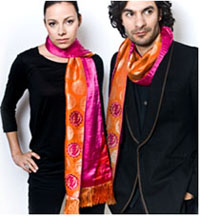 Inspired by the cultural richness encountered in their upbringing in West Africa and India, Hazel and Kweku Aggrey-Orleans have created a unique range of scarves that combine the richness of Ghanaian Kente with the delicacy of Indian silk.
ReConnect Africa spoke to Hazel and Kweku about the inspiration behind Orleans Designs.
We had always been interested in fashion. However, the turning point came after Hazel had the design confidence to create her own wedding dress in August 2006. The overwhelming response was the first clod of earth to be added to the growth and creation of Orleans Designs as a brand.
The next steps were perhaps the easiest. We had for years bemoaned the underuse of bright colours in the fashion palette of the Western World: White, Blue, Black and Grey seemed to dominate all collections with the odd exceptional colourful summer offering. 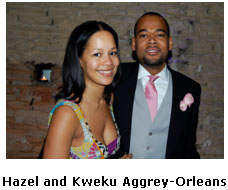 In winter, it was near impossible, e.g. women's coats in vibrant colours, and those found were often either at the high or low end of the fashion market. As West Africans, the absence of vibrant colours in mainstream fashion was a peculiarly unjustifiable twist.
From the market research we undertook in the first stages, we discovered that many people wanted to add more vibrant colour to their wardrobes. The idea of undertaking a wholesale revolution in terms of replacing a standard wardrobe based on blue, black, white and grey with a vibrantly coloured one was, we felt, a challenge few would wish to undertake.
We strongly acknowledged that elegance was largely made up of the wearer's confidence and ease with a garment. It was at that stage that we decided, through Orleans Designs, to accessorize with colour.
Creating any collection from the ideas of two individuals is not without its challenges. The fact that the other individual is your husband or wife certainly does not make the task any easier. Frequent clashes of ideas and emphasis are not uncommon in our design relationship, however, our underlying respect for each other's ideas often serves as a catalyst in the development of our designs in that we are each obliged to justify and analyse the reasons behind the rejection or acceptance of any design. From conflict we are then able to generate a strong consensus and understanding of each design.
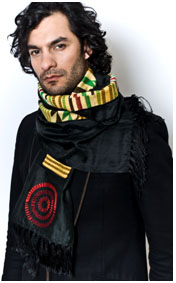 As keen adventure travellers, we would set out annually from London. It was during our travels, particularly through West Africa and India that the idea was born not only to create vibrant scarves but to marry in those scarves fine cloths from Ghana and India – two countries at different stages of the same development, but both with a strong appreciation of fabrics.
In Ghana and in India, like in many countries in Africa and Asia, fabrics hold an elevated status within the societies and, for example, they are presented as part of the dowry for a bride's hand.
Their intricate weaves will sometimes reflect the status or position of its bearer, lending a sense of authority to our choice of fabrics. On many levels, we found the collaboration between Kente and Indian silk complementary. The sourcing of our fabrics was the next step.
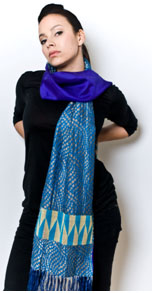 In Ghana, there was little difficulty in relying on the skill and artistry of Dento Mills to weave the Kente strips used for our scarves.
The same mill, under the current owner's father's stewardship had, in 1960, woven the Kente quilt presented to the United Nations in New York by Kwame Nkrumah (Ghana's first president after Independence) on the occasion of Ghana's membership.
The traditional looms of Dento Mills continue the time consuming art of weaving Kente strips: One strip can, given its detail, take its weaver a day to finish.
In India we turned to the well-known artisan weavers of the Hindu Holy City of Varanasi to source rich, textured, hand-woven silks. The intricacy of their work was evident.
Some scarves have additional detailing of embroided Adinkra symbols, each of which in turn symbolizes a proverb or virtue. The finishing idea behind the collection was to be able to present each scarf as an inspiration for its wearer: Each carries a name of its own derived from its detail and each is packaged in 100% recycled paper.
We believe that our genuine conviction in our designs and product has strengthened our brand. Over the years we would want to see Orleans Designs become synonymous with elegance and quality.
We are currently in negotiations with various hotels and boutiques in West Africa to stock our products from autumn of 2009. We are also looking to branch into the Western market with a product that is not only aimed at Africans or those with an African link, but at everyone.
We are also very excited about our additional project to launch African print fabrics by Christmas 2009. In line with our scarves, vibrant colours will be the theme throughout our fabrics.
Orleans Designs scarves can be bought online at www.orleansdesigns.com








 Keep yourself updated with our FREE newsletters now!