


Connecting Africa’s Skilled Professionals

 ReConnect Africa is a unique website and online magazine for the African professional in the Diaspora. Packed with
essential information about careers, business and jobs, ReConnect Africa keeps you connected to the best of Africa.
ReConnect Africa is a unique website and online magazine for the African professional in the Diaspora. Packed with
essential information about careers, business and jobs, ReConnect Africa keeps you connected to the best of Africa.




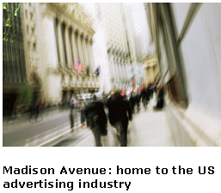 Harbouring hopes of entering the American advertising industry? Well, the facts about your chances of success may surprise you.
In what is describes as 'a wake-up call' to Madison Avenue, a new study shows the extent of racial discrimination behind the glossy facade of the US advertising industry.
An exhaustive study of America's advertising industry has found dramatic levels of racial discrimination throughout the industry. The study revealed evident bias against African-American professionals in areas ranging from hiring to pay, assignments and promotion.
The study was initiated by a coalition of legal, civil rights, and industry leaders who, in 2008, created the Madison Avenue Project to address advertising's deep-rooted racial bias.
Prominent US civil rights lawyer Cyrus Mehri, the leader of the Project, called the findings "absolutely astonishing in this day and age", while Angela Ciccolo of the NAACP, another Project partner, commented that "the time has come to stand up to change this industry."
The findings from the study reveal that, overall, racial discrimination is 38% worse in the advertising industry than across the broad American labour market. Worse still, the "discrimination divide" between advertising and other U.S. industries is more than twice as bad now as it was 30 years ago.
So what exactly did these findings reveal? Some specific results include:
While employment discrimination across the United States has steadily decreased over the last forty years, what the report terms "systemic barriers to equality" within the advertising industry have remain virtually unchanged. 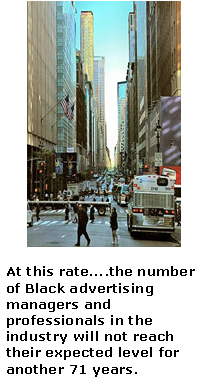 Practices which were deemed back in 1978 by the New York City Human Rights Commission to be "not simply the result of neutral forces, but emanating directly from discrimination" continue unchecked today.
Many of the changes needed to eliminate these practices would have to be initiated by advertising agencies themselves who, despite occasional public pressure to address these disparities, have responded with little more than token efforts such as training and minority internships.
Measures which, at today's rate of progress, the study's authors conclude, will mean that the number of Black advertising managers and professionals will not reach their expected level for another 71 years.
The study found the primary source of discrimination to be agencies' implicit assumption that the cause of Black under-representation is a shortage of 'qualified' Black job seekers. Ironically, those initiatives that have been taken to increase 'pipeline' Black talent have simply served to increase the already substantial number of qualified Black candidates.
In reality, the study says, the problem is not a shortage but a "persistent unwillingness by mainstream advertising agencies to hire, assign, advance, and retain already-available Black talent."
A total transformation of the workplace culture of advertising agencies is needed if change is to be substantial and permanent, says the study. Specifically, agencies will need to reform human resources practices in which "personal relationships and social comfort often outweigh job performance". Also key to change in the industry is what the report terms "obsolete assumptions that racial minorities lack skills applicable to non-ethnic markets".
The Madison Avenue Project is led by the NAACP and attorney Cyrus Mehri, the founding partner of law firm Mehri & Skalet, who has won several multi-million dollar discrimination settlements against such corporations as The Coca-Cola Company, Morgan Stanley and Texaco Inc.; with the cooperation of Sanford Moore, a former advertising executive, current New York City talk radio co-host, and longtime advocate for racial parity in advertising.
"We are sending a message to the advertising industry: this conduct is unacceptable and must change," Mehri says. For Sanford Moore, the study illustrates what he terms "the mendacity and machinations that have kept African-Americans invisible on and to Madison Avenue for over four decades." The advertising industry, he notes, has "created and perpetuated a 'separate and unequal' marketing paradigm" and "even though our dollars provide the profits, the industry is still afraid of the dark."
Angela Ciccolo, on behalf of the US civil rights group, the NAACP, describes the report as an opportunity for Fortune 100 companies "to stop aiding and abetting widespread discrimination by this industry."
"The Madison Avenue Project is designed to send a special wake up call to the advertising industry. It's time for Madison Avenue to wake up to civil rights and to the meaningful inclusion of African Americans in this highly segregated industry."











 Keep yourself updated with our FREE newsletters now!