


Connecting Africa’s Skilled Professionals

 ReConnect Africa is a unique website and online magazine for the African professional in the Diaspora. Packed with
essential information about careers, business and jobs, ReConnect Africa keeps you connected to the best of Africa.
ReConnect Africa is a unique website and online magazine for the African professional in the Diaspora. Packed with
essential information about careers, business and jobs, ReConnect Africa keeps you connected to the best of Africa.




'There is a shift in the world's economy that favours Africa and we are witnessing a new paradigm.' When some of the world's top financiers and analysts gathered to discuss investing in Africa.
 When some of the world’s top financiers and analysts gather to discuss investing in Africa, it’s time to listen.
How many times do you hear people begin a statement with the words, "the trouble with Africa..?" said former Commonwealth Secretary-General Don McKinnon at the start of a remarkable investment conference held in London earlier this year.
In a day packed with presentations, analysis and debate, some of the most influential investors and analysts on Africa and the emerging markets made the case for Africa’s emergence as an investment destination. In his opening remarks at The Africa Investment and Finance Conference organised by Brand Communications, Don McKinnon summed up the attitude of the day when he said, “my analysis of Africa’s economic situation is simply this; many good things have happened in the last decade – but they are not yet noticed. For Africans and non-Africans alike, those that have noticed them are doing well, while others are held back by a combination of bad news and received wisdom."
The issue of investing in Africa offers a clear illustration of how perceptions are often hard to change. As the Commonwealth Secretary-General pointed out, 25 years ago only 3 out of the continent’s 54 countries were democracies. Yet the landscape has now been transformed and across the continent today, more than 40 countries hold regular multi-party elections. Emerging superpowers such as China, Russia, India and Brazil are increasing their investment in Africa while South Africa has seen a five-fold increase since 1994 in its trade across the continent.
At the same time, sub-Saharan economies have routinely grown at nearly 7% per annum over the last five years and cleared well over $50 billion of debt. Remittances of around $8 billion dollars a year are now finding their way back into the continent while the capital markets reflect an enormous growth in the numbers of listed companies.
Citing former IMF Head Michel Camdessus" description of "the silent revolution" taking place in Africa, McKinnon said, "ignorance breeds ignorance and loss of opportunity. The negatives perpetuate their own myths but I can easily argue in favour of an Africa on the move."
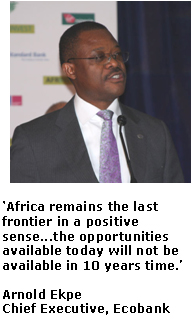
"A new generation of leaders is emerging,’ said Arnold Ekpe, Chief Executive of pan-African bank Ecobank and a sponsor of the conference. Founded in Togo twenty years ago, Ecobank has been a major investment in the continent, providing banking services today in 21 African countries.
As an investor, Ekpe was quick to point out the basis of his company’s success in Africa.
"Today inflation rates and interest rates are down to single digits in many cases. Institutional reforms have taken place and there have been many favourable changes in the way many governments operate. We are seeing the emergence of the African consumer – a small and growing middle class."
While some may be hesitating, Ekpe pointed out that the investment sector is seeing the benefits of investment in the continent.
"We are seeing savvy and experienced hedge funds and private equity firms that see opportunities in Africa today."
The impact of technology has connected Africa to the global economy and this, said Ekpe, has created a revolution.
"Private capital and access to international capital markets is spawning a new financial and investment landscape in Africa," he said. ‘Ecobank has 43% of its capital owned by foreign investors today and we have recently seen the emergence of Africa capital, with MTN and Celtel as examples. A number of African companies are growing into regional players with several Nigerian banks, for example, now operating subsidiaries in other countries."
The perception of Africa as an undesirable investment destination, said Ekpe, is one that is slowly changing. This is a critical issue when it comes to attracting capital.
‘What is important is perception. There is a changing perception that Africa is, after all, an attractive market,’ he said.
‘The higher returns available on fixed income investment at 50% represent the highest in the world. Investor protection has improved and it is easier to get money out of African markets. Currencies are more stable across the continent and there is a new breed of central bank governors who are placing the economic stability of their countries as their prime concern.’
African governments are also changing their priorities for the better, observed Ekpe, realising the need for investment as a key to ensuring sustainable economic development.
What makes the possibilities for Africa different today? According to Ekpe, what makes now different is that this time we are seeing something new across much of the continent.
‘What is most important is the sociology of change. When people who have to make the change happen believe in it, there is a fundamental attitudinal change.’
Africans, he said, are today increasingly comfortable with international norms and practices. ‘We are seeing many Africans in the Diaspora beginning to return home, work in Africa and support its development.’
Nevertheless, he acknowledged, perceptions take a while to change. However, the emergence of regional investors and Africans investing in Africa is accelerating the change.
‘One of the most exciting developments in the last five years has been the investment of Africans into Africa,’ he said.
‘Africa remains the last frontier in a very positive sense’, said the Ecobank chief.‘The opportunities available today will not be available in 10 years time.’ These opportunities are being seized by many within the continent.
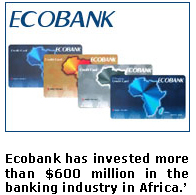 Ecobank has invested more than $600 million in the banking industry in Africa and many Nigerian banks are investing millions in other African countries. This type of activity, said Ekpe, is what will sustain growth.
‘Unless Africans believe in the growth of Africa, they cannot expect non-Africans to do so.’
Greater access to locally raised capital has been a key factor in enabling economic expansion. Increased liquidity and capital supported by access to international capital as well as a willingness to challenge the longer-established multinationals have played a major role in this expansion.
Ekpe called for Africa’s governments to also do their part to aid the progress being made. ‘We need a clearer policy from governments and other authorities on the privatisation of investment and the creation of jobs and opportunities, not just on the returns made on financial investment,’ he added.
Investing in Africa involves taking a strategic and long-term view, he said, and long-term, the growth in Africa is better than anywhere else in the world. ‘Now is the time for Africa; the perception of Africa is a lot worse than the reality. If you take a long-term view of Africa, it represents and will continue to represent a very profitable destination for foreign investors.’
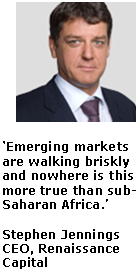
‘G7 economies have slowed to a crawl while emerging markets are walking more briskly - and nowhere is this more true than sub-Saharan Africa’ said Stephen Jennings, CEO of the investment and fund manager, the Renaissance Group.
‘Projected growth is less then 2% in the US and around 2.1% in Europe. Yet projected growth in 2008 in sub-Saharan Africa outside South Africa is around 7.2%,’ he pointed out. ‘Developing nations will account for 50% of growth in GDP this year.’
Renaissance Capital has a presence in Nigeria, Kenya and South Africa and provides asset and wealth management services in high-opportunity markets. Jennings, who was once quoted as saying "If Russia was a once-in-a-lifetime opportunity, sub-Saharan Africa is a second once-in-a-lifetime opportunity," has substantially increased his company’s investment in the continent.
‘In Africa, we are investing in retail, infrastructure, communications and other sectors,’ said Jennings.
 Markets in the so-called frontier markets have fared better during the credit crisis, he said, and the impact of the slowdown in developed markets on emerging markets will not be as before because these nascent markets are now far more able to stand on their own feet.
‘There is a shift in the world’s economy that favours Africa,’ said Jennings. ‘We are witnessing a new paradigm and every country will add a national flavour to its renaissance.’
The issue of leadership is a critical factor in this shift, said Jennings.
‘There is a new generation of Africans taking on the mantle of leadership. The vast majority of successful African business will be led and managed by this new generation. Our senior people and key decision makers live locally where they can understand the local dynamics.’
‘This is a world that will be led and managed by local talented entrepreneurs,’ he said. ‘This is a world where there is a tremendous role for private equity.’
The potential opportunities for private equity in Africa were endorsed by Kofi Bucknor of Kingdom Holdings, whose fund of $122 million includes partners from development finance and private equity.
‘Private equity is a new discipline in Africa and it comes with its own demands,’ he said. The challenge within Africa is to identify good growth opportunities with the clarity that investors seek.
‘There is still a fair degree of ignorance about opportunities and the lumping of Africa as one country’, he added. ‘Many people also don’t realise the pool of talent that we have.’
Nevertheless, he insisted, investors are interested in the continent.
‘These are exciting times for Africa.’









 Keep yourself updated with our FREE newsletters now!