


Connecting Africa’s Skilled Professionals

 ReConnect Africa is a unique website and online magazine for the African professional in the Diaspora. Packed with
essential information about careers, business and jobs, ReConnect Africa keeps you connected to the best of Africa.
ReConnect Africa is a unique website and online magazine for the African professional in the Diaspora. Packed with
essential information about careers, business and jobs, ReConnect Africa keeps you connected to the best of Africa.




Gbenga Olatunji of the 2007 MBA class reports on the first trip by the School to West Africa, an exhilarating and refreshing learning experience.
London Business School students organised a trip to Ghana and Nigeria during spring break 2006. Gbenga Olatunji of the 2007 MBA class reports on the first trip by the School to the region, an exhilarating and refreshing learning experience.
“Over an 11-day period, we visited some of the exciting sites in both countries, met business leaders, participated in volunteer service and found time to have fun as well!” says Gbenga.
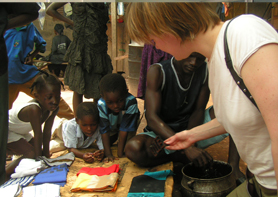 The first stop was in Ghana where the group spent a day sightseeing in the capital, Accra. Ghana and Ghanaians are very proud of their history so there were a number of places to see including the Kwame Nkrumah Mausoleum, the art and craft market and the Independence Square. This was followed by a drive from Accra through the central region to Obuasi, home of the famous Ashanti gold mines. Along the way, the students discovered a local palm wine distillery and learnt about brewing local gin, while sampling some fresh palm wine!
In Obuasi, the group was received by AngloGold Ashanti and given a tour of the over 100 year old mine by "Captain" who had been working there for 23 years. He was thoroughly entertaining, and made the long walk quite enjoyable. The group got lessons on blasting and drilling, witnessed some of the training exercises for the miners and walked a distance of 800 feet below surface (although most felt it was a lot further than that!) There was also a visit to the ore processing facility and lessons about the process for extracting gold from the ores and AngloGold Ashanti's environment friendly enzyme based extraction process. Unfortunately, the group didn't get to take any gold with them, but had a lot of fun!
Then, it was off to Kumasi to learn more about the Ashanti history and culture. Kumasi is the home of the Ashanti Tribe of Ghana. Ashanti are famous for their wars, military tactics, Kings and queen mothers, Gold and Kente cloth: a living culture that symbols the much of what people know of Ghana. There, the group visited the Manhyia Palace Museum and the Palace of the Ashantihene (king), the National Cultural Centre, market, art and crafts shops and had some real Ghanaian hot, spicy and delicious food. There was also a visit to the home of kente and adrinka cloth making. A few students tried their hands at cloth making and found it fun! The nightlife in Kumasi was very lively as well and everyone had fun dancing most of the night in the hip clubs. With good music, a young and vibrant crowd, and fun seeking London Business School students, it was a night out to remember.
“I could have gone to Japan, the Caribbean or Peru. I chose Africa and I would do it again!” After Kumasi, the group drove back through the Cape to see two brilliant sights in Ghana. The Kakum National Park is comprised of mostly undisturbed virgin rainforest. Excellent walking tours (and a canopy walkway) through the forest provide the opportunity to see much of Ghana’s indigenous plant life, as well as rare butterflies, birds and game (that could include the extraordinary bongo and forest elephant). The brave participants took a walk on the 350-metre long and 35 metre high canopy walk, the only such walk in West Africa. Afterwards, the group visited Elmina Castle, the site of some of mankind's most unfortunate events and the exit point for many hundreds of thousands of Africans shipped off to slavery. The castle, recognised as a World Heritage Monument by UNESCO is a must see for anyone interested in finding out more about the events of the slave era.
Back in Accra, the group organised a volunteer event for young entrepreneurs. Working in partnership with Pan African Students Summit, the group held an event to learn about doing business in Ghana, deliver presentations on business planning and raising finance as well as reviewing business plans for entrepreneurs venturing into poultry, tourism and fishing businesses. We also met with officials of Guinness Ghana and GSK to learn more about doing business in Ghana and the challenges faced in their industries.
After a fairly nail biting race to catch the flight to Lagos, the group was welcomed to Nigeria with a dinner hosted by First Securities Discount House on behalf of Lagos based Alumni and RAB members. Hosted at the chic Saipan restaurant, it was fun to meet this group of successful business leaders and the event continued until almost midnight. Attendees included Alero Otobo, Rilwan Belo-Osagie, Osaze Osifo, Tayo Emdem, Ayo Gbeleyi, Femi Lijadu, Mark Riksen and Orlando Ojo.
The first full day in Nigeria consisted of a series of visits to leading businesses in Lagos. The first stop was a visit to Oando Plc where a group that included London Business School alumni received us. The company's presentation highlighted the successful entrance and growth of the company to the Nigerian market and its expansion to West Africa as well as listings in Nigeria and South Africa. It was also a good general discussion on the energy industry in Nigeria. Everyone found a few minutes in-between the presentation to catch the solar eclipse from the 10th floor window.
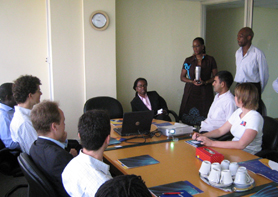 Then, it was off to Guaranty Trust Bank, where the management team led by a board member gave a presentation on the Nigerian banking industry, challenges and prospects. The bank, which is one of the country's leading banks is considered a Nigerian success stories and is the subject of case studies by Harvard Business School. With little time to spare (and fortunately little traffic), it was off to Shell for a presentation on the exploration and production industry in Nigeria. Finally, a last stop at Coca Cola's Nigeria office where there were discussions with Carl Willis, the Franchise Director for Nigeria.
Next day, it was off to Abuja, the Nigerian capital. Built as a new capital to move away from the congestion of Lagos, it was a very interesting contrast to Lagos. As guests of the Minister for the Federal Capital, we were given a tour of the city and visited the Nike art gallery. The high quality art included works by some of Nigeria's most famous artists. Lunch was an opportunity to have discussions with some of the young people working with the minister to manage Abuja and retain its status as a leading city in Nigeria.
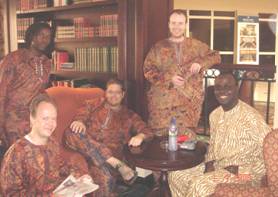 Back in Lagos, the team held a second volunteer event in partnership with LEAP Africa. It was another interesting session attended by young entrepreneurs in software, shoe making, textiles, telecoms and several other industries. It was an interesting learning experience for all participants with London Business School students challenging the participants to expand the scope of their business ideas, presenting tips on business planning and providing insights into financiers' expectations. It was also an opportunity to meet Ndidi Nwuneli, who is a widely acclaimed youth leader in Africa.
Then, it was off to a Nigerian wedding! It was a very colourful event with lots of music, beautiful attire, friendly people and interesting activities.
The participants were an excellent reflection of the diversity of the School community. We had British, Finn, Dutch, Chinese, Senegalese, Kenyan, Norwegian, Canadian, Nigerian and South African participants. The diverse nationalities and professional backgrounds impressed most of the companies and professionals we encountered. It was a really good opportunity to showcase some of the selling points of the School.
Organising this trip was another opportunity to discover and explore opportunities provided by the alumni and advisory board resource pool. We received support from alumni based in Nigeria and the UK, while the Africa Regional Advisory Board members assisted from London, Lagos and Johannesburg.
As Norwegian MBA student Gustav Ellingsen said after the event, "It was extremely interesting to see first hand what Sub-Saharan Africa is all about. It has certainly given me a new perspective. I could have gone to Japan, the Caribbean or Peru. I chose Africa and I would do it again!"





 Keep yourself updated with our FREE newsletters now!