


Connecting Africa’s Skilled Professionals

 ReConnect Africa is a unique website and online magazine for the African professional in the Diaspora. Packed with
essential information about careers, business and jobs, ReConnect Africa keeps you connected to the best of Africa.
ReConnect Africa is a unique website and online magazine for the African professional in the Diaspora. Packed with
essential information about careers, business and jobs, ReConnect Africa keeps you connected to the best of Africa.



 How Nigeria's capital markets are modernising and gearing up for growth.
Nigeria, already the world's sixth most populous nation with 167 million people, is poised to take over from South Africa as the African region's no. 1 economy by 2020. A recent conference in London shone a spotlight on the reforms taking place in the country and the impressive growth being seen.
The Nigeria Economic and Financial Markets Conference, organised by Business in Africa Events, provided a platform for key players in the country's financial and business sectors to promote Nigeria's growth story and to highlight the investment and commercial opportunities there.
With inflation currently under 11% and GDP growing at around 7.8%, Nigeria's government reckons that the economy should grow above 8% by the end of the 2012 fiscal year. The non-oil sector remains the biggest growth driver in the country, accounting for 40% of its total GDP, with agriculture forming about 70% of that.
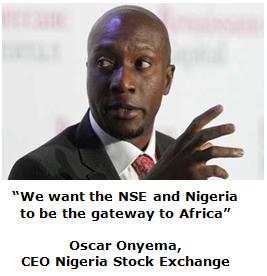
In his keynote presentation, Oscar Onyema, the CEO of the Nigeria Stock Exchange (NSE), highlighted the importance of Nigeria's capital markets to the country's economic growth strategy.
The NSE is the largest stock exchange in sub-Saharan Africa outside South Africa and is larger than the Greek and Polish stock exchanges. Established in 1960 and starting operations a year later, the Exchange supports approximately 5 million investors, with foreign investors providing 81% of market activity and locals 19%. Over 230 broker dealer firms deal with the NSE, which has 14 electronic trading floors around Nigeria. The NSE aims to position itself as the gateway to African markets and is targeting $1 trillion in market capitalisation by 2016.
"Nigeria is a first-rate market with first-rate companies including Total, Mobil, Nestle, Guinness, Unilever, Lafarge, Exxim Mobil, PZ Cussons, UBA, and more," and investing on the NSE can bring very health returns, said the CEO. An investment of N1000 in 1996 would have yielded N13,030 today – a return of over 1,200%, he added, making equities the asset class to be in.
There have been challenges, however. With a high degree of foreign investment, the impact of the sub-prime crisis and more recent Eurozone problems have had an impact on investor confidence. The 2011 banking crisis in Nigeria that led to the nationalisation of three banks also meant, Mr. Onyema said, that investors "took a beating". However, the country has weathered both the global economic downturn and its own domestic banking crisis well, thanks to the structural banking and economic reforms of the past decade and has improved risk management, and the CEO stressed that there was light at the end of the tunnel, with results from the banking sector quite good in comparison with last year.
Along with a growth rate that he described as 'phenomenal', foreign private investment (FPI) into Nigeria has also grown significantly, said Mr. Onyema.
FPI in 2011 is estimated at $3.37 billion – an increase of 34% on 2010. FPI inflows accounted for over 80% of the transactions and were primarily driven by countries including the UK, USA, Hong Kong, Luxembourg, South Africa and Germany.
"Foreign investors understand that equity markets are circular and they have continued to be active in Nigerian markets because of the growth rates – significantly higher than the 5.5% predicted for sub-Saharan Africa and the significantly lower rates expected from developed markets," he said.
The NSE has been making strides to reach out to the Nigerian people and to provide investment education, making clear the risks as well as the rewards of the stock market. Investor clinics and other events are part of their outreach strategy and the NSE continues to explore new products to give investors exposure to other opportunities, such as gold, as a hedge between the naira and the US dollar.
The NSE Chief Executive outlined his projections for the year, pointing out the ongoing volatility in certain regions and sectors that continue to be subject to civil unrest. He predicted that the growth drivers will come from Asia and sub-Saharan Africa, projecting growth for Nigeria of between 7.5% and 8.5%.
"We have a stable democratic government with over 160 million people – 1 in 4 in Africa – and a large market you cannot ignore, and with a growing middle class," he said.
Anticipated legislation in the petroleum sector will, he believes, also provide opportunity for growth of the capital markets by deregulating the petroleum sector and giving indigenous oil and gas companies an opportunity to become major players in the country.
"There is an urgent requirement for fiscal consolidation and a need to address the issue of unemployment," he said, citing agriculture as a sector that could be used to drive an increase in employment potential.
Africa's most populous country aims to be part of the G-20 group of advanced and emerging market economies by 2020. Through continuous reforms, Nigeria can be a source of rapid growth, both for the country and for Africa as a whole.
For the NSE, the next 5 years will involve targeted business development efforts alongside a strong regulatory environment and stringent investor protection. Reform has already introduced new rules and penalties for violations and compliance rates on regulatory reporting have soared from 5% to 90%.
The NSE has introduced an investigations panel and a new code of conduct, said the CEO, while disclosure standards on company reporting have greatly improved. The NSE has introduced a certification programme for compliance with SEC Code of Corporate Governance Standards and share buy-back policies are now in place. In a bid to make the NSE more attractive to SMEs and other investors, new listings standards were approved in March 2012 and the Exchange is looking to introduce options trading in 2013 and financial futures in 2015. The tax treatment of returns from investment is also favourable, with a 10% flat tax on dividends and no tax due on capital gains.
"We want the NSE and Nigeria to be the gateway to Africa," Onyema said. "We have abundant natural resources and investment opportunities. There are many reasons to come to Nigeria and we invite you to join us."








 Keep yourself updated with our FREE newsletters now!