


Connecting Africa’s Skilled Professionals

 ReConnect Africa is a unique website and online magazine for the African professional in the Diaspora. Packed with
essential information about careers, business and jobs, ReConnect Africa keeps you connected to the best of Africa.
ReConnect Africa is a unique website and online magazine for the African professional in the Diaspora. Packed with
essential information about careers, business and jobs, ReConnect Africa keeps you connected to the best of Africa.




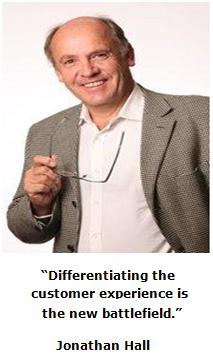 As competition becomes keener than ever, engaging your employees to differentiate the customer experience is the new battlefield, says Jonathan Hall
It takes less than 6 months to copy a car. And even less to clone computer hardware. As access to information and technology makes it increasingly easier for competitors to imitate all the features and benefits of any product or service quickly, it's getting harder for brands to own a distinguishable and sustainable market position. Technology is closing the gaps between offerings fast, compelling marketers to seek out new ways to distinguish their value and price from rivals.
A differentiation area that's hotting up, mostly because it's proving to be a highly successful one, is the customer experience space. Research by the Gallup, Towers Watson and the Hewitt groups show that organisations who have gained the commitment of employees to distinguish a customer's experience of their brand get a 3.9 times higher Total Shareholder Return than rivals, and nearly 50% more in operating income than competitors who failed to do the same thing. Margins are 18% higher and customer loyalty levels are 23% better. The Institute for Employment Studies proves the same case: a 1% increase in employee commitment to the brand promise increases sales by 9%.
The research also reinforces what marketers already know: customers are sensitive to how they're treated. And customers who have a good or bad experience influence others significantly. In an interconnected age where social media makes it easy to distribute positive or negative recommendations at the speed of ether, the importance of fulfilling an experience promise to customers takes on far higher importance - and demands even greater urgency.
Recent customer experience studies confirm that over 79% of customers who had a poor experience of a brand told their contacts about it. 76% of customers indicated that their buying decisions were influenced mostly by people they were connected to. Research by consumer trend-watch specialist AC Nielsen, confirms that the recommendations and opinions of personal networks influence people 7 times more than any form of advertising message.
Research findings and the technology-fuelled trends point clearly to a new battlefield for the hearts and minds of customers: winning will no longer depend on what the company does. Future success will have a lot more to do with how the company does it. An ability to keep the promise of a differentiated experience may turn out to be the only discernible difference between brands in the modern world. An opportunity for those that believe it? A threat to those that don't?
Making the promise of a differentiated experience is the easy part. Advertising agencies do a pretty good job of packaging a client's promise to the market. Big sums are quickly spent inventing and delivering the proposition. But research shows that when the rubber hits the tar, many companies fail to deliver on the promise consistently – flushing away investments fast. And in a free and fast media age where bad references spread like wildfire, broken promises and the time and money to fix the damage to reputation can cost a lot more than just the wasted ad money.
Most companies struggle to keep the promise of a differentiated experience because, unlike the promise of a quality product, the fulfilment of a quality experience depends vastly more on cohesive human behaviour. And getting people with different perceptions, attitudes and agendas to commit to the promise and work together to keep it is a bit like trying to herd cats. Which is why, if gotten right, an experience advantage is big and sustainable. Because the DNA of an engaged enterprise is difficult to build, it's also hard to copy.
The body of contemporary research highlights why most companies struggle to deliver on their promises. The Gallup and Towers Watson Groups surveyed millions of employees in thousands of organisations across the globe to find that only 28% of a typical organisation's staff complement is engaged in their enterprise objectives. Put another way, that's a bit like saying that of the 11 people in an average soccer team expected to beat their competition; only 3 will run on the field knowing where the goals are - and how the game should be played!
The research does not show that the average employee is unwilling or unmotivated to help their employers to achieve the firm's objectives. To the contrary, the studies revealed that most staff want to do good work. What the surveys did pinpoint is that many leadership teams are doing a lousy job of sharing their goals with teams and are even worse at involving employees in the development and implementation of plans to achieve them. As a result, employee engagement and satisfaction surveys typically show that employees don't know what their firms are trying to achieve and/or don't believe that the direction picked is the right one.
Most surveys reveal that many employees don't feel connected to the goals, don't think that leaders listen to their suggestions, and don't feel that their efforts are seen or appreciated. In essence, most employees have no ownership of the goals and no sense of belonging. The impact of these shortcomings show up in the alarming survey statistics: Nearly 70% of employees working in an average enterprise do not believe they can influence their firm's success while over 72% of employees in engaged firms that think they can, and do. (Source: Gallup Group.)
10 million employees surveyed by Gallup Groups poll in 2010 put their need to be involved in the development of the firm's goal and engaged in the plans to achieve it at the top of the list of factors that motivate them. Having a relevant role to play, knowing what was expected, getting regular performance feedback and being recognised and appreciated for contributions, also featured high on the list of things that inspire employees to commit. The message that the research is delivering is simple: Organisations that rely on people to distinguish an experience of their brands will need to place a high priority on addressing the things that really motivate employees if they want to succeed.
The proof of the employee engagement pudding lies in the eating: organisations that actively addressed the employee needs identified in the research got high paybacks by any measure: 18% better profits, 32% higher customer loyalty, 70% more productivity, 30% less absenteeism, and nearly 40% higher staff retention.
Take a look at the way most companies try to align employees to goals and you'll see a lot of videos, posters and newsletters. A lot of telling going on. Very little listening. The message from the research is profoundly simple: Employees will commit to enterprise goals and to working together to achieve them if they co-own the plans created to keep the promise, if there's a relevant, clear and meaningful role to play, and if there's a personal payback for investing effort to deliver on the promises. (Interestingly, the research reveals that financial rewards rank comparatively low on the list of paybacks that motivate employees to commit: recognition, appreciation, prospects, security, care and belonging to a successful team feature far higher as paybacks than money.)
Organisations that achieved high levels of employee commitment all shared a few things in common. Each sought a genuine partnership with employees and demonstrated this by launching a deliberate initiative to collaborate. Each kick-started enterprise wide conversations with their internal 'partners' by sharing information and inviting staff to apply their minds to what needed to be done, and how it should be done, to achieve the goals. Each listened to employee inputs carefully and showed that every opinion was valued by responding to them. Plans were iterated through the process until all bought-in. Every employee's part in the shared game plan was made clear. Teamwork became crucial. Ways to link and measure individual and team performances were agreed. Every employee's role got evaluated continuously and feedback on how the enterprise was doing got shared with all stakeholders openly and frequently. And in every highly engaged firm, the ability to say 'thank-you' featured highly.
The research and available information proves a compelling case for enlisting and engaging employees. Almost every enterprise that started a collaboration process got big paybacks – and the differentiation needed to get and sustain a substantial edge over rivals. Which is why, according to the McKinsey Group, employee engagement has become the number one priority for CEO's.
The Gallup and Towers Watson research findings show not only how big the opportunity is – but also how child-like the principles of employee engagement really are. Explain the challenge. Ask for help. Say thank you when you get it. And show and tell often.











 Keep yourself updated with our FREE newsletters now!