


Connecting Africa’s Skilled Professionals

 ReConnect Africa is a unique website and online magazine for the African professional in the Diaspora. Packed with
essential information about careers, business and jobs, ReConnect Africa keeps you connected to the best of Africa.
ReConnect Africa is a unique website and online magazine for the African professional in the Diaspora. Packed with
essential information about careers, business and jobs, ReConnect Africa keeps you connected to the best of Africa.



 Are Africans in the Diaspora afraid to be themselves and embrace our own cultural identities when working in the West, asks Jude-Martin Etuka?
Asking this question is a bit like asking a person if they actually know who they are?! For the term ‘cultural diversity’ refers to a person’s origins, their history and traditions; the clothes they wear, food they eat, music they listen to, etc. Indeed, it refers to their very ‘identity’ as individuals, out of which their talent-base is identified, defined, developed and continually refined. Indeed, there is no getting away from your cultural identity…
I was at an organisation some months ago running a leadership development program for ‘hidden’ talent with potential, and it was interesting hearing the personal life stories of the delegates, many of whom as it happens, were from Black and Minority Ethnic (BME) backgrounds. The resounding theme running through their stories was the fact that they lacked self-belief, had low self-esteem and low levels of believability in their own potential, such that it prevented them from aspiring to higher levels within their organisation.
But one point that stuck in my mind from our discussions was a certain fear of being themselves, of being proud of their culture, such that they were weary of the ‘peculiarities’ they naturally brought along to the organisational table – hence the question this article seeks to address: Should we be weary of our cultural diversity? Is this something to be ashamed of? Do we really need to hold back on our rich traditions which make us who we are when working in so-called ‘westernised’ environments?
As a person of Nigerian parentage born and living in the UK, and as someone who has had the opportunity to work with a range of organisations to source, identify and develop talent from a range of backgrounds, this topic is very pertinent to me, more so given the 2 premises below drawn from the reality of the UK workplace context which may appear to suggest that ‘cultural diversity’ is not playing the strategic impact it ought to:
Premise 1: There is presently clear under-representation of people from BME backgrounds in Senior Management positions in the UK’s FTSE 100
At the end of 2007, the BME share of the population in the UK was approximately 10.3%. However their overall share of the employed population was approximately 8%. The share of BME’s in management positions was 6.8% or just 1 in 15, whereas those from white backgrounds who make up between 89-90% of the UK population had approximately 92% of the UK employed population – and a constituted the majority in management positions.
Indeed, it must be mentioned here that the overall representative figure for people from ‘African backgrounds’ is actually likely to be less than 6.8% as the BME grouping is also inclusive of people of Jewish, Irish, Eastern European and Traveller backgrounds. Indeed, recent figures further suggest that just 0.4% of women from BME backgrounds presently constitute Director level positions in the FTSE 100. I’ll let you work out the maths…
Premise 2: Evidence from Occupational Psychologists, HR Practitioners and Equality Best Practice Bodies suggest that some very talented BME individuals suffer from an apparent lack of confidence and self-belief
This thinking is actually derived and connected to the first premise and the thinking behind it is quite simple. Where there is an absence of representative role models for people from BME backgrounds in organisations, it can, and does, have a negative psychological impact on the confidence levels of talented BME employees aspiring for positions of authority, or even believing that they possess the capability to achieve those ‘lofty heights’ in the workplace.
Do the above premises suggest that we be weary of our cultural diversity then? Like every story, there are always two sides. Here’s the other for your consideration:
There are a great number of role models from a range of BME backgrounds who have clearly demonstrated how not being weary of who they are, socially, culturally and otherwise has led to them being recognised as role models thereby providing inspiration to others – see the attached link for more information: :(http://www.dailymail.co.uk/news/article-478012/Top-100-black-role-models-unveiled-new-list.html)
In addition, from a strategic talent management/development perspective, it is also important to mention that the demand for diverse talent has drastically increased fuelled by a number of factors including the Equality Act 2010 and its overall inclusive approach to recruiting talent from diverse backgrounds, the European Commission’s proposals to increase gender representation at Board Level particularly in private sector and, importantly, the demands of ‘globalisation’ and the ensuing cultural diversity implications on transnational companies’ ability to deliver services and products that are capable of meeting the needs of their diverse customers.
The impact the above drivers are having, from a cultural diversity viewpoint, is that organisations are very keen to attract people from a range of backgrounds to different organisational levels so as to utilise their experiences (derived from their cultural identity) to drive new approaches to doing business - effectively.
Therefore, following some simple but practical steps below will assist you to begin to remove any self-limiting barriers to ensuring your progress and development:
A mistake that we all tend to make at times, subconsciously and consciously, is attempting to be like others. The consequence of this is that we forget who we are as unique individuals with the rich experiences, traditions, skills and talents we naturally possess off the back of our cultural diversity.
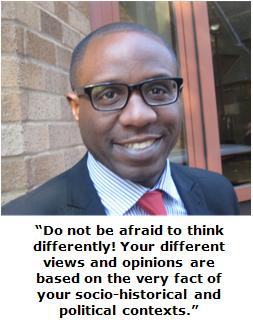
Do not be afraid to think differently! Your different views and opinions are based on the very fact of your socio-historical and political contexts. More often than not, I have met extremely talented and educated individuals who for one reason or another have become weary and afraid of thinking differently from the status quo whereas this is precisely what many recruiters, head-hunters, talent spotters and organisations are looking for.
There is no doubt that the availability of visible and accessible senior role-models in organisations can go a long way to ensuring that those that are under-represented begin to gain the needed confidence and self-belief to aspire toward greater things. Where there is a shortage of role models in your organisation, it is important to realise that there are rich resources of inspirational stories that are accessible online, in bookshops, and importantly, through networking – a point we shall shortly explore below.
Indeed, where a shortage of role models exists in your organisation, why not consider role-modelling others yourself? This may sound slightly absurd given one’s personal need for a role model, but from my experience, role-modelling those who are under-privileged, either through volunteering or providing assistive services during your spare time, can have a reverse positive impact of providing you with the needed drive and impetus to achieve that towards which you are assisting others!
Never underestimate the power of networking. Networking puts you in the right place at the right time, aligned to the perfect opportunity. There are a good number of workplace networks that you can join, both within and outside your organisation, and where you can meet like-minded people, some of whom have great stories that you can use to leverage your experience. Indeed, some of my greatest colleagues have been met through networking.
Here are some practical steps for you to consider: Ensure you have a profile on LinkedIn; subscribe to best practice career development e-mails and links; consider setting up a blog to discuss interesting issues and get feedback from others; join staff networks groups (SNG’s) in your organisation and contribute to shaping organisational policies and procedures; put yourself forward for arising opportunities; seek the advice of a career coach, some of whom offer free taster sessions.
The simple point being made here is that there is so much you can do of your own accord to assist with building and boosting your confidence and, importantly, your inner longings to become the vision you have for yourself.
We all have bad days that at times make us question our abilities. Here’s a quick tip: Look at yourself in the mirror when are by yourself and sternly tell yourself that you are more than capable, that you will get to where you want to get to! It is amazing how sometimes positively screaming at yourself in the mirror literally injects the endorphins needed to increase believability and confidence. Now go ahead and act on it...
This topic, and the resulting tips above, point to one thing: that regardless of the contextual circumstances of the workplace, our cultural identity and diversity is not something to be weary of at all, rather it is that which we need to connect with during periods of low self-esteem and reduced believability; for it is within that very connection that our success will be discovered…and harnessed positively.







 Keep yourself updated with our FREE newsletters now!