


Connecting Africa’s Skilled Professionals

 ReConnect Africa is a unique website and online magazine for the African professional in the Diaspora. Packed with
essential information about careers, business and jobs, ReConnect Africa keeps you connected to the best of Africa.
ReConnect Africa is a unique website and online magazine for the African professional in the Diaspora. Packed with
essential information about careers, business and jobs, ReConnect Africa keeps you connected to the best of Africa.


 I seem to be turning into a modern day Cassandra of employment issues. Like the legendary princess of Greek mythology who was given the gift of seeing the future, I find myself constantly warning all about me of the evils they face if they are not careful of the image they present when it comes to finding a job.
Fresh from warning several people about the dangers of large and unsightly (well, to me anyway) tattoos, it seems I must now turn my attention to the perils that lurk in the world of social media.
Thankfully, getting people to appreciate how easy it is for their social media profiles to sabotage their careers seems to be an easier sell, judging from some recent studies on the subject.
A survey by recruitment firm, Robert Walters, revealed that almost seven in ten working professionals are concerned that an 'unprofessional' Facebook profile will affect their career. In their global survey of more than 3,500 professionals, a large majority of respondents claim to regularly de-tag themselves from pictures and remove comments from Facebook, in case potential employers see them.
While 10% admit to not having given what they get up to on Facebook and how it might impact their careers much thought, 21% of respondents actually believe that what goes on Facebook does not impact their careers. Not true, folks.
Employers are people too, and are just as social-media savvy as the people they are looking to hire. And, by the way, if you're looking for a job in the technology industry, bear in mind that techies are, by definition, going to do some technical research. According to a 2012 technology market survey conducted by Eurocom Worldwide, almost one in five technology industry executives say that a candidate's social media profile has caused them not to hire that person.
Eurocom's previous surveys had found that nearly 40% of survey respondents check out potential employees' profiles on social media sites. But, they say, this survey was the first evidence that candidates are actually being rejected because of them.
According to Chris Hickey, Managing Director of UK Recruitment at Robert Walters, employers are increasingly looking at potential recruits' profiles on social networking websites, such as Facebook and Twitter, when hiring. A would-be employer is looking for clues into the real you – potentially unravelling all the benefits of that interview skills training course that you paid for.
After all, how else are they going to find out if you like to hit the pub every night or if you carefully omitted to mention your passion for extreme sports on your CV? Sharing those wacky photos on Facebook of you dancing on the table at your friend's wedding to amuse your 400-plus friends is a great idea - until you start job hunting.
Chris Hickey agrees with me. "We would advise those who currently are not maintaining their profiles on social networking sites from a professional perspective to start doing so," he warns. "Ultimately, your profiles on these sites represent you and can easily be found by anyone running a few simple online searches."
Before posting anything, the real question you need to keep in mind is 'what does my social media profile say about me?' Once it's out there…..it's out there. Videos or comments posted on YouTube, Twitter, Facebook or LinkedIn can be picked up immediately and circulated before you've had time to consider whether it was a good idea, making it virtually impossible to withdraw, even if you try. (If we're honest, how many of us only read an e-mail we would otherwise have deleted because we see the sender has tried to recall it?)
And don't think you'll get away with it in Africa, either. According to Tasneem Mohamed, Marketing Manager of the Landelahni Recruitment Group in South Africa, "Job seekers should take heed of the fact that social media are being used as a recruitment tool by employers. Your social media profile is a powerful tool that can unlock job opportunities. But it must be managed in a responsible way. Your online footprint is a reflection of your personal brand. Your profile, status updates, threads and pictures form a picture that may influence a potential employer's hiring decision."
Of course, the upside is that you can also make your social media profile work positively for you when those pesky employers are trawling the net. Highlighting your skills and experience on LinkedIn, for instance, will get you noticed for all the right reasons, and extend your employment reach right around the world.
It's not just the photos; your comments, choice of networks and inconsistencies between what your profile and your CV says, can all keep you in the unemployment wilderness.
So, if you are determined to carry on grumbling about your boss or posting racy comments, do make sure you've checked and activated your security settings to minimise the chances of your privacy being breached and embarrassing yourself or having your friends embarrass you with their posts. By the way, some companies will also consider you grouching about them to be grounds for dismissal if it brings their brand into disrepute, so think hard before you tap the 'enter' key.
Heed my words, folks. Ancient Greek legend has it that Cassandra was later cursed so that even though she could see the future, no one would believe her. Now, I may not be quite as gifted as Cassandra in the prophecy department, but on this issue, trust me, for I know of what I speak.

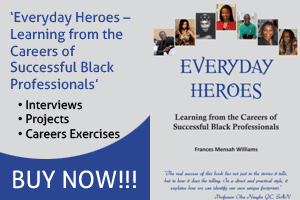
Author of 'Everyday Heroes – Learning from the Careers of Successful Black Professionals'. Available online from www.everyday-heroes.co.uk and on order through booksellers. ISBN 978-0-9569175-0-8










 Keep yourself updated with our FREE newsletters now!