


Connecting Africa’s Skilled Professionals

 ReConnect Africa is a unique website and online magazine for the African professional in the Diaspora. Packed with
essential information about careers, business and jobs, ReConnect Africa keeps you connected to the best of Africa.
ReConnect Africa is a unique website and online magazine for the African professional in the Diaspora. Packed with
essential information about careers, business and jobs, ReConnect Africa keeps you connected to the best of Africa.




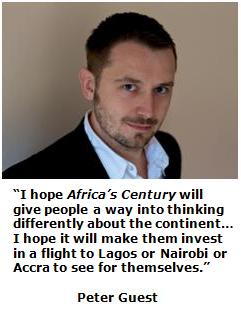 Award-winning journalist Peter Guest talks about his new book ‘ Africa’s Century’ and why he believes Africa’s star is now rising.
Peter Guest is an award-winning journalist and editor who writes about Africa and international development.
He has contributed articles on the continent's emerging economies to a number of national and international media outlets, including the Financial Times, the Wall Street Journal, Wired Magazine, CNBC, the Guardian and Forbes Africa. He was the founding editor of the Financial Times Ltd's highly acclaimed This Is Africa magazine, which he managed until 2011.
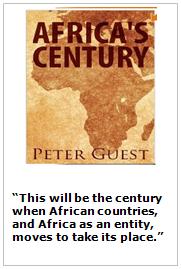
ReConnect Africa spoke to Peter Guest about his new e-book, ‘Africa’s Century’ and his take on why Africa’s star is now rising.
ReConnect Africa: You have been writing about Africa for many years. What led you to write ‘Africa’s Century’?
Peter Guest: I have been working in and around the African business and investment space for a few years. On the way I’ve been introduced to a number of the big picture themes - demographics, democracy, South-South integration - but also met a lot of people who are doing good business on the continent in ways that may surprise people who have tended to stick to the business mainstream.
‘Africa’s Century’ is an attempt to form some kind of a synthesis of both the high level macro themes and the realities of working in what can be challenging business environments, and in doing so, give some insight to people who may not have been fortunate enough to have seen the opportunity firsthand.
ReConnect Africa: What are your views on how the media’s reporting on Africa has changed in recent years?
Peter Guest: It’s difficult to generalise. Perhaps ten years ago there was still some latent fear of Africa in the mainstream of European society. I think this stemmed from a combination of archaic cultural reference points - whether that be Conrad or Hollywood - and a simple lack of investment in coverage, which meant that it was entirely driven by dramatic events or by NGOs driving an agenda. We have been so saturated by images of Africa as a place of poverty, disease and conflict that many people came to reject any other portrayal as a matter of instinct.
Africa was seen as somewhere you could make your name as a journalist - there were pre-prescribed narratives of conflict that you could slot any story into. Anything political was flawed; anything with money attached was corrupt and anything that looked hopeful had to be on a doomed arc to noble failure. Discussion of business was totally off the agenda.
I do think that narrative has shifted now due to a combination of factors. I think the simple facts have begun to weigh on the coverage. It is very hard to watch a country like Ghana grow for nearly two decades, undergo a succession of peaceful democratic transitions and then say, ‘It’s Africa, it’s all going to go wrong’.
The fact that so much of the continent is blossoming at a time when the rest of the world is going through its own economic hardship is showing people that the benefits of taking a risk on unstructured - but growing - markets is worthwhile, and that has helped. I do think that people associate Africa with growth and opportunity more than ever before, and the instinct to dismiss it has faded, at least amongst more informed circles. The media is a business too, and so when the money starts to flow towards somewhere, the narrative has to keep up.
How durable this shift is, I don’t know. I hope it’s permanent. As a journalist, though, I have to make the point that I still firmly believe that you have to remain objective. That means acknowledging the corruption that remains in some governments, calling out the companies from the developed world who might exploit that, and supporting our colleagues in the African media who speak truth to power under far less privileged conditions. I think that ascribing to a new narrative of pure Afro-positivism, if that is the term, is actually quite dangerous.
ReConnect Africa: What are your key reasons for believing that this is Africa’s century?
Peter Guest: One billion people today, two billion by the middle of the century. Try as you might, you cannot ignore that. Africa has a huge amount of the world’s resources, both human and mineral. It has huge areas of uncultivated land, more than enough to solve not just its own, but the world’s future food needs. It has the sun and the wind to power itself. These facts alone are enough to convince me that this will be the century when African countries, and Africa as an entity, moves to take its place in a world that has been governed by historical inequities for a long time.
I think we have seen a period of huge flux since the end of the Cold War in which the absence of a single global hegemony has caused a lot of conflict, but I think we are seeing the world start to coalesce not into a new system of two poles, but into a more equitable system of interests. I have heard the term ‘G-Zero’ used - one where no single club can dominate world affairs. In that environment, the bargaining power that African countries have, grows.
Couple with that the fact that the continent’s internal engines of growth - its people - are rising in education, economic opportunity and representation. This mix of international and domestic ambition is potent.
ReConnect Africa: How much of an impact do you think the perception of Africa has had on its ability to attract investment and generate growth, and how much of a role has the international media played in shaping perception?
Peter Guest: I think it is inevitable that the way the media portrays Africa has an impact on investment flows. If the collective atmospheric noise around a continent is negative that changes the perception of risk.
I think equally important is the collective failure to explain that Africa is not a country. When something happens in Somalia, it does not, by and large, change the value of Ghana’s consumer markets. And yet, the perception that every crisis is universal is very damaging. More education is needed. But as I said earlier, I think the overall situation in terms of how the continent is reported is changing.
ReConnect Africa: In your book, you describe Africa as the greatest economic opportunity today. Which countries and sectors do you believe offer the greatest return for investors as well as individuals looking for business opportunities?
Peter Guest: It is difficult to answer the geographical part as so much of the opportunity depends on your sector and appetite for risk. For sheer size, no one should ignore Nigeria. I firmly think it should be on every investor’s radar right now. But then you have Ghana, which as I mentioned earlier is a phenomenal prospect for the right company.
Cote d’Ivoire is a real recovery play too. In the east, the whole EAC could be a major destination as long as Kenya’s transition next year goes smoothly and there can be a bit more progress on integrating those markets to make it a single bloc for investors. If you are more adventurous, somewhere like South Sudan, the world’s newest country, is a real growth play. There is not a great deal there, to be blunt, and people have the same aspirations as anywhere else.
 That leads me to the sectors. I think in the short term, the best returns can be made in any business that fills the gap between people’s daily realities and their aspirations. That means providing solutions to everyday challenges unique to developing markets - communications, utilities and so on. Africans are increasingly affluent and urbanising. That means consumer goods - from healthcare products to beer to automobiles and financial services are all coming into the reach of average citizens. With the size of the populations we’re talking about, that is an incredible market.
The other thing is import substitution. In many cases on the continent, agriculture is the biggest contributor to the GDP, but the countries are still importing processed food. There are historical reasons for that, but those companies that move the processing stage onshore to Africa, I think stand to do very well.
A lot is made of technology and telecoms. I think you can still make a lot of money in the infrastructure side of that, but I think ICT is an enabler for other businesses. Anything that uses ICT to leapfrog other challenges has potential.
ReConnect Africa: Along with opportunities come challenges. What would you say are the key challenges that people face in entering a frontier market like Africa profitably?
Peter Guest: Information. There is still a huge information gap for investors. Whether that’s at a government level - i.e. they simply can’t access the documents they need - or that their counterparts are not used to providing financial data, or so on, it is an issue that needs to be addressed. That’s hard to do in a systemic way, but businesses do get around it by simply getting on the ground and kicking the tyres.
ReConnect Africa: More than half of sub-Saharan Africa’s population is under the age of 25. With high levels of youth unemployment in many countries, How do you believe this demographic can be turned into a positive advantage for the continent?
Peter Guest: If I had the answer to that I would have a shot at being in power here in the UK. It is not an easy issue and a failure to acknowledge it can have very negative consequences.
We have seen that in Europe and in South Africa of late. I am an idealist, however, and I think that as a species we tend to solve problems best when we have no other option. I think in a decade’s time we will think very differently about the organisation of economies and about how wealth and opportunity is spread across societies, and that readjustment may answer some of these very difficult questions.
ReConnect Africa: What do you hope people will gain as a result of reading ‘Africa’s Century?
Peter Guest: I hope it will give people a way into thinking differently about the continent. It is not comprehensive - it is a teaser, if you like. I hope it will make them invest in a flight to Lagos or Nairobi or Accra to see for themselves.
ReConnect Africa: How can readers buy a copy of ‘Africa’s Century’?
Peter Guest: At the moment, it’s available on Kindle through Amazon.com and via the web link: http://www.amazon.co.uk/Africas-Century-Making-Frontier-ebook/dp/B008VPWWZM





 Keep yourself updated with our FREE newsletters now!