


Connecting Africa’s Skilled Professionals

 ReConnect Africa is a unique website and online magazine for the African professional in the Diaspora. Packed with
essential information about careers, business and jobs, ReConnect Africa keeps you connected to the best of Africa.
ReConnect Africa is a unique website and online magazine for the African professional in the Diaspora. Packed with
essential information about careers, business and jobs, ReConnect Africa keeps you connected to the best of Africa.




 Recruitment methods contribute to women losing out to men in the selection process for senior posts, with the right ‘fit’ being prioritized over competency, according to research findings
The appointment of women to FTSE 350-listed non-executive director roles is being held back by selection processes which ultimately favour candidates with similar characteristics to existing male-dominated board members, according to a report by the UK Equality and Human Rights Commission.
The report, ‘Gender diversity on Boards: the Appointment process and the role of executive search firms’, produced by Cranfield School of Management for the Equality and Human Rights Commission, is the first in-depth study into the appointment process to corporate boards and the role of executive search firms. It follows the recent Davies Review which called upon executive search firms to take on a more active role in increasing gender diversity on FTSE boards.
The EHRC report shows that women continue to lose out to men in the selection process for senior posts because it favours “fit” over competency, meaning boardrooms remain dominated by men. The findings show that only candidates who are perceived to “fit in" with the values, norms and behaviours of existing board members get to the short list and are appointed. This process favours male candidates, the report said.
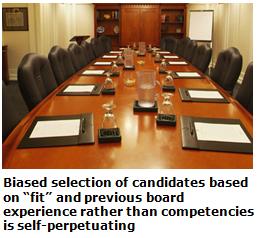
The research also revealed how the biased selection of candidates based on “fit” and previous board experience rather than competencies is self-perpetuating, as it works against women who have had fewer opportunities to gain previous board experience. It also restricts the ability of chairmen to broaden the range of skills and experience of their boards.
The research with headhunters and board chairman from FTSE 350 firms revealed that appointing women to non-executive director roles had been restricted by recruitment methods which support candidates with similar characteristics to existing board members. This is despite the fact that many chairmen and executive search firms recognise that gender diversity needs to improve at board level.
 Headhunters have already introduced a voluntary code of conduct, as suggested in the Davies Review, and had some success in getting more women on long lists.
The interviews with senior consultants at 10 leading London search firms, which are all signed up to the voluntary search code, showed that search firms are beginning to challenge chairmen and nomination committees when defining job briefs. In particular, this means putting more importance on underlying competencies than “fit” with existing board members.
In addition to the biased emphasis on “fit”, the survey also revealed a lack of consensus among search firms about what the desired qualities for board candidates should be beyond their experience. This lack of clarity creates room for “shifting criteria and subjective judgement in the appointment process,” researchers said.
As well as identifying examples of good practice at executive search firms, the report concluded that a “more transparent, professional and rigorous approach to the selection process” would support chairmen and search agencies to appoint more female candidates and encourage more women to think about applying for roles as non-executives.
Whilst the research revealed good practice amongst some executive search firms, the report makes recommendations including:
The Equality and Human Rights Commission is a statutory body established under the Equality Act 2006. It took over the responsibilities of Commission for Racial Equality, Disability Rights Commission and Equal Opportunities Commission. It aims to reduce inequality, eliminate discrimination, strengthen good relations between people, and promote and protect human rights.
Baroness Prosser, deputy chair of the EHRC, said: “Research shows that diverse boards produce better performance. Many companies recognise this and we commissioned this report to support their efforts to improve the representation of women at board level. However, the often subjective way appointments are made ends up replicating existing boards rather than bringing in the talented women who could bring real benefit to individual company performance and ultimately help Britain’s economic recovery.”











 Keep yourself updated with our FREE newsletters now!