


Connecting Africa’s Skilled Professionals

 ReConnect Africa is a unique website and online magazine for the African professional in the Diaspora. Packed with
essential information about careers, business and jobs, ReConnect Africa keeps you connected to the best of Africa.
ReConnect Africa is a unique website and online magazine for the African professional in the Diaspora. Packed with
essential information about careers, business and jobs, ReConnect Africa keeps you connected to the best of Africa.




 Award-winning playwright and script writer, Ade Solanke, has recently been dazzling audiences in the UK with her award-nominated debut play, ‘Pandora’s Box’.
Solanke has taught scriptwriting in London, Lagos and Los Angeles, and has also written radio scripts for the BBC.
A nominee for Best New Play 2012 for ‘Pandora's Box’ by the Off West End Theatre Awards, she is also the winner of the Best Playwright 2012, Nigerian Entertainment and Lifestyle Awards and winner of the Best Playwright 2011, African Film Awards. Her company, Spora Stories, tells the dynamic stories of the African diaspora.
ReConnect Africa spoke to Ade Solanke about her career and the influence of her Nigerian heritage on her work.
ReConnect Africa:(RCA) Congratulations on the success of ‘Pandora’s Box’. What inspired you to write the play?
Ade Solanke: Thank you! I'm still on a high from the fantastic reception it's had. We were nominated for Best New Play in the Off West End Theatre Awards and Best Playwright in the Nigerian Entertainment and Lifestyle Awards. I keep pinching myself. People keep asking me, 'Ade, when is it coming back?' That's so nice of them. It's a really nice feeling to know your work has touched people so deeply.
I think it's because the play is entertaining and it deals with an issue that's so close to peoples' hearts: helping diaspora children achieve their full potential. In fact, what inspired me to write the play was seeing so many friends struggle with that very issue, and seeing kids at risk in the UK transformed after a stint in Africa! What do they get there that they're not getting here? That's the question I asked myself, so I just designed the story around that situation, and made the main character a mother who gets cold feet about leaving her son behind in Nigeria.
RCA: When did you realize that playwriting was an area in which you could excel?
Ade Solanke: Well, again, thank you! I certainly aim for excellence and work hard at writing, so hopefully I'm getting there! But it's not work - it never is when you love what you're doing. I've always been a writer; I think it's what I'm born to do. I always knew I'd be a writer - I have an instinct for how arranging words can create specific effects.
My first job was as a journalist with Concord Weekly, a Nigerian newsmagazine published from London, then I started my own writing and research service and won an award as 'London's Top Youth Entrepreneur.' After that, I went to the University of Southern California Film and TV school and did an MFA in Screenwriting. The emphasis was on storytelling and connecting with the audience and that was the kind of work I wanted to make. It was a wonderful adventure overall. I worked in Hollywood and got an insight into the African-American experience. Made some great friends too, so did my son.
RCA: Tell us about some of the plays you have written and where these have been performed?
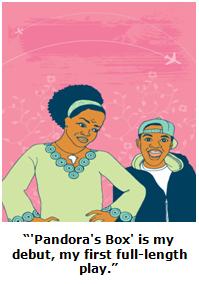
Ade Solanke: I'm fairly new to playwriting. 'Pandora's Box' is my debut, my first full-length play. The first version was developed with Tiata Fahodzi Theatre Company as part of their New Writing showcase at the Almeida in 2008.
Before that, I'd written 'Man of the House,' also about a mother-son relationship. That was a short piece performed at the Young Vic as part of Talawa Theatre Writers' Festival. Before this recent production of ‘Pandora's Box' at the Arcola, I'd written two other plays and am looking for good homes for them!
RCA: How does your Nigerian heritage feed into your work?
Ade Solanke: Beautifully. We have a great story to tell as diaspora Africans, Afro-peans, Afropolitans, whatever we call ourselves. I was always conscious, even as a child, how unique we were as British-born Africans. It felt exciting to me! As I've grown, I've become more aware how valuable that experience. In story terms, we're still largely untold and that's an opportunity - and a responsibility. It's our job to put ourselves into the picture.
 RCA: Why did you set up Spora Stories?
Ade Solanke: I suppose I realised I didn't have to wait for other people to put my plays on; I could produce my work myself, as well as allow other producers to develop some of my projects. And I do enjoy business - making things happen is fun. Also, I was really lucky having a mentor, Jon Harris, to help me. But producing is really hard work.
I don't know if I quite realised what I was letting myself in for! I was working 24/7 for five months. After several hiccups, I ended up doing most of the marketing myself. Luckily, lots of organisations rallied round to support the show - Afridiziak Theatre News, 100 Black Men of London, Damilola Taylor Trust, Black History Studies, Black History Walks, Tiata Fahodzi, Goldsmiths College - they sent the word out brilliantly. We were so blessed. Again, they connected with the play and so they took it to their networks willingly.
Their backing made a massive difference. So this first experience was challenging, no doubt, but hugely rewarding because, in spite of the problems, we succeeded. And producing the next play will be way easier - I've learned a lot and now know the importance of developing a core team.
RCA: How have you dealt with the challenges of bringing Black theatre to the stage in the UK?
Ade Solanke: I love our theatre and it's great that more and more theatres are willing to serve new audiences and to assess writing on its merit, rather than the race or social background of the writer. That's so encouraging, isn't it?
I'd say the best way to overcome the challenges is to focus on excellence. My goal is to provide great stories, well told. And the best way to contribute good work is to surround yourself with people who are talented, hard-working, love what they do and share your values. That's what I mean by building a core team - it's like having a dream team. When you have that kind of base and a larger, looser network - as we're forming now in the London African theatre scene - it helps you all move forward.
There are so many different ways to do African theatre and they're all valid. As I was aiming to attract non-traditional theatre audiences from the African community, I knew the show had to be as authentic as possible, so I had a largely Nigerian cast. I was manically concerned about making sure the actors cast in the Yoruba-speaking roles were Yoruba speakers. I know my people: they do not take kindly to any misdemeanours in representing their culture!
So it was an important job communicating these values to the rest of the team; that this show was about attracting and serving a new theatre audience. It took time, but we got there! With people coming to the show two, even three, times, I think it's safe to say they found it truthful and satisfying. The repeat business was so gratifying for me - really, when people came up to me and said they'd been the night before and had to bring their mother, sister, son, it was so moving! And regular theatre-goers also enjoyed the show. They came too, so win-win. We didn't have to pander to their tastes - they appreciated the new experience!
RCA: As a lecturer, you help develop new playwrights. What advice can you offer to those who are considering a career in this field?
Ade Solanke: Interesting question. As we all know, no-one can teach someone else how to write. So don't do a course thinking it'll make you a writer. It won't. But it may give you approaches and information that sharpen your ability to spot viable ideas, develop your capacity to develop them, improve your 'wordsmithery', your craft, and help you get a sense of the overall market/environment you're operating in.
I always say born writers are made better by good training. But the training ultimately comes from you - reading lots and writing more. It's all about the graft, really. Hard work, self-belief and good luck. And make the latter for yourself!








 Keep yourself updated with our FREE newsletters now!