


Connecting Africa’s Skilled Professionals

 ReConnect Africa is a unique website and online magazine for the African professional in the Diaspora. Packed with
essential information about careers, business and jobs, ReConnect Africa keeps you connected to the best of Africa.
ReConnect Africa is a unique website and online magazine for the African professional in the Diaspora. Packed with
essential information about careers, business and jobs, ReConnect Africa keeps you connected to the best of Africa.




 The 12th Annual Africa Day Conference in London explored what is being done in Africa to ensure that success is not only achieved, but also sustained
The 12th annual Africa Day Conference run by the Africa Club at London Business School took place this year at The Royal Society in London.
With the theme of ‘Investing for Sustainable Success’, the conference brought together a roster of entrepreneurs, financiers, innovators and thought leaders to conduct an extensive dialogue on the requisites for sustainable success in Africa.
The theme for the event, said the organisers, underscored “the importance of ensuring that the oft-touted African economic growth miracle is the real thing, and not just another boom cycle.” While growth in a number of African countries has been remarkable, they said, “How do governments and the private sector work together to harness this economic engine, facilitating and prioritising investments which will lead to vibrant, inclusive and lasting development across the continent?”
Africa is fertile ground for innovation, the organisers said, and its entrepreneurs and cultural agents are capitalising on this, building successful businesses that are fostering growth. Major infrastructure and energy projects are underway all across the continent, addressing deficiencies which have previously curtailed productivity. All of these investments are transforming Africa into a dynamic, competitive economic region.
The theme of sustainability was endorsed by the keynote speaker of the 2012 Africa Day conference, Ali Bongo Ondimba, President of Gabon. Ahead of the event, the President said: “I believe that alongside building socio-economic infrastructure, strengthening democratic institutions and improving governance, the long-term success of our African economies must begin with sustainability.”
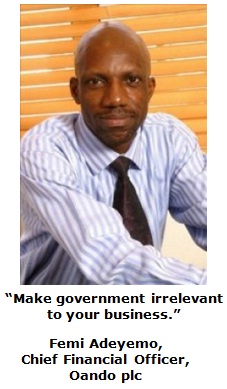
“When it comes to sustainability…it is often down to private enterprise to fund their own solutions.”
Femi Adeyemo, Chief Financial Officer, Oando plc
The conference explored issues relating to finance and investment in Africa and how the increasing ‘afro-optimism’ from the global financial community can be channelled into Africa’s real economies. It also looked at the business of culture and the need to boost both the impact and the export value of African culture. A session on Energy and Infrastructure looked at ways of satisfying the energy demands of a growing continent, while the session on entrepreneurship and innovation examined how to pave the way to a new business revolution.
In a stirring address, Femi Adeyemo, Chief Financial Officer of Oando plc, addressed some of the key challenges facing Africa in general, and Nigeria in particular.
Africa, he said, will offer a market of up to 1.5 billion people by 2030, while foreign direct investment has shot up from US$9 billion to US$62billion. Average inflation rates across the continent have fallen dramatically from an average of 22% in the 1990’s to around 8% today. By 2012, he said, more than 20 African countries had revenues in excess of $3 billion, and success stories can be found in countries in the east, west and north of the continent.
Adeyemo outlined the challenges that he believes Nigeria faces to ensure that its growth is sustainable. With an estimated population of 170 million citizens, he said, the country is challenged by inadequate infrastructure - poor electricity and water supply and inadequate road networks - and security issues, making it more difficult and expensive for business to be done.
Despite the rising wealth, there has been an increase in security issues across the continent, exacerbated by the increasing inequality between the have’s and have nots.
Another key factor in ensuring sustainable growth, said Adeyemo, is that of governance. Citing issues such as security of title for land and adherence to contracts and legal agreements as concerns for investors, he pointed out that governments have to play their part in creating an enabling environment for business. Access to finance is also an issue, he said, as banks do not lend enough and then only to established businesses which, in turn, stifles the entrepreneurial spirit. 84% of Nigerians have never applied for a loan, he said, representing a vast untapped market for the banking sector, particularly with unemployment at almost 25%.
According to Adeyemo, a lot more is now being done by regulators to restrict the concentration of investments by the banking industry. Where almost 70% of finance used to go to the oil sector, banks are now required to have no more than 10% of the assets in their credit portfolio against one sector. This has forced banks to diversify and to look at other sectors, such as manufacturing, when considering lending. While funding continues to be an issue for seed capital, the easiest way for people to start business is by tapping into the resources of friends and families.
The lack of necessary infrastructure, said Adeyemo, has resulted in organisations and people pooling their reserves to create their own ecosystems. In areas where, for example, manufacturing is concentrated, companies look to pool activities. This could include a joint venture to build gas power plants to obtain lower cost electricity, or roads linking their facilities. In effect, he said, business should not look to government for solutions but should “make government irrelevant to your business”.
“By making the impact of the government on your business as minimal as possible, you are not allowing government to slow you down,” he said. This attitude will eventually lead governments to react positively to the challenges faced by business and do better at what they are supposed to do.
Adeyemo referred to the key issues of human resources and skills, pointing out that today Nigeria has fewer people in primary and secondary education, relative to its population, than it did 20 years ago. Citing the growth in poverty and the correspondingly reduced incentive in going through education with such high unemployment, he pointed to the need to ensure that the education provided in the country is relevant.
“The school curriculum,” he said, “has not moved with the times and is not suited for today’s environment.” He spoke of Oando’s corporate social responsibility programmes in education and the company’s investment in re-educating teachers to teach in a way that is relevant for today. The initiative has proved so successful, he said, that the Nigerian government has approached the company to work in partnership on the scheme.
The company’s partnership with government has also extended to skills transfer and capacity building within the public sector. Pointing to low salaries as a disincentive to attract high calibre talent to government ministries, Adeyemo highlighted his company’s role in seconding skills to government and even paying for international training to give civil servants the opportunity to learn from those in other countries.
“When it comes to sustainability,” Adeyemo said, “it is often down to private enterprise to fund their own solutions.” As an example of this, he referred to the importation of petroleum products into Nigeria, a process he described as “expensive and chaotic”. His company is currently building an offshore loading terminal to increase the speed and decrease the cost of offloading, a situation that demonstrates how, so often in Africa, it is necessary for private enterprise to invest in the infrastructure necessary for them to do business.
“The African boom is going to be successful, as long as China stays stable,” was the view of Richard Dowden, Executive Director of the Royal African Society, in the second keynote address of the conference.
According to Dowden, the three factors that have led to the change in Africa’s economic status are: China’s considerable financial and skills investments since 1992, the massive penetration and connectivity arising through mobile phones/technology, and the rise of the African middle class – a cadre of Africans that can operate effectively anywhere in the world and is able to navigate and challenge governments.
What could impact Africa’s trajectory? Dowden cited Africa’s growing population – 1 billion now, and an estimated 2 billion by 2050 – as a major issue. “The biggest change,” he said, “is a lot of educated children looking for opportunities. What will happen with them?”
Africa’s continued progress will also depend on public perception of opportunities for investment as well as creating the right quality of education for the continent’s resource base. Currently, he said, public perception may lead to short rather than long-term investment. However, he added, he remains optimistic about the continent’s sustained progress.
“If trade barriers can come down, and support for business growth takes place,” he said, “it will make Africa the continent of the 21st century.”










 Keep yourself updated with our FREE newsletters now!