


Connecting Africa’s Skilled Professionals

 ReConnect Africa is a unique website and online magazine for the African professional in the Diaspora. Packed with
essential information about careers, business and jobs, ReConnect Africa keeps you connected to the best of Africa.
ReConnect Africa is a unique website and online magazine for the African professional in the Diaspora. Packed with
essential information about careers, business and jobs, ReConnect Africa keeps you connected to the best of Africa.




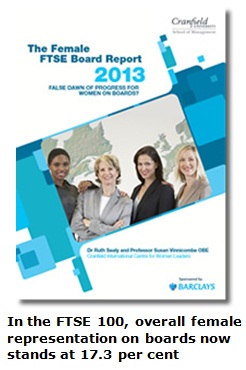 A slowdown in the rate of women being appointed to boards in the UK raises the question of whether firms are doing enough to develop female talent, says a new report
There are more women on British boards than ever before, but a slowdown in the rate of appointments should give cause for concern, says a report by Cranfield University’s School of Management.
Female FTSE Board Report 2013 charts improvements in female board representation and the UK’s progress in meeting a target set by Lord Davies in his 2011 review, that FTSE 100 boardrooms should aim to be 25 per cent female by 2015.
In the FTSE 100, overall female representation now stands at 17.3 per cent – up from 15 per cent in 2012 – with the number of all-male boards falling from 21 to seven in the past two years.
The study also found that 27.6 per cent of FTSE 250 companies now had boards where more than a fifth of members were women, up from 19.6 per cent in 2012. Total female board representation in the FTSE 250 was 13.3 per cent, up from 9.4 per cent last year.
But while 44 per cent of all new FTSE 100 board appointments went to women in the six months immediately after Cranfield’s 2012 report, this figure fell dramatically to 26 per cent in the following six months. For FTSE 250 firms the proportion of new female appointments also fell, from 36 per cent to 29 per cent.
Dr Ruth Sealy, who wrote the report, warned that the latest data meant businesses were falling behind the 33 per cent of new female appointments required to achieve Lord Davies’ goal.
She said: “Lord Davies’ target for FTSE 100 companies is still in sight, but only if the rate of new appointments going to women regains momentum promptly. Only a quarter of FTSE 100 companies have already achieved the target and the drop in the last six months is worrying.”
Sealy added that the fall was particularly concerning because there had been a parallel decline in the female pipeline – with the percentage of women on FTSE 100 executive committees down from 18.1 per cent in 2009 to 15.3 per cent in 2013.
The Cranfield report also showed that only 48 per cent of female executive directors in the FTSE 100 were internally promoted compared with 62 per cent of men, suggesting that women were being forced to seek promotion outside of their own companies.
Dawn Nicholson, HR consulting partner at PwC, which has itself moved from having zero to 27 per cent of women make up its executive board in the last 18 months, said: “The fact progress is stalling raises the question of whether the net is being thrown wide enough. Firms should be held to account about whether they are doing everything they can to develop the female talent that they have.”
Commenting on the figures, Maria Miller, the UK Minister for Women and Equalities, said: “Cranfield’s report indicates we are heading in the right direction when it comes to women’s representation at senior levels. But the priority is to maintain that momentum, not only within listed companies but across the economy as a whole.”
The ‘30% Club’, a group of chairman committed to upping female board representation, said that Cranfield’s findings should be a “wake-up call” for firms.
“There are companies who may feel they've done enough after appointing a single woman to their board,” explained Helena Morrissey, CEO of Newton Investment Management and the club’s founder. “We need to encourage – not berate – them to continue to use vacancies to move further towards balance.”
But the Trade Union Council has gone further, calling for the introduction of mandatory quotas – a measure the UK government has so far dismissed.
“The only way we will end the old boys’ network is if the government introduces compulsory quotas for the composition of boards, as recommended by the European Commission,” said TUC general secretary Frances O’Grady. “Without this, female board members will continue to be a rarity.”
Cranfield’s research found that the top performing company in the UK for female representation was Burberry, with three female directors out of eight (37.5 per cent of the board). It was also the only FTSE 100 company with two female executive directors – the CEO and CFO.











 Keep yourself updated with our FREE newsletters now!