


Connecting Africa’s Skilled Professionals

 ReConnect Africa is a unique website and online magazine for the African professional in the Diaspora. Packed with
essential information about careers, business and jobs, ReConnect Africa keeps you connected to the best of Africa.
ReConnect Africa is a unique website and online magazine for the African professional in the Diaspora. Packed with
essential information about careers, business and jobs, ReConnect Africa keeps you connected to the best of Africa.



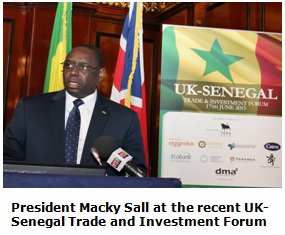 The 2nd UK-Senegal Trade and Investment Forum brought President Macky Sall and a high level delegation to London to showcase investment and business opportunities in Senegal
As the first port of call for the US President’s tour of Africa, Senegal has been enjoying a high profile in recent months.
However, business partnerships between the UK and Senegal were the focus of the recent investment forum held in London by Developing Markets Associates (DMA).
“Senegal has enjoyed decades of relative political and social stability, reflected in last year’s historical and peaceful elections,” said Atam Sandhu, Chief Executive of DMA, in the lead up to the event.
“Of Africa’s francophone countries, Senegal has the most developed trade exchanges with the UK and is one of the top partners of the UK in sub-Saharan Africa, ranking fifth in terms of trade behind South Africa, Nigeria, Ghana and Kenya. Going forward, UK-Senegalese relations can be braced for even strong prospects and we hope that this Forum will contribute to enhancing those ties.”
The Republic of Senegal is well positioned to access the sub-regional market and offers a competitive destination for investments in Africa. Thanks to its political stability, strategic geographical position and improving infrastructure, many international organisations and businesses have made Dakar, its capital, their base for operations across West Africa.
The country has a population of 12.86 million and has French as its official language, with Wolof as the national tongue. With a growth rate of 3.7% in 2012, the country rebounded from growth of only 2.6% in 2011.
Senegal is a member of the West African Economic and Monetary Union, whose eight member states share a common currency, the CFA franc, which is pegged to the euro.
Since its independence in 1960, Senegal’s economy has changed from what was essentially agriculture production – about 70% of the population work in the agricultural sector - to a greater emphasis on its services sectors. The secondary sector has been boosted by the construction of buildings and road infrastructure, while telecommunications have contributed greatly to the growth of the tertiary sector a result of the digital economy.
During the course of 2013, economic growth, driven by the tertiary and secondary sectors, is expected to reach 4.3%. Additional growth is also expected from the extractive industries and the energy and construction and civil engineering sectors.
The sectors considered to have high economic potential include horticulture, tourism, agriculture, medicine, financial services, real estate, chemicals and telecommunications, all of which are likely to also generate economic growth for the country.
In 2012, a Memorandum of Understanding on Trade and Investment was signed between Senegal and the UK, and negotiations are underway to conclude a Double Taxation agreement between the two countries.
The delegation to the Trade and Investment Forum was led by Senegalese President Macky Sall, and included Ministers, advisers and civil servants. Setting the scene, John Marshall, the UK Ambassador to Senegal, highlighted the three key changes in the country over the past two years.
The first of these were the elections in Senegal in March 2012 that led to a change of government and the election of President Macky Sall with 65% of the vote.
The new President, he said, has laid emphasis on the importance of good governance and transparency for Senegal’s development and had “embarked on this agenda with vigour and determination.”
 The second key change, Marshall said, was the increased interest from British business in Senegal. Over the past decade, over 40 new British investor projects have been realised in the country; some companies are coming new to the market with the desire to look beyond their traditional markets, while others already established in Senegal are seeking to expand. Opportunities for doing business in Senegal, he said, extended from energy, to agriculture, infrastructure, financial services and education.
The third key development, the Ambassador said, was in the range of support that the British Embassy offers to companies exploring opportunities in Senegal and a place to invest.
The Senegalese Ambassador to the UK, HE Abdou Sourang, gave a brief address, describing Senegal as a destination for investment and partnership and a land of hospitality.
Delivering his keynote address in French, the President of Senegal, HE Macky Sall, welcomed delegates to the Forum and outlined the areas of opportunity for business and investment in his country, highlighting infrastructure, tourism, agriculture, mining and energy, in particular.
He described Senegal as a tolerant and democratic country with strong institutions and harmonious relations between its different religions and citizens. The President stressed his country’s constant vigilance against corruption, citing the national office set up to fight corruption and to ensure that public service was properly conducted.
The President stressed the need for partnerships and win/win approaches that ensured business could be done profitably and that the interests of the people and the country are served.
 Aida Wane, the Managing Director of the Senegal Investment Promotion Agency (APIX) described the country’s goals as “a political and economic programme of harmonious and inclusive vision”. In the medium-term, she said, Senegal expects to see growth of around 6.7% by 2017. The country is aiming a private investment rate of 23% and to see 500,000 new jobs created. With growth in agriculture and energy set to take off, she highlighted the government’s concern to ensure that development impacted all regions of the country.
The political transition in March 2012, she said, confirmed the country’s tradition of stability and democracy, laying the ground for well-balanced growth and prosperity.
The President’s immediate priorities, she added, were on improving the country’s infrastructure, with roads, railways, ports and airports all requiring upgrading and further investment. Energy and water production were the other priority areas.
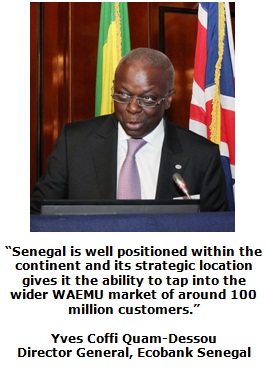
The presentation by Yves Coffi Quam-Dessou, Director General of Ecobank Senegal, reflected the confidence felt by the business community in Senegal. Ecobank, the pan-African bank now present in 33 countries in Africa and listed on 3 stock exchanges, is the third largest bank in Senegal.
He gave a brief overview of Senegal’s economic indicators, noting that the country has enjoyed a stable and increasing level of foreign direct investment since 2011 into sectors including agriculture, fishing, mining, transportation, energy and infrastructure. The country is well positioned within the continent and its strategic location gives it the ability to tap into the wider WAEMU market of around 100 million customers.
Quam-Dessou reiterated the key sectors for investors, noting that over 80% of the population are involved in agriculture – Senegal is currently West Africa’s largest sugar producer - and that the sector offers many opportunities to improve production. Mining, he said, continues to present investment opportunities, with phosphate mining the second largest source of foreign exchange for the country.
The export sector is growing and gold, agricultural crops and petroleum products accounted for more than 50% of the country’s exports in 2012. In terms of Senegal’s export market, France accounted for 15% of Senegal’s exports in 2012, closely followed by Nigeria. Although the EU dominates the country’s export market, exports to India and China are also growing.
Senegal is well positioned in the sub-region, he said, and Mali acts as its primary export partner. Although there is room for improvement, he added, Senegal leads in logistics performance in the West African region and the country can help to boost the current level of West Africa’s intra-regional trade.
For further information about the Forum: www.developingmarkets.com




 Keep yourself updated with our FREE newsletters now!