


Connecting Africa’s Skilled Professionals

 ReConnect Africa is a unique website and online magazine for the African professional in the Diaspora. Packed with
essential information about careers, business and jobs, ReConnect Africa keeps you connected to the best of Africa.
ReConnect Africa is a unique website and online magazine for the African professional in the Diaspora. Packed with
essential information about careers, business and jobs, ReConnect Africa keeps you connected to the best of Africa.




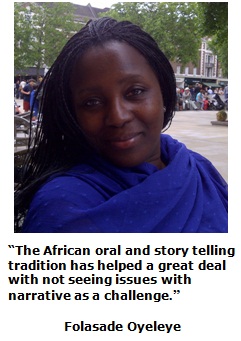 Continuing our ‘Spotlight on…’ series, ReConnect Africa spoke to Folasade Oyeleye about a career in Film & TV Editing
ReConnect Africa (RCA): Folasade, Can you tell us a bit about yourself and your early years?
I was born in London to Nigerian parents. There is a strong oral tradition of telling stories within our culture and as children we were encouraged to read, be academic and also be creative.
I now work as a freelance film and television editor and I previously worked as a Stage Manager in theatre.
What made you decide on a career in film and TV editing?
As a child, watching television was very much restricted but we did go to the Saturday cinema, which was a big event. I was a precocious reader and used to read film books from the age of eight.
I purchased my first film book through a school book club. I still have it. It listed all the credits of each film synopsis and stills and I was curious about how it was put together. I think it was an interest in film and doing some short courses which led me to do a two year apprenticeship in film and television. I think I was a natural editor.
RCA: What kind of qualifications does one need to get into the industry?
There is no particular qualification needed to enter the film industry. People come from many disciplines and qualifications. There are many good media courses now available and the broader your training and experience, the more you bring to your area of specialization.
RCA: What are some of the factors that you would say contributed to your success?
Enjoying editing, scripting and working well with directors have all been contributory factors.
RCA: What are some of the myths people have about working in your field?
There is a great underestimation of what an editor can bring to a production. An editor will always strive to enhance and create an invisible edit which is structured and cohesive and tells a good story. Ironically, in many cases it appears as if nothing has been done, but that is the skill, and it is also the reason why people don’t see the importance of that skill.
RCA: What would you say have been the key challenges for you in developing your career in TV and film editing?
It is harder now to have continuity as the business has changed a lot. Schedules and finances have changed, and that affects the amount of time available for a production.
RCA: What impact has your African heritage had on your career?
The African oral and story telling tradition has helped a great deal. It helps me to not see issues with narrative as a challenge and to have the mindset to be able to not see a problem as a problem.
RCA: What lessons would you offer anyone who would like to work in your field?
I would advise people to go to the cinema and support the industry that way by watching films. Also, to read original screenplays or books which have been adapted to the screen and compare these with the finished edited product. This is a good way of understanding why certain decisions are made, when translated into the medium, in order to tell an engaging and successful story.






 Keep yourself updated with our FREE newsletters now!