


Connecting Africa’s Skilled Professionals

 ReConnect Africa is a unique website and online magazine for the African professional in the Diaspora. Packed with
essential information about careers, business and jobs, ReConnect Africa keeps you connected to the best of Africa.
ReConnect Africa is a unique website and online magazine for the African professional in the Diaspora. Packed with
essential information about careers, business and jobs, ReConnect Africa keeps you connected to the best of Africa.




 Women on Boards is an open, action-oriented, UK-wide organisation for women seeking to leverage their professional skills and experience into board and leadership roles.
The focus of Women on Boards is to encourage, inspire and actively support women - from all sectors and ethnicities - to find their own pathway to the boardroom. Its goal is a measurable and sustainable increase in the number of women on boards and in leadership roles across all sectors in the UK.
Reconnect Africa spoke to Fiona Hathorn, Managing Director of Women on Boards UK about the organisation and her desire to support women of colour onto boards.
ReConnect Africa (RCA): What was the inspiration behind setting up Women on Boards?
Fiona Hathorn: When working with female entrepreneurs I was shocked at how few women got funded in the UK despite their well-articulated investment plans and exit strategies. Prior to this work I had not realised how hard some women find it to sell their ideas and how many of them were brushed quickly aside before they had even had a chance to properly present.
At the same time I was aware of the UK government’s push to help more women get onto FTSE boards. In my quest to find out more information on the issues that women face getting noticed, I came across the Women on Boards website in Australia. Shortly after this, I met Claire Braund and realised that the Australian Women on Boards business model had something innovative to offer in the UK.
RCA: How many members do you have and how diverse is your membership?
Fiona Hathorn: We currently have 3,998 members of Women on Boards UK in the UK and the membership is very diverse;
RCA: What key barriers do women face when it comes to board room opportunities?
Fiona Hathorn: Ultimately I would like ambitious women, as soon as they start their career, to think about the route to the top. There are now many female role models out there for women to see, not enough admittedly, but enough for women to observe and work out that it is possible for them to get to the top if they so desire.
In the UK currently, there is a lot of discussion taking place about how to get more women onto boards. However the focus is very much on recruiting high quality female NED’s to boost boardroom percentages up to Lord Davies’s 2015 target of 25%. The UK’s corporates very much want to prevent the introduction of quotas.
Despite all this movement at the top, the pipeline of women below the board level is still very poor. Changing corporate culture, which has been established over decades, takes time. Real change will not happen until executive managements truly accept that there is a problem. However, the UK’s new diversity reporting codes, similar to Principle 3 in Australia, will help. Transparency is key to driving recognition and then change.
RCA: How does Women on Boards support women to become ‘board ready’?
Fiona Hathorn: We provide women with information about all the boards available to them throughout their career. In the UK we now have a lot of information about the top FTSE companies and their boards, but there is very little information for women on all the other boards out there; for example Charity Boards, Public Bodies, Non-Departmental Government Bodies and Building Societies.
We provide courses through the WOB Pathways Programme empowering women to take charge of their own careers, network smartly and think about what they can offer in terms of their skill-sets and knowledge, and how to join all the boards out there.
We are outcome-focused, in that we intend to not only tell women about all the boards in the UK but we also find and advertise board positions for them to apply for, should they wish to.
We source board/trustee vacancies for them to apply for. Women are often time short and are not hearing or searching for vacancies. We help source vacancies for them and email them weekly vacant position information. Full subscribers of Women on Boards UK get access to the detail of these vacancies and support when applying for roles; introductions, CV profile support and interview information…… we have thousands of women, currently sitting on boards, who we can connect our member to, if appropriate, prior to interviews. This support is in addition to the sectoral Boardroom Conversations that we run to introduce our members to a range of different board opportunities out there for them, should they have the right skill set.
RCA: WOB is keen to welcome more women of African and Caribbean heritage. What misconceptions do you think women of colour have about accessing board positions in the UK?
Fiona Hathorn: We welcome everyone; all ages, all cultural backgrounds and levels of business experience. Transparency and openness is key, in our opinion, if you want to see the real benefits of diversity in decision making. The UK today has a very diverse heritage and this diversity is not currently reflected in senior management, let alone on boards. We are working with the Cabinet Office to try and ensure that they meet their targets of 50% of all new appointments to Government Boards (Non Executive Appointments) being women from 2015 onwards. Currently not enough women apply for these rules and therefore the make-up of these boards does not reflect our society.
For these boards to be effective, the people on them need to represent the communities that they serve. In our discussions with the Cabinet Office, we are very aware that these boards are woefully short as regards ethnic minority representation. Women on Boards UK believe this must change and we would therefore be delighted to see more ethnic minority members so that we can ensure better representation and more effective boards.
Ethnic women are no different from other women in that they often look at these boards, and who sits on them, and simply do not apply. These boards do not look like them and currently far too many board positions go via word of mouth rather than via an open and transparent selection processes. As a consequence, women do not get asked to apply and therefore they do not get selected.
RCA: Are there any general skills or level of expertise that women should have before exploring board level opportunities?
Fiona Hathorn: To sit on boards you need to understand your fiduciary responsibilities and statutory duties. That said you need do not have to be a financial wizard. All you need to have is a basic level of financial account understanding to ensure you fully comprehend the board’s financial situation.
Effective boards need a balanced set of skills and knowledge on them ranging from Financial Accounts to Marketing, Governance and Strategy, to name just a few. Remember there are many types of boards out there, from small tiny charities to large PLC boards. There are also Industry Association Committees, NHS Trusts and thousands of Government Non-Departmental Government Bodies (the BBC is one of these). So there will be one for you and your skill knowledge; just open your eyes and ears and find out what boards are out there that might really welcome your value add. Women on Boards UK’s Resource Centre will help you.
RCA: In your view, what impact does being on a board have on an individual’s personal and professional development?
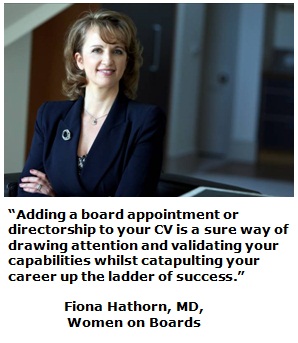
Fiona Hathorn: Adding a board appointment or directorship to your CV is a sure way of drawing attention and validating your capabilities, whilst catapulting your career up the ladder of success. There are many benefits to be gained from this career portfolio strategy. Joining a board indicates to management or your clients that you are interested and engaged in your community at a leadership level - a directorship can be a point of difference on your CV when applying for a new role. You will build market and industry knowledge and networks through exposure to a diverse range of issues from the perspective of a director. It will also build your capacity to develop career and leadership skills that you may not be able to develop in your day job.
Directorships improve career resilience and provide strategic understanding of workforce dynamics.
RCA: How can women sign up to WOB?
Fiona Hathorn: Just sign-up and register onto our website => www.womenonboards.co.uk, it is absolutely free to be part of our web community. There is a huge amount of information on our website for you to access and those that register will receive our uplifting e-newsletter every 6 weeks and event alerts.
We only charge £120 a year for members who wish to become full subscribers and who want access to our event discounts, our one-on-one advice and access to NED vacancy information for application.










 Keep yourself updated with our FREE newsletters now!