


Connecting Africa’s Skilled Professionals

 ReConnect Africa is a unique website and online magazine for the African professional in the Diaspora. Packed with
essential information about careers, business and jobs, ReConnect Africa keeps you connected to the best of Africa.
ReConnect Africa is a unique website and online magazine for the African professional in the Diaspora. Packed with
essential information about careers, business and jobs, ReConnect Africa keeps you connected to the best of Africa.




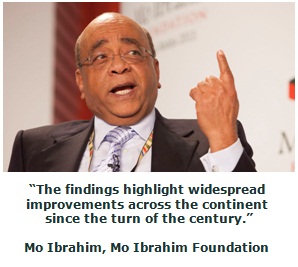 Things are getting better but there’s still a long way to go in governance standards in Africa, say the findings from the Ibrahim Foundation
The seventh Ibrahim Index of African Governance (IIAG) confirms that overall governance in Africa continues to improve at the continental level. The countries that have experienced overall governance improvement since 2000 are today home to 94% of people living on the continent.
Established in 2007, the IIAG is the most comprehensive collection of quantitative data on governance in Africa. The Index is compiled in partnership with experts from a number of the continent’s institutions and provides an annual assessment of governance in fifty-two African countries (Sudan was not included in the recent study).
The IIAG provides a framework for citizens, governments, institutions and business to assess the delivery of public goods and services, and policy outcomes, across Africa and the data used in the compilation of the 2013 IIAG is from 2000 to 2012. The Foundation worked with 33 organisations to collect data and its findings provide Africa’s leaders with a tool with which to govern, highlighting continental, regional, national and thematic governance results.
The data is classified within four categories: Safety & Rule of Law, Participation & Human Rights, Sustainable Economic Opportunity and Human Development. Each category has 14 sub-categories.
“The findings highlight widespread improvements across the continent since the turn of the century,” says Mo Ibrahim, founder and Chair of the Mo Ibrahim Foundation, the organisation behind the IIAG. “Eighteen out of the 52 countries analysed saw their best ever performance in this year’s IIAG. But these figures, of course, also reveal challenges.”
Among these is the likelihood that some important Millennium Development Goals will be missed in 2015; a good reason, says Ibrahim for those in leadership to bring “an increased focus on what we can learn from these successes and failures.”
Since 2000, the strongest improvements at continental level are registered in the categories of Human Development (+10.2), Sustainable Economic Opportunity (+5.6) and, to a lesser extent, Participation & Human Rights (+3.2). Meanwhile the Safety & Rule of Law categoryhas declined worryingly (-1.1), showing year-on-year declines since 2010.
Only 20 countries in the category show improvement, with national security issues such as an increase in internal unrest and conflict contributing to this rating.
This category has shown diverging trends between its sub-categories. While the National Security sub-category continues to show progress, with Cross-Border Tensions being the largest improving indicator, the Personal Safety sub-categoryhas seen concerning declines, with four of the five indicators sitting in the ten most deteriorated indicator group. Personal Safety has also shown the largest sub-category level deterioration since 2000. While the Accountability sub-category has improved slightly since 2000, especially in the Corruption & Bureaucracy indicator, the Rule of Law sub-category has declined.
“In this continent, where two thirds of the population is now under 25, these diverging trends within the Safety & Rule of Law category are concerning. They may sound a warning signal, with the new century seeing fewer regional conflicts but increased domestic social unrest,” said Hadeel Ibrahim, the founding Executive Director of the Mo Ibrahim Foundation.
The 2013 IIAG reflects the growing complexity of the African landscape. The challenge, says the Foundation, is how to secure sustainable progress. More than ever, equitable allocation of resources must be a priority for policy and decision making. Commitment to, and balance in each of the four IIAG categories–Safety & Rule of Law, Participation & Human Rights, Sustainable Economic Opportunity and Human Development, is critical to secure improvement in the long-term.
The IIAG shows a growing diversity in governance results on the continent. There is a widening span in performance between the best and worst governed countries - with the top performing country, Mauritius, scoring 82.9 while Somalia, the poorest performing country, registers the lowest country score at 8.0 – and increasingly noticeable differences between the performance across different categories; and conflicting trends within the categories.
Five post-conflict countries - Liberia, Angola, Sierra Leone, Rwanda and Burundi - top the league of the table for most improved performers since 2000. Two countries, Angola and Rwanda, have, remarkably, shown year-on-year improvement in overall governance, coming from their lowest point in 2000 and reaching their highest peak yet in 2012.
However, both of these countries have room for continued improvement, with Rwanda ranking 15th in overall governance, and Angola ranking 39th (out of 52 countries).
“Rwanda has been registering the best progress since 2000 of the post-conflict countries,” explains Ibrahim. “It is the only country that has registered year on year improvement in all four key indicators – which is encouraging, although there is progress still to be made.”
The top ten performers over the years have remained relatively stable, with eight countries managing to remain in this grouping since 2000 (Mauritius, Botswana, Cape Verde, South Africa, Seychelles, Namibia, Tunisia and Ghana).
“Health has been the greatest success story of Africa in the past decade,” says Mo Ibrahim and the 10 biggest improvements noted by the study include antiretroviral transmission provision (+49.6), immunisation (16.6) and child mortality (15.2).
Meanwhile, the bottom ten has displayed more fluctuation in and out of the grouping. Six countries (Zimbabwe, Equatorial Guinea, Chad, Central African Republic, DRC and Somalia) have constantly remained in the bottom ten in all years between 2000 and 2012. Since 2000, seven countries have managed to pull themselves out of the bottom ten, four of which are post-conflict countries (Angola, Burundi, Liberia and Sierra Leone).
The 10 worst areas of deterioration include Workers’ Rights (-23.5), Safety of person (-22.8) and Human Trafficking (-7.8).
The IIAG continues to be a work in progress, says Ibrahim, with the data giving options to governments and other stakeholders to develop policies.
“The fact is that we cannot run a country without reliable data,” he said, calling on African leaders to strengthen their national statistical offices. Data enables leaders to see where their policies are weak or strong and to analyse what needs to be done. “These findings are based on data, on reality, and are without bias of any kind.”
It is not the Foundation’s role to offer opinions on the policies of African governments, Ibrahim insists. “We are measuring outcomes of governments, not their intentions or political manifestos. We are interested in the facts on the ground.”
The announcement in October 2013 that, “after careful consideration” the Ibrahim Prize for Excellence in Leadership would not be awarded that year has led to consternation about the prize and the state of Africa’s leadership. It is awarded to a former Executive Head of State or Government by an independent Prize Committee composed of eminent figures, including two Nobel Laureates. Following another year without a winner, it has also raised questions about how achievable the prize is, given the criteria.
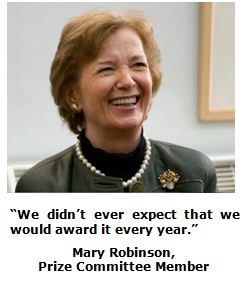 The Prize is awarded for excellence in leadership and recipients are intended to serve as a role model to new leaders, says Salim Ahmed Salim, Chairperson of the Ibrahim Prize Committee.
“We considered every head of state who has retired in the past three years. We have had 3 laureates who have won based on these criteria, so we are satisfied. We hope that those interested in getting the prize will be impressed by the winners and will strive to do their best to improve the quality of life for their people.”
Former Irish President and Prize Committee member, Mary Robinson, stresses that the prize is for excellence and to inspire good leadership. “We didn’t ever expect that we would award it every year and the Prize Committee is not worried that this year we couldn’t find a leader to award.”
Mo Ibrahim, who is not involved in the selection and awarding process, emphasises that the prize is a unique award intended for African presidents due to the influence they exert within Africa’s young democracies. The prize helps, he says, to “focus on the head of the fish – where the power lies.”
“There’s a new generation of African leaders coming up who are very serious,” he says. “In the future we will have problems with selecting the recipients for the Prize because there will be so much choice.”
“We need to look at the areas that are lagging behind,” says Ibrahim. “Sustainable development needs to be equal development. We can’t have some things okay and others not. We invite stakeholders, civil society, the media, economists and governments to use this data to develop solutions.”
The findings from the IIAG reflect the complexity of the Africa story, says Ibrahim. “Neither Afro-pessimism nor Afro-optimism do justice to modern Africa. This is now the age of Afro-realism - an honest outlook on our continent. It’s about a celebration of its achievements but also a pragmatic acknowledgement of the challenges that lie ahead.”
Success will not be overnight, he says. “It takes time. Nations take time to build systems, build infrastructure, and for schools to produce good men and women. We should not rush to expect miracles. That’s why it’s important to look at a longer time span. It took China 40 years to get where it is now. It is not an overnight success – it is a process of hard work.”
The full data set of the 2013 IIAG can be found on the Foundation’s website
Images: Mo Ibrahim Foundation









 Keep yourself updated with our FREE newsletters now!