


Connecting Africa’s Skilled Professionals

 ReConnect Africa is a unique website and online magazine for the African professional in the Diaspora. Packed with
essential information about careers, business and jobs, ReConnect Africa keeps you connected to the best of Africa.
ReConnect Africa is a unique website and online magazine for the African professional in the Diaspora. Packed with
essential information about careers, business and jobs, ReConnect Africa keeps you connected to the best of Africa.




 Research by the African Management Institution (AMI) shows that the continent is severely lacking in managers with the skills to advance its economies
A much larger pool of competent local managers is absolutely essential for driving competitive African private and public sectors, for cultivating knowledge-based economies and for achieving development goals, says a report by the African Management Initiative.
According to the research by AMI, an initiative formed by the Association of African Business Schools, the Global Business School Network, the Tony Elumelu Foundation and the Lundin Foundation to transform Africa through high quality management, a bold systemic approach is needed to build a critical mass of Africans managers, supported by high-quality schools and resources, and working in dynamic organisations that allow talent to flourish.
The report draws on interviews with over 50 experts and employers, and dozens of secondary resources, to understand the management gap from an individual and organisational perspective.
It maps Africa’s existing education and training landscape and identifies pockets of excellence. It illustrates that the current management development ecosystem is insufficient to meet the requirements of Africa’s buoyant economies and presents ideas for intervention and recommendations for next steps.
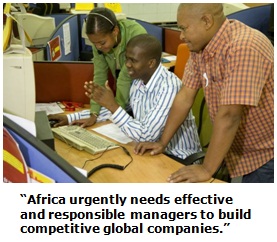
“We believe good management is the missing link in the African growth and development story,” says Rebecca Harrison, the Project Director of African Management Initiative. “Africa urgently needs effective and responsible managers to build competitive global companies, a thriving SME sector and visionary public and civil society institutions.”
According to the report, “Africa has the potential for real progress. It has natural resources in abundance and a young expanding population. Foreign investment is on the rise. But Africa’s economic growth, among the fastest in the world, is rapidly draining the pool of local managers. These are the very people who are vital for translating opportunities into tangible results, increased competitiveness and a better life for all.”
The lack of sufficient management competency on the ground is one of the greatest constraints facing the continent, says Harrison. “Our research shows that Africa boasts good business leaders, but not nearly enough. Smaller businesses in particular often lack the management know-how to take their businesses to the next level.
While Africa has some great business schools, and impressive programmes for smaller businesses and entrepreneurs, these existing efforts are simply inadequate to meet the scale of the need. The continent needs innovative, accessible and massively scalable solutions to help close the management gap.”
Organisations typically employ one manager for every 10 workers and the report estimates that Africa’s formal labour force of 111 million includes approximately 11 million managers. For good management practice to be embedded, they estimate that at least one-tenth of managers – over a million people – need to be fully equipped with the knowledge needed to drive Africa’s development. This is a target that employers say is far from being reached.
The AMI survey drew from 50 in-depth interviews with individuals at 40 organisations across Africa, including employers, educators, thought leaders and training providers, among others. The research was largely qualitative and its results are therefore based on the perceptions of interviews not on empirical survey-based evidence.
The research showed that “only a minority of African managers, particularly at mid and lower levels, are well-trained.” Participants in the study - large businesses, entrepreneurs, investors, NGOs, educators, training providers and consultants from across the continent – highlighted poor management and a disconnect between theoretical knowledge and on-the-job behaviour as widespread. The scarcity of good quality is a major challenge for companies struggling to find the people to launch their brands in new markets and for entrepreneurs seeking good managers to help grow their businesses.
According to the study, “the biggest need is in the middle of the organisational pyramid”. Participants highlighted their greatest concern as the “huge gap” between highly educated and experienced senior staff and “a much less able engine room of middle and lower level managers” unable to execute the organisation’s strategy. There is an urgent need to bridge this gap through programs and institutions focused on this segment.
Employers cited a deficit in skills across areas such as personal drive and planning, ethics and integrity, critical thinking, flexibility and practical experience. However, the report suggested, the hierarchical and authoritative cultures of many African organisations can also be barriers to enabling the development of strong managers. Senior leaders will also need coaching if they are to put in place the right kind of organisational culture to develop the kind of managers they need.
The lack of available management development resources in Africa is also a key factor. Africa has roughly 90 business schools offering an MBA, says the report authors, approximately 1 per 11 million people. This compares to more than 1,500 schools in India that offer MBA courses.
In Africa, by contrast, they say, “Fewer than 10 African institutions measure up to international standards. While South Africa and parts of North Africa are strong, Central and West Africa are woefully underserved. Only the largest companies provide in-house training. There are a handful of good schools at the top of the pyramid, but not enough.”
The report criticises the quality of many local business schools, describing them as “low-quality, overly academic and out of step with the requirements of fast-growing African economies.” The quality of training outside these institutions is patchy and there are no mechanisms to measure quality.
According to the report, Africa urgently needs “high-quality and affordable institutions and programs at this level, which can also reach rural and underserved urban areas.”
Their interviews did reveal pockets of excellence in management development in Africa and other emerging markets and some world-class business schools and entrepreneurship training programs, as well as creative in-house corporate initiatives. Common features of these high quality establishments and programmes were that they were entrepreneurial, interactive, accessible, practice-based and relevant to their local communities. These institutions, they suggest, offer a framework for those designing new management training projects, as well as those seeking to improve existing institutions.
“More of the same will not be enough,” the report concludes. “We need new models for management education and development rooted in African realities and with potential for real scale.”
The report offers a model for understanding the management development ecosystem, and points to four areas of possible action:
Inputs: Developing high-quality combined offline and online curricula and materials; providing faculty and facilitator training and facilitating resource-sharing between institutions.
Providers: Supplying templates for creating more top-tier business schools. Piloting or franchising more accessible programs and finding and developing new delivery channels and supporting existing providers.
Organisational enablers: Strengthening companies and organisations through in-house methods such as mentoring and performance management systems.
Quality Assurance: Developing quality assurance mechanisms, possibly through a ‘register’ or ‘network’ which could benchmark individuals, organisations, educators and training providers against a scorecard of best management practice.
Top Image: Chris Kirchhoff, mediaclubsouthafrica.com











 Keep yourself updated with our FREE newsletters now!