


Connecting Africa’s Skilled Professionals

 ReConnect Africa is a unique website and online magazine for the African professional in the Diaspora. Packed with
essential information about careers, business and jobs, ReConnect Africa keeps you connected to the best of Africa.
ReConnect Africa is a unique website and online magazine for the African professional in the Diaspora. Packed with
essential information about careers, business and jobs, ReConnect Africa keeps you connected to the best of Africa.



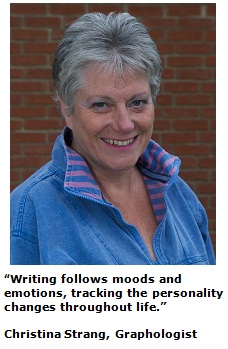 Are you truly in harmony with yourself? Graphologist Christina Strang explains how our handwriting reflects our changing moods and emotions
Personality has been defined in many different ways. J P Guilford (1959)1 described it as “a person’s unique pattern of traits”; and Raymond Cattell (1950)2 called it that which permits a prediction of what a person will do in a given situation.
So what is it that drives a person to do certain things in certain situations?
Without going into the nature/nurture debate, it has been claimed that “we are the product of the interaction of our heredity and our environment, neither of which we chose. The decisions we make today are determined by events that happened in the past, plus the present situation which we perceive in terms of our past experiences.”
Assessing Personality through Handwriting
However, this is not the full story; there are other factors that determine who we are – how we act and behave can be determined by whether we are controlled predominantly by our minds or by our emotions. The impact of social interaction and activity levels also play a major part in the personality make-up, and moods and emotions are as much a part of us as are our physical characteristics. It is partly a result of this that our writing differs from others, even though they learned to write alongside us.
Writing follows moods and emotions, tracking the personality changes throughout life. Through graphology, you can make an assessment of an individual’s personality, their strengths and weaknesses, how they relate to others, their intellectual capabilities, social inclinations, and abilities.
With emotions and feelings changing throughout time and day by day, certain aspects of your writing will also change. For example, if you are feeling stressed because your son has not tidied up his bedroom, your husband is late home from work and the family are all arriving for dinner, then the likelihood is that your muscles will be tense, and there will be more rigidity with your handwriting and this can be seen in the analysis.
In effect, a good graphologist has to be a detective trawling through the writing looking for the clues of personality and looking for inter-related movements.
Some of the many recurring questions asked of graphologists are “Are you psychic?”, “Is it intuitive?” and one of the statements made regularly is “Well it isn’t a science, is it!”
My reply to this is that it is both a science and an art; and I suggest that the person asking the question thinks of a jigsaw. Cutting out the pieces is a science, like identifying the different writing traits, but then putting those pieces back together to form a picture is an art form; think of a 2-sided or even multi-dimensional jigsaw, because every written trait can mean something different when seen with other written traits. For example, large writing with upright writing means something different to large writing with right slanted writing.
A person in harmony with themselves will provide a well-balanced, rhythmical writing. If, however, there is discord then the system operates irregularly and writing will show disparity in the size, slant, space between words and lines, baselines, etc.
The emotional discord, if not resolved, will lead to dysfunction; this can mean dysfunction of the nervous system and muscles which will affect the writing pattern and stroke formation. Over a period of time, if the dysfunction is not resolved, then the writing will become devoid of rhythm among other signs, at which point the disease is manifesting.
In the Introduction to Handbook of Personality and Health, Professor of Personality Psychology, Margarete Vollrath writes “Among the psychological factors that impact health, personality……plays a pivotal role. Indeed, the strength of the effects of personality on health can be similar to those of known biological risk factors…” 5
Therefore knowing a person through their writing gives anyone a head start in understanding that person, what motivates them and indeed what makes them “tick”, helping with appreciation of the emotions and drives of that individual.
“Among psychosocial factors, personality has the greatest potential to contribute to the diseases responsible for the most mortality in the Western World, including cancer, heart disease, and diabetes.” Segerstrom, S C; Smith, T W; Physiological Pathways from Personality to Health: The Cardiovascular and Immune Systems. Handbook of Personality & Health 2006 John Wiley & Sons, Ltd.
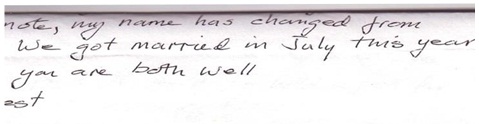
Arthritis in feet, legs, hands and spine.
Look at the dots at the base of the letter ‘g’, this is a sign of an ankle or feet problems. The stiffness in the writing signifies issues with pen hold. When a person has arthritic hands, pain is caused by the flexing of the fingers and extension is restricted so you will find that in general the right margin on the page becomes wider as you go down the page. I understand that rheumatoid arthritis can be caused by “repressed anger”. There are a number of indications in the writing of this anger, but they are too involved to explain in this article.
REFERENCES










 Keep yourself updated with our FREE newsletters now!