RCA Flag
RCA Flag
Connecting Africa’s Skilled Professionals
RCA Flag

ReConnect Africa is a unique website and online magazine for the African professional in the Diaspora. Packed with essential information about careers, business and jobs, ReConnect Africa keeps you connected to the best of Africa.

ReConnect Africa Magazine

Books and Resources

Heading to Africa?

Editorial - Connecting Africa’s Global Talent

In May 2006 we launched ReConnect Africa.com as the ‘go to’ place for professionals of African origin overseas


Diversity

Are Black women doubly disadvantaged in the European workplace? A unique study about the Image experiences of Black and ethnic minority women at work, ‘Different Women, Different Places’, reveals what women of colour really think.

‘Different Women, Different Places’ evolved from the discussions and experiences of a small network of successful women and the realisation that they were not just women or just black but women with multiple identities that were inextricably inter-linked. What also emerged, however, was that being a Black or Asian woman meant different things to different people.

Intent on finding more information about the experiences of women of colour in Europe, Caroline Harper Jantuah, Director of The Diversity Practice, formed a study group with two other professional women. The goal was to move beyond previous studies that focused on problems and barriers faced by Black Women.

Black Women – Doubly Disadvantaged?

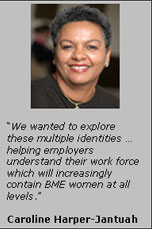
“The objectives of the study were to improve our knowledge about the experiences of Black and Minority Ethnic (BME) women at work and challenge the notion that Black women are doubly disadvantaged,” says Harper Jantuah. “We wanted to explore Imagethese multiple identities and produce case studies of role models for the next generation, helping employers understand their work force which will increasingly contain BME women at all levels.”

The ‘Different Women’ study is a partnership between The Diversity Practice and Katalytik, two UK-based organisations committed to equality and the celebration of diversity in the work place. Carol Compayne is the Equality & Diversity Manager for London South Bank University and a Principal Lecturer in Strategic Management, and Marketing while Jan Peters is a leading authority on women and science.

The Process

The study gathered information, through the career histories of black and minority ethnic women, of visible difference, from across Europe and also used an on-line questionnaire, face to face interviews and discussion dinners to focus on emerging topics. Dinners, sponsored by investment banking group, Credit Suisse, were held from late 2006 to January 2007. Forty-two women took part and the essence of the first dinner - the issues raised, the atmosphere and the energy were captured by ethnographers and graphic recorders.

A range of themes were explored at the dinners including individual success strategies and the notion of 'double disadvantage' and organisational style and culture as barriers to career progression for BME women. Also explored were the leadership styles of BME women and how they differ from their white counterparts, and participants debated the ideal workplace for BME women and what they considered the added value characteristics of BME women.

Findings from the Survey

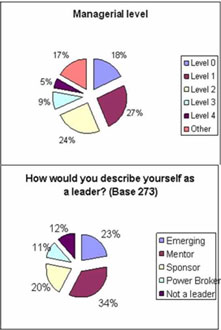
Some of the findings from the online survey:Image

Managerial level:

More than half of the respondents are at levels 1 and 2 in their organisations, in other words hold positions akin to director, partner or senior executive (level 1) or manager, senior associate or principal scientist (level 2) category.

Leadership Maturation:

This refers to one's stage of leadership development (courtesy of the League of Black Women).

Survey respondents identified themselves predominantly as in the mentor leadership category followed by that of emerging leader.

Education:

41% of survey respondents spent the whole of their educational period in Europe and 19% came at a later stage for their University education.

Job Satisfaction

The women were asked about how satisfied they were with their careers to date - satisfaction levels are high! 25% were very satisfied, 50% were satisfied. This is less to do with the support of their organisations and more to do with the progress they have made in spite of the challenges many of them have faced along the way.

Important Influences

While family was seen as an important influence on career and career choice by 57% of respondents, only 12% felt a strong influence from teachers. In fact 54% refuted that their teachers had any influence on their career.

Other Statistics
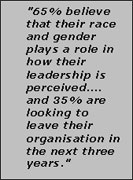
  • 65% believe that their race and gender plays a role in how their leadership is perceived
  • 36% do not perceive their race and gender to be a double disadvantage
  • 38% are looking to leave their organisation in the next three years this should be a source for concern for organisations that have invested in developing this talent
A New and Dynamic Perspective on Successful Black Women

ImageIn response to the findings, Caroline Jantuah said, “This study presents a new and dynamic perspective on the factors that guide successful BME women, bringing to light findings of value to HR and diversity professionals, government bodies, business and organisations, as well as BME women themselves. We have met and heard the stories of some amazing women and want to ensure that their voices are heard and that their strategies for success are shared as widely as possible”

Data analysis of the findings and the drafting of the report have been completed and dissemination of the findings will commence during December 2007. Fundraising activities are underway to promote the work of the project.

Organisations interested in sponsoring the project are invited to contact the Diversity Practice office 020 8408 7172 or email results@differentwomen.com

Image We take a look at the US companies that made the DiversityInc. Top 10 for recruitment, retention and promotion of Black employees.


Now in its 11th year, The DiversityInc Top 50 Companies for Diversity list began in 2001 when many corporations were beginning to understand the business value of diversity-management initiatives.

Today, the DiversityInc Top 50 Companies for Diversity® is the leading assessment of diversity management in corporate America and globally.

The DiversityInc Top 50 list is derived exclusively from corporate survey submissions and participation in the survey has increased dramatically, up 19 percent in 2011 to 535 companies. Companies are evaluated within the context of their own industries, with more than 15 industries represented. Subsets of the same data submission are used to determine the organisation’s other lists, including the DiversityInc Top 50 Companies for Blacks.

Image The Top Ten

According to DiversityInc, this list recognises companies that value all talent, including Black talent. These companies “show consistent progress in their recruitment, retention and promotion of Black employees, have active Black employee-resource groups, have higher-than-average procurement spend with minority-owned suppliers, and have strong cross-cultural mentoring programs.”

Distinguishing Features of The DiversityInc Top 10 Companies for Blacks:

  • Their workforces are almost 20 percent Black, compared with 10.8 percent for the U.S. adult population (Bureau of Labor Statistics)
  • Their managers are 17 percent Black, compared with 8.4 percent of the U.S. population (Bureau of Labor Statistics)
  • Thirty-two percent of their promotions into their first management jobs were to Blacks, almost double the average of the DiversityInc Top 50
  • Their senior levels (CEO and direct reports and two levels down) all have more than 10 percent Blacks
  • Thirty-three percent of their employees on average are members of their Black employee-resource groups (employees do not have to be Black to be members)
  • They average 68 percent of their philanthropy going to multicultural groups, compared with 35.1 percent for the DiversityInc Top 50
  • They spend 6 percent of their Tier I (direct contractor) procurement with minority-owned businesses, higher than the DiversityInc Top 50 and more than national averages (estimated at 2 percent)

No. 1: AT&T

As demonstrated by its support of Project Aspire, which aims to stem the dropout rate of low-income students, many of whom are Black, AT&T is a long-time leader in supporting the current and future workforce. A staggering 59 percent of its philanthropy is aimed at multicultural organizations. AT&T's community support is also evidenced by its strong supplier-diversity program, with 10.5 percent of Tier I procurement spent with minority-owned business enterprises (MBEs).

No. 3: Kaiser Permanente

The healthcare organization is a clear leader in workforce diversity and talent development. For Blacks, particularly, its demographics are strong overall, including at the top. Its board of directors is 21.4 percent Black. Thirteen percent of its workers are members of its Black employee-resource group.

No. 4: Northrop Grumman Corp.

The defence contractor is one of the few companies whose promotions of Blacks into first-line management positions equals the percentage of Blacks in the workforce, a telling ratio for talent development. Fifty-one percent of its philanthropy goes to multicultural organizations, including the Martin Luther King Memorial, Great Minds in STEM and the Jackie Robinson Foundation.

No. 5: Marriott International

With a workforce and management that have strong Black representation, Marriott has made a major effort to reach out to building the community through supplier diversity and philanthropy, including donations to the National Black MBA Association, the Black Executive Exchange Program, National Association of Black Accountants, NAACP and National Society of Minorities in Hospitality

No. 6: Southern Company

The utility company has strong workforce and management representation of Blacks as well as a long history of community philanthropy, including the National Center for Civil and Human Rights, the UNCF, the NAACP, the National Black Arts Festival, and many local scholarship programs benefiting Black students.

No. 7: Sodexo

Sodexo clearly has an inclusive culture that enables Black employees to be promoted and realize their potential. The company's board of directors is 37.5 percent Black. Sodexo excels at mentoring and talent-development programs for everyone, but especially for Blacks and other traditionally underrepresented groups.

No. 9: Altria

Altria has strong demographics for Blacks in its workforce and shows real improvement at the management level. Its philanthropic efforts include the Boys and Girls Clubs of America, UNCF, Thurgood Marshall College Fund, and numerous scholarships.

No. 10: The Coca-Cola Co.

A decade after settling the largest racial-discrimination lawsuit in corporate U.S. history, the beverage giant has emerged as a workplace diversity leader, especially for Blacks. The rate of Blacks promoted into their first management job was almost double the current management representation of Blacks, and there is strong representation of Blacks at every management level. In addition, one-third of U.S. employees are members of the Black employee-resource group, the company reports.

Source: DiversityInc

Image Negative perceptions about older workers are declining and there is widespread recognition of the value that they can bring to the workplace long beyond traditional retirement ages, says a recent report.


As the UK default retirement age starts to be phased out, leading to increased levels of older workers, a new report by the UK Chartered Institute of Personnel and Development (CIPD) calls on employers to prepare for these workplace demographic changes. A combination of anti-ageism legislation and more older work colleagues appear to have shifted attitudes on the part of employers.

According to 'Managing an Ageing workforce', a research report by the CIPD and the Chartered Management Institute (CMI), 93% of the managers who responded to a questionnaire agreed that the knowledge and skills of older workers were very valuable. Most said they had removed age from application forms and 91% offer training regardless of age.

As the report says: “The evidence is that negative stereotypes about the abilities of older people are gradually being eliminated over time.”

Is Your Organisation Prepared?

When asked whether their organisations were well prepared to cope with an ageing workforce, however, the managers gave a massive vote of no confidence, with only 14% agreeing that their organisations were ready. And only a third said the issue received board-level recognition. The report suggests that employers now need to adopt more sophisticated age management policies. These include age and skills profiling, improved performance management with better training for line managers, a more strategic approach to retirement and more involvement at board level.

93% of the managers who responded to a questionnaire agreed that the knowledge and skills of older workers were very valuable.


“The results suggest a surprising lack of preparedness within UK organisations,” the report says. “The removal of the default retirement age (DRA) is likely to require a major shift in perceptions and behaviour.”

According to the CIPD Adviser on Diversity, Dianah Worman, the Human Resources function needs to focus on “getting the board to understand the agenda and getting the line to behave appropriately”. Pointing out that 59% of respondents thought young managers found it hard to manage older workers, she said: “In particular, younger managers need to appreciate that what drives older people might not be the same as for themselves.”

Managing People as Individuals

Patrick Woodman, Policy and Research manager at the CMI, which represents the general managers who took part in the research, commented: “The big debate out there is about how to handle and manage older workers. There’s a real challenge and tension about this and 89% said there was no training in their organisation for managing older workers. But it’s not really different to managing anyone else.

“It’s about managing people as individuals and recognising that because of their age some issues are more likely to arise. They might need training, want to work flexibly, or be caring for grandchildren or elderly parents.”

The ten case studies included in the research show that the way in which organisations manage the ageing workforce depends partly on their type of business. For some companies, like RJD Technology, because the special skills they require can take years to build, staff members can work well into their seventies.


For others, such as Hutchison Ports, the nature of the work may be physically very demanding with a high degree of risk, making it more difficult for older employees to physically perform certain tasks and therefore continue working. In some cases, however, the company uses retired workers to provide holiday cover for roles needing inside knowledge and other employees have worked on past retirement age, including a 72-year-old former engineering manager who works part-time in the procurement department.

Other case studies demonstrate a wide range of approaches to older workers, from age auditing and retirement planning at the Magnox nuclear reprocessor, to flexible working and a senior officer to champion age diversity at Dyfed-Powys Police.

According to the CIPD, the reality is that there will be more grey hairs in the workforce of the future, so all organisations need to build age management into their strategic plans.

‘Managing an Ageing Workforce’: Highlights of the Report
  • 1,033 responses were received from junior, middle and senior managers, directors and HR specialists.
  • 42% backed removal of the default retirement age (DRA); 18% wanted to raise it; 35% to retain it.
  • 57% had a retirement age of 65, 19% had a normal retirement age below 65 and 16 per cent no fixed retirement age – roughly the same as in a similar survey in 2005.
  • 47% thought the DRA had brought no change, while 36% thought more employees now stayed on past 65.
  • 51% said their organisation was reviewing its policy or had done so since 2005. 43% did not know what their organisation had done.
  • 40% thought their retirement process needed to be reviewed, 59% thought it worked well for the organisation and 55% thought it worked well for the retiree. Of those with no fixed retirement age, 68% said it worked well for the retiree.

Source: CIPD

ImageEthnic minorities living and working in Britain consider professions including banking, politics, law and journalism, as closed off to them.


The Race for Opportunity report Aspiration and Frustration is an in-depth survey of the attitudes of 1,500 people from all the main ethnic groups living in the UK, including white Britons.

It investigates how different ethnic groups view their prospects of employment and promotion and reveals shockingly that racism is still prevalent in the workplace.

The report shows that despite ethnic minorities having a strong work ethic and high career aspirations, more so than white Britons, many rule out careers in the professions because of perceptions of racism.

Aspirations

The objective of the survey was to find out how certain industries in the UK are perceived by Black, Asian and minority ethnic (BAME) people. In so doing, it sought respondent opinions on eight professions which included those seen as the best paid in the country and others that have high status or profile within the community.

A total of 1,500 people were interviewed for the survey and responded to questions about their opinions and aspirations for careers in the following sectors: Politics, Armed Forces, Police, Medicine, Banking/finance, Legal/law, Education, Media (incl. PR, journalism).

(The survey) sought respondent opinions on eight professions which included those seen as the best paid in the country and others that have high status or profile within the community.


In terms of participants, the largest group was Indian (15%) followed by white British, white mixed race and Pakistani each 14%, and Black Caribbean/Other Black at 13%.

Key Findings

Among the key findings from the report was evidence that despite high levels of aspiration among ethnic minorities, a majority sees many of the key professions – especially those that offer the potential for the highest salaries – as being closed off to them.

It was also clear from the respondents that employers with an historic reputation for racism are still seen as unwelcoming to ethnic minorities. The police, despite considerable effort spent wooing ethnic minorities, is still regarded as deeply racist: close to half of all respondents, including white Britons, subscribe to this view, rising to 72% for Black Caribbeans.


Despite a strong desire from ethnic minorities, there are few role models in the key professions, which may explain the negative image they appear to have.

The survey responses highlighted that blatant racism is still far too prevalent in the workplace. While only a minority has suffered it, for those who have, the pattern of behaviour can be highly offensive and at worst seems unchanged from the 1970s.

Within the report there is sub-data that extracts the opinion and views of each ethnic group

Recommendations for Action

The report's authors have set out a number of recommendations to policy makers, educators and employers, including an appeal to the new UK coalition Government to clearly demonstrate its commitment to tear down the barriers of social mobility set out within its coalition document programme for government ‘Freedom Fairness Responsibility' by ensuring a focus on race.

Recommendations also include that the range of measures the UK government plans to introduce to end discrimination at work, including promoting equal pay, takes full account of race as well as gender. Government is also urged to extend its commitment to promote gender equality on boards of listed companies to also include race diversity, and to widely promote its plans for providing internships for BAME people in every Whitehall department as a practice to be followed by private sector employers.

The report's authors also recommend that school curricula include courses that will assist entry into the professions, particularly careers such as Law, Accountancy and Banking where BAME students are under-represented.

Schools, colleges and universities are urged to must make sure that students see these careers as viable opportunities. In particular, these institutions should widen career support networks to include the professions; train careers officers in cultural awareness and ensure that they work towards meeting the aspirations of BAME people instead of pigeon-holing them into stereotypically "ethnic" jobs; and work with employers to bring BAME role models to school, college and university careers events.

Role of Employers

Employers within the main professions need to look at why they currently risk putting off potential BAME candidates from seeking a career with them, the report concludes.

Despite a strong desire from ethnic minorities, there are few role models in the key professions, which may explain the negative image they appear to have.


They should work together to agree a common approach to promoting access to industry sectors, ensuring BAME talent is not lost; utilising mentoring programmes and activities. Employers should also commit to producing diverse shortlists for vacancies, particularly in those sectors that this report has shown are seen as off limits, uninviting or unsupportive.

Employers are encouraged to make it clear in their recruitment materials that they welcome candidates from BAME backgrounds and ensure that there are no issues that present "invisible" barriers to minorities, while senior leaders are urged to promote mentoring within their organisations through personal example and encouraging employees to participate in mentoring activities within their workplaces and communities.

Employers can assist by encouraging more experienced BAME employees to join networks such as Business in the Community's MERLIN (Minority Ethnic Role Models for Learning and Inspiration) mentoring and role model program for young people.

"The challenge is to ensure that for ethnic minority candidates the door to the city law firm is as open as the call centre, and that being a public leader is as normal as sitting behind a supermarket till," says Sandra Kerr, National Campaign Director, Race for Opportunity.

No Profession Devoid of Racism

The report shows that despite ethnic minorities having a strong work ethic and high career aspirations, more so than white Britons, many rule out careers in the professions because of perceptions of racism.

The study showed that no profession was seen as devoid of racism. Similarly, over a fifth of Black Caribbeans consider the media and legal industries to be either subtly or overtly racist. Worryingly, more than a quarter cited politics as another problem area, rising to 30% when white respondents were excluded and 39% for the Black Caribbean group.

"The results from the survey show there is still much work to be done," says Sandra Kerr. "The results are a call to action for politicians, employers and educators to look harder at how they can ensure that these professions are seen as truly equal opportunity employers."


 
Welcome to the new, upgraded ReConnect Africa website.
Please help us provide you with information relevant to your needs by completing the fields below (just this once!)