RCA Flag
RCA Flag
Connecting Africa’s Skilled Professionals
RCA Flag

ReConnect Africa is a unique website and online magazine for the African professional in the Diaspora. Packed with essential information about careers, business and jobs, ReConnect Africa keeps you connected to the best of Africa.

ReConnect Africa Magazine

Books and Resources

Heading to Africa?

Editorial - Connecting Africa’s Global Talent

In May 2006 we launched ReConnect Africa.com as the ‘go to’ place for professionals of African origin overseas


Human Resources Management

ImageHow Nigeria is powering Global growth in the Oil and Gas Sector

Speaking at the inaugural Future Talent Summit, Chris Osarumwense of Nigerian National Petroleum Company (NNPC) outlined his company's approach to building a local talent pool in Nigeria.

Even in the midst of the today's economic problems, the need to plan ahead for better times has never been truer for the oil and gas sector. Years of lay-offs, an aging workforce and a decline in the number of skilled workers entering the industry make the need for talent potentially one of its greatest challenges.

Shifting Resources

The Future Talent Summit, organized by CWC, an independent provider of energy analysis and information, brought together industry experts and decision makers to discuss the global skills crisis facing the sector and to explore strategic and long term solutions to this very real problem.

Delegates represented a diversity of countries including the USA, Libya, Trinidad and Tobago, Angola, Kenya, Kuwait, Malaysia, South Africa, Ghana and Egypt.

Established in 1977, the NNPC has over 11,000 employees and operates both upstream and downstream. With six major joint ventures, the company's oil production is over 2 million barrels per day and accounts for 80% of the foreign earnings for Nigeria.

An aging workforce and a decline in the number of skilled workers entering the industry make the need for talent potentially one of its greatest challenges.

In his presentation at the Summit, Osarumwense, the General Manager of the company's Group Learning Department, highlighted the challenges faced by company in its mandate to deliver the nation's aspirations.

"For NNPC," he said, "the key is to truly become an oil and gas company, while addressing environmental challenges."

Image"There is a need for executive capacity in-country to meet the company's aspirations," he said.

Currently there is a shortfall and a capacity gap of around 2,600 engineers. Over the last three years, however, the company has partnered with engineering institutions and service providers to train engineers in order to reduce the gap.

The challenges for an emerging economy such as Nigeria's are many, Osarumwense pointed out. They include investment and funding, human talent and capacity building, technological challenges and resolving the Niger Delta crisis.

In recent times the company has reduced its staffing – the company underwent a huge transformation from a staff base of 18,000 to 9,000. Yet, with an age profile closer to 50 than 40, upskilling and succession are critical issues.

"Building a local talent pool is a strategic imperative for the Nigerian oil and gas industry....and it needs collaborative and creative solutions."

The fact that the average employee age is 46 is a consideration that spurred the recent recruitment of 2000 graduate engineers, taking the company's staff numbers up to 11,000. Other measures have also been taken to replenish the company's technical skills base, including accelerated professional and technical development and a concerted effort to "grow skills where traditionally we did not have skills."

'What's the Deal in Joining Us?'

NNPC's aggressive recruitment of new graduates and mature professionals has called on the company to crystallise what Osarumwense called its "employee value proposition".

"What's the deal in joining us? Development, growth potential and higher remuneration than at traditional civil service levels," he said.

The company has adopted a number of approaches to raise awareness of what it can offer young professionals through events such as careers fairs. It has also focused on universities and technical institutions where executives such as Osarumwense can explain the opportunities and job roles available. Customised remuneration packages also helps attract experts in the Diaspora, allowing NNPC to not only recruit home grown talent, but also contribute to reversing the African brain drain.

Training and Development

The company spends many millions each year on training and development initiatives to develop their talent and has introduced learning processes and systems including a fast-track accelerated development process, coaching and mentoring, a leadership development programme and dedicated career planning.

"Building a local talent pool is a strategic imperative for the Nigerian oil and gas industry," Osarumwense said, "and it needs collaborative and creative solutions."

The key issue for this sector, he added, is not the material resource but human resources. "Where are the engineers and geoscientists of the future going to come from?"

Changing Perceptions

"Research in India has revealed that future talent sees the oil and gas industry as an old and dirty industry but also one that offersImageexciting travel opportunities and the chance to be nationalistic – to serve my country," explained Osarumwense.

The perception of the industry is one that he urged delegates to address.

"We need to sell the industry much better than we have done," he said. "We need to help career decisions by showing fully mapped out careers even at a young age and to seek credible advisers to help people through the information maze."

Despite the challenges of the economic slowdown, the long-term needs of the industry have to be kept in focus, he said.

"We need to build a global talent pipeline for this industry. We need to invest in local institutions for people development and facilitate knowledge transfer for sustainable localization for countries where educational institutions may not have been as good as was needed."


ImageRecent changes in UK Immigration law have changed the landscape for employers seeking to recruit from outside Europe.

UK Immigration law has undergone a series of major changes in recent years, driven by the desire of the UK Government to attract skills needed in the UK while addressing increasing social concerns arising from immigration into the country.

In the words of former Home Secretary, Charles Clarke, on presenting the changes designed to revolutionise the previous approach, "the UK needs a world class migration system to attract the brightest and the best from across the world, while at the same time being more robust against abuse".

Recent changes have placed a greater responsibility on employers while restricting the categories under which people can enter the UK. In March 2006, following a wide-ranging consultation exercise, the Home Office published proposals for a new Points Based System (PBS) designed to manage the flow of migrants from outside the EU coming to the UK for work or study. The new points-based system is, according to the Home Office, the "biggest shake-up of the immigration system for 45 years".

Global Talent

In the global war for talent, organizations are seeking the best employees from an ever wider pool and the need to recruit from outside the EU can arise for a number of reasons. In some cases, overseas talent is needed to perform jobs requiring specialist skills, such as technical or language skills that are not available in the UK. In other cases, it may be necessary in order to fill vacancies for which there is a shortage of skills in UK applicants or to bring staff in on secondment or transfer from an overseas division for developmental assignments.

Recent changes have placed a greater responsibility on employers while restricting the categories under which people can enter the UK.

While EU and Swiss nationals are free to enter, live and work in the UK, other nationalities now face new restrictions. Ten new countries joined the EU on 1 May 2004 and the British Home Office has established a Worker Registration Scheme to monitor participation in the labour force from eight of these. On 1 January 2007 Bulgaria and Romania became members of the European Union, but Bulgarians and Romanians, often referred to as 'A2' nationals, still need work permits or their equivalent to take employment in the UK.

The new system is intended to ensure a clearer, more transparent and consistent system, while better identifying and attracting of migrants who have most to contribute to the UK, says the British government. Such skilled migrants are those the UK hope will help deliver high-level benefits for the country including increased economic competitiveness and cultural exchange.

Work Permits/Tier 2

Before November 2008 when Tier 2 of the new PBS was introduced, work permits were the main mechanism for employers to bring staff to the UK or to vary their status once they were within the UK. ImageToday, Tier 2 is the route of most use to employers as it covers skilled workers with a job offer or who are intra-company transfers.

Under Tier 2, only employers that have registered with and are licensed by the Home Office are permitted to issue a Certificate of Sponsorship (CoS). Certificates are issued to a named individual, who must then apply for permission to enter the UK based on a skill set, experience and profile broadly equivalent to previous work permit criteria.

The onus is on the employer to undertake a strict verification exercise in order to issue a CoS. The complex nature of the CoS has led to a lower number of licence applications by employers to date than was expected.

Tier 2 is the route of most use to employers as it covers skilled workers with a job offer or who are intra-company transfers.

Employers have to apply online to become a licensed sponsor. A Tier 2 licence costs £300 for small organisations (fewer than 50 employees) and £1,000 for large organisations. Each migrant's certificate of sponsorship costs £170. Approval is currently taking at least six weeks.

A licence will be issued only if the employer is able to show that it has the necessary monitoring and record-keeping systems in place. In checking this, the government looks at five specific areas of employers' Human Resources systems: they must be capable of monitoring immigration status and preventing illegal employment, maintaining migrant contact details, providing accurate record-keeping, tracking and monitoring migrants, and logging professional registrations and accreditations.

Of particular interest to professionals from Africa is the Highly Skilled Migrant Programme (HSMP) that was introduced in 2002.

Organisations that want to use Tier 2 migrants must first prove that they cannot fill the post with a resident worker, unless the job is on a shortage-occupation list. To go on the lists, a job must require skills in short supply and it must be "sensible" to recruit those skills from outside the European Economic Area.

ImageHighly Skilled Migrant Programme/Tier I

Of particular interest to professionals from Africa is the Highly Skilled Migrant Programme (HSMP) that was introduced in 2002. This route into the UK was to provide stand-alone immigration permission for employment or self-employment for skilled, graduate professionals able to contribute the UK economy.

The HSMP was replaced by Tier 1 which was phased in from the end of June 2008 and keeps to the principle of stand-alone immigration permission for highly skilled migrants based on qualifications, age and earnings.

To apply under the points-based system and to be accepted into the highly skilled worker category, applicants must pass a points-based assessment. An applicant must score:

  • 75 points for their attributes (age, qualifications, previous earnings, and experience in the United Kingdom); and
  • 10 points for English language; and
  • 10 points for available maintenance (funds).

Applications will be refused where applicants do not score a minimum of 75 points for their attributes and 10 points for English language and 10 points for available maintenance (funds).

Employers' Responsibilities

According to the UK Government, the new system is not intended to deter employers from using Tier 2 migrants. Jeremy Oppenheim, the senior civil servant who has been at the forefront of the points-based system, sees the new approach as simpler to understand and one that supports employers to bring in people who are "appropriate, right and skilled to do the job".

"The work permit system had potentially 80 different complex routes and sub-routes associated with it," he says. "The points-based system has five, with one currently in suspension. And the online approach means much of this work can be done almost instantly. People abroad can print out the relevant documentation to take to an entry clearance officer to enable them to gain entry to the UK."

For further information*:

* Source: CIPD

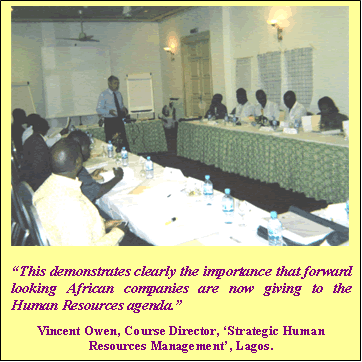
“Transforming HR from Cost to Benefit” was the theme of the recent training programme held in Lagos to address the importance of the Human Resources professional in business development.  The course marked the first joint project between Interims for Development and Regal Exchange and Associates and brought together 20 senior managers and HR Directors from major corporations and organisations across West Africa.

Privatisation of public services, corporate mergers and trade liberalisation across the continent are presenting new and demanding challenges to the traditional role of the HR Manager.  These changes require the HR professional to become a strategic partner involved in the transformation of the enterprise and contributing to company wide issues.  Africa’s private and public sectors need HR professionals today who are able to initiate policy, manage change and ultimately add value.

The two-day training programme entitled ‘Strategic Human Resources Management’ was developed and delivered by Interims for Development to focus on the key issues relating to the perception, image and actuality of HR in today’s businesses.

Image 


Designed to enable participants to review the business and interpersonal competencies that the HR role now requires, the course examined how to build and negotiate new relationships with staff, line and top management and how to communicate the strategic vision of HR to internal and external stakeholders.

The programme also linked business strategy with the compensation, recruitment and performance policies of an organisation.

Delegates were provided with an opportunity to review the key areas of HR activity and learn to develop strategic approaches to managing change, thereby making the HR function an essential partner for organisational success.  

“Africa’s private and public sectors need HR professionals today who are able to initiate policy, manage change and ultimately add value”

For Regal Exchange, specialists in financial services training in Africa, the programme responded to training needs articulated by many of their African clients and offered a longer-term opportunity. 

“By asking Interims for Development to join us to host ‘Strategic Human Resources Management’, we sought to give a more complete solution to the issue of training business professionals; offering delegates and their organisations not just the direct benefits of the course itself, but also the continuing benefits available through the services offered by Interims”, says Bayo Jide, Regal Exchange’s Head of Business Development for Africa. “Delegate response to this more holistic approach has been positive and we hope to be able to continue to offer the expertise of Interims in this field as an additional benefit to our portfolio.”

Vincent Owen, the Course Director and Senior Consultant for Interims for Development, led participants through an intense 2-day programme that challenged the administrative bias traditionally directed at the Human Resources department in Africa. 

“I was delighted to see so many participants from different kinds of businesses attending the programme, not only from Nigeria but also from Ghana and Sierra Leone”, says Owen, who has developed and delivered programmes for Interims across Western and Central Africa. “I think this demonstrates clearly the importance that forward looking African companies are now giving to the Human Resources agenda. It is frequently stated in Annual Reports that people are the greatest asset any company has; it is very encouraging to see that the ability of Human Resources to make a strategic contribution to the future success of companies is now being recognised”.

For further information about Human Resources Management training and services:
http://www.interimsfd.com/html/human_resources.html

contact Interims for Development :
+ 44 (0) 20 8200 2373

ImageManaging employees that work in a different country or culture can be a challenge in its own right, but when the country or region is in a state of conflict, the challenge is all the more daunting.
Ensuring that your employees have the skills to sensitively manage employment and community relations is critical as hasty or uninformed decision-making can have a negative and high-risk impact on both the employee’s and the company’s reputation.Farnham Castle,
one of the leading providers of intercultural training, has launched a 2-day workshop to assist companies in delivering their duty of care to employees working in high risk areas.  The course, which was developed in partnership with Kroll, an independent risk consulting company, is designed to help companies reduce their exposure to global threats and protect their employees and assets.

Client Services Director, Jeff Toms, is responsible for the management and development of Farnham Castle’s Intercultural Training business.  In this role, he has been primarily responsible for the creation of the broadest portfolio of intercultural support programmes on offer anywhere.  With his prior experience as a Board Director with a number of leading UK and International Marketing agencies and his experience of living overseas, Jeff Toms is an acknowledged expert in his field.  ReConnect Africa spoke to Toms about his company’s new initiative.

RCA:  Jeff, Farnham Castle is well known for its intercultural training.  What was the prime factor behind developing the Doing Business in Conflict Risk Countries programme?

JT: Our regular briefings on “more challenging” destinations include information and discussion on the basic practical aspects of keeping the individuals involved, safe and well. In discussion with a number of clients, many of whom are in the extractive industries, we identified a need to provide a more in-depth briefing and discussion for destinations where there was a clearly identifiable higher level of risk. We therefore got together with one of the world’s leading independent risk consulting companies specialising in helping clients reduce their exposure to global threats, to develop a unique combination of country briefing supported by specific target country conflict risk advice.  

RCA:    So what can a programme like this cover in 2 days?

JT: The objective of this programme is to equip individuals with the necessary cultural awareness and understanding of the area of operation. It also provides the tools to assist individuals to define and operate a safe and practical personal security environment. Day one of the programme provides an overview of the underlying attitudes of the people of the particular region or country, a thorough understanding of the social and business culture and an in-depth introduction to conducting business in the target region and country. Day two of the programme focuses on the avoidance and sound management of conflict situations. These can cover a broad range of issues such as bribery, compensation, human rights, security and travel health. 

RCA:    What is the nature of risks that some of your clients are experiencing when it comes to Africa?

JT: In the extreme, the issues faced by companies operating in high risk areas range from kidnapping, bribery to theft of confidential and sensitive information. The other key area revolves around socio-political issues; situations where the conduct of the client’s business has an impact (positive and negative) on the political and social structure of the district and country of operation. 

“In an increasingly unstable world, companies need to invest in briefing and cross-cultural training for all international employees.”

RCA:    Jeff, you are a leading figure in the cross-cultural sector and you contribute regularly to presentations and discussions on many aspects of this industry. In your experience, how well do companies address cultural training for employees and business people working in high risk areas?

JT: Our experience shows that the support provided by companies is varied. It is a difficult balance between providing sufficient information and advice to ensure the safety of the individuals involved and the efficient and profitable conduct of business. Of course, many of the organisations have corporate policies in place and provide security briefings. However not all provide those briefings in the context of cultural understanding, which provides a foundation on which much of the policy can be implemented and many unnecessary and difficult situations can be avoided in the first place. 

RCA:  Farnham Castle holds the view that in an increasingly competitive global marketplace, the ability to manage cultural differences to competitive advantage has to be a corporate imperative, 'not a nice' to have option.  How well is this message getting across to multinational companies?

JT: Although cultural understanding is currently high on the agenda and will remain so for the foreseeable future, too few companies still do not afford it the priority and investment it requires. Whilst heavily sponsored in HR and Training departments, more often than not the budgets lie with line Directors and Managers, who see the provision of briefing and training as an avoidable cost rather than an investment inincreased security for employees, improved probability of long-term success and diminished impact on the bottom line!

RCA:    Providing a duty of care is implicit in the employment relationship.  What benefits do you see the kind of training offered by Farnham Castle in upholding this duty?

JT: In an increasingly unstable world, companies need to invest in briefing and cross-cultural training for all international employees. The benefits to the company are numerous and the moral argument to provide duty of care to individuals being sent abroad and their families is indisputable. There are an increasing number of reasons why employees no longer readily accept an overseas posting, a major factor being the safety and security of the family members. Providing an in-depth briefing provides confidence and assurance to all participants and allows them to settle quickly and effectively in their new roles. This allows the assigned individual to get on with the task without unnecessary distraction. Importantly it lessens the possibility of an assignment failure with all the associated human and monetary costs. 

For further details about Farnham Castle and the Doing Business in Conflict Risk Countries Programme, contact Jeff Toms at jtoms@farnhamcastle.com

Welcome to the new, upgraded ReConnect Africa website.
Please help us provide you with information relevant to your needs by completing the fields below (just this once!)