 How Sierra Leone's Diaspora is promoting Investment for the country's development
Sierra Leone today is open for business. With enormous potential across sectors including tourism, mineral resources, fisheries and agriculture, investing in the country also offers a link to the wider market of West Africa and the 225 million inhabitants of the Economic Community of West African States (ECOWAS). However, for potential investors - including non-resident nationals of Sierra Leone - gaining access to information and advice about investment opportunities within the country can be difficult.
The Sierra Leone Investment Information Portal (SLIIP) was developed to address the lack of cohesive Diaspora-specific investment information on Sierra Leone. An initiative of the Sierra Leone Diaspora Network (SLDN), SLIIP was borne out of a series of consultative forums held by Diaspora in the UK in 2005 and in Sierra Leone in 2006.
ReConnect Africa spoke to Georgina Awoonor-Gordon, Programmes Manager of SLIIP, to learn more about the organization and what it is aiming to achieve for the country.
RCA: What factors influenced the SLDN to create the Sierra Leone Investment Information Portal (SLIIP)?
G A-G: Sierra Leoneans have long been major investors in Sierra Leone, but this has been largely on an informal basis. The first Sierra Leone Investment Forum in the UK in June 2005 posed the question of the role of the Diaspora in Sierra Leone's development.
"The main challenge for us over the last few years has remained the perception that Sierra Leone is still engulfed in war."
One of the constraints to investment in Sierra Leone, as highlighted by the delegates, was the lack of Diaspora specific investment information. Further consultation sessions also pointed to the need for a 'one stop shop' that provided information on investment opportunities.
In short www.sliip.org was launched to provide information that was at the time, unavailable through other sources. The information provided is focused on business, policies and regulations that relate to the various sectors, employment and consultancy opportunities in Sierra Leone.
RCA: How do you reach out to Sierra Leoneans in the Diaspora with investment advice?
G A-G: SLIIP is an online portal so is open to the Diaspora and all investors all over the world. Regular bulletins and newsletters are sent out to our database and posted on various networks.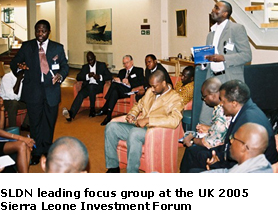 One of our objectives is to form sector specific working groups (based on interest and skills) in order to encourage active participation in investment back home. These working groups are then charged with formulating action plans for sustainable investment within the various sectors.
SLDN works closely with the Sierra Leone High Commission and other groups and individuals. After various consultative meetings, two areas for intervention and investment were identified, namely Agriculture and Health. Until a governing body is elected, these working groups are led by SLDN Steering Committee specialists.
Based on a number of enquiries to SLIIP, another group has been formed which will focus on Alternative / Renewable Energy investment in Sierra Leone.
RCA: What are some of the perceptions that challenge your efforts to market Sierra Leone as an investment destination?
 G A-G: The main challenge for us over the last few years has remained the perception that Sierra Leone is still engulfed in war, or in some level of civil and political unrest. This is a perception that has affected Sierra Leone on so many different levels, and one which we, along with other individuals and organisations, are very keen to reverse. The term 'Re-branding Sierra Leone' has now become a buzz word for many Sierra Leoneans in the Diaspora.
Another challenge is the unfortunate reputation of corruption. Related to this are the reports of the various complications encountered when trying to set up a business in Sierra Leone. We are happy to say that the Government of Sierra Leone (past and present), in collaboration with other NGOs, most notably DFID, have worked hard over the last few years to reverse these barriers to investment. This has resulted in an official announcement in February this year, outlining a reduction of the administrative steps to setting up a business. Of course, the process of effecting these changes in still in its infancy, but we are hopeful that this signals a positive and encouraging step for potential investors.
RCA: What are some of the initiatives and projects that SLIIP is involved in?
G A-G: SLDN currently acts as the coordinating body for the sector-specific working groups mentioned earlier. On a day to day basis, SLIIP welcomes enquiries about investing in Sierra Leone. We are keen to link people and networks together with the aim of creating a bigger impact. We have had requests for information from as far as Singapore, and we have managed to link this source with a women's agricultural community based organization in Sierra Leone.
"The first step to making any investment is 'Research', and this is where the information provided on SLIIP proves important; be aware of the policies and regulations that govern your sector of interest."
SLIIP holds an 'Announcements' section where clients can upload various consultancy and project details. As well as our very popular job vacancies section, another major project for us is the collation of a skills database of Sierra Leoneans. This database will highlight the wealth of intellectual and entrepreneurial resource that can be found within our nation, both at home and in the Diaspora. The potential of such a resource cannot be overstated as it would mean that one can tap into skilled Sierra Leoneans across various disciplines all around the world.
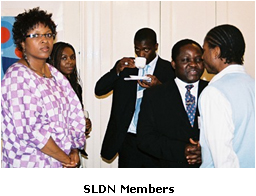 It is important to understand that SLIIP is a portal of information and a 'signposting' vehicle to other relevant organizations and individuals, with the main aim of boosting economic growth in Sierra Leone. We are keen to complement the work of other investment and developmental organizations such as the Sierra Leone Business Forum (SLBF), whose mission it is to support Private Sector Development (PSD) in Sierra Leone. SLDN will be hosting an event on PSD and Relocation to Sierra Leone in May, in collaboration with the SLBF and the newly opened Office of the Diaspora. Please visit www.sliip.org for more information.
RCA: What are your future plans for organisation and for getting your message out to a wider audience?
G A-G: It is all about 'promotion, promotion, promotion' for SLIIP at the moment. Our main aim for the future is to continue to produce reliable and quality information so that we can acquire a bigger client base by building upon our brand.
We are also keen to develop strategic partnerships with relevant organisations, again as a way to promoting collective action. For example, SLIIP will work with Sierra Leone Television (SLTV), aired on BEN TV (Sky Channel 194). This partnership will provide an opportunity for SLIIP to highlight the work being done on a global level to support socio-economic development in Sierra Leone.
SLDN will continue to work with the Government of Sierra Leone, making recommendations for improvements in policies and regulations across the various sectors, as necessary.
"Our main aim for the future is to continue to produce reliable and quality information so that we can acquire a bigger client base by building upon our brand."
We have an Outreach Officer who is charged with the responsibility of visiting various Diaspora organisations nationally and internationally to promote the work of SLDN and SLIIP's services.
RCA: What advice can you offer to potential investors from the Diaspora?
G A-G: My top five tips for Diaspora investment are:
- The first step to making any investment is 'Research', and this is where the information provided on SLIIP proves important; be aware of the policies and regulations that govern your sector of interest;
- 'On the ground' research is of course, vital. It is surprising how many people embark upon projects in Sierra Leone without a proper business plan (including a budget);
- Join a network like SLDN, where potential investors can network and share and exchange ideas and experiences;
- Be open to forming partnership(s).
- Look beyond the capital, Freetown, for viable investment opportunities
For further information on SLIIP and the Sierra Leone Diaspora Network (SLDN): www.sldn.org.uk www.sliip.org




 ReConnect Africa is a unique website and online magazine for the African professional in the Diaspora. Packed with
essential information about careers, business and jobs, ReConnect Africa keeps you connected to the best of Africa.
ReConnect Africa is a unique website and online magazine for the African professional in the Diaspora. Packed with
essential information about careers, business and jobs, ReConnect Africa keeps you connected to the best of Africa.












.jpg)

 In May 2006 we launched ReConnect Africa.com as the ‘go to’ place for professionals of African origin overseas


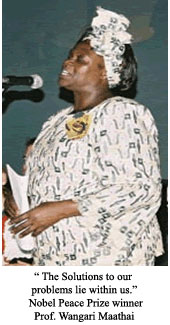 Arriving to a standing ovation, the keynote speaker for the event, Professor Wangari Maathai, Assistant Minister for Environment and Natural Resources in Kenya and 2004 Nobel Peace Prize winner, expressed her delight at the commitment of Africans in the Diaspora to the economic and social development of Africa. While acknowledging the efforts of the musicians campaigning in London’s Hyde Park, she urged the Africans present to remain focused on what they are already doing.
 Financial resources are not the only options on offer and a number of Africans in the diaspora would also like to offer human resources to support African development. For many who want to share their skills within Africa, a combination of ineffective structures and systems as well as negative attitudes on the ground, often prove a major obstacle.
 "We are starting with the skills mission and this mission is allowing the diaspora to take time to share their skills, either in their country of origin or from a pan African perspective, to empower local grass roots entrepreneurs," she explains.