
Connecting Africa’s Skilled Professionals

 ReConnect Africa is a unique website and online magazine for the African professional in the Diaspora. Packed with
essential information about careers, business and jobs, ReConnect Africa keeps you connected to the best of Africa.
ReConnect Africa is a unique website and online magazine for the African professional in the Diaspora. Packed with
essential information about careers, business and jobs, ReConnect Africa keeps you connected to the best of Africa.













.jpg)

 In May 2006 we launched ReConnect Africa.com as the ‘go to’ place for professionals of African origin overseas

Innovative thinking about employment is top of the agenda of every African leader says a report from the African Development Bank.
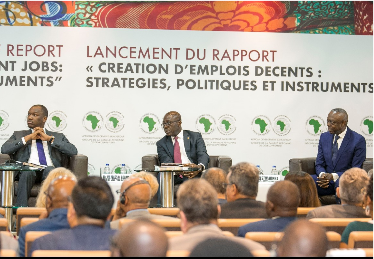
The African Development Bank has presented its new policy research report Creating Decent Jobs: Strategies,Policies and Instruments at a launch at its headquarters attended by senior management, diplomats, staff, and media representatives.
The report brings together some of the world’s leading labour and development economists to provide specific policy recommendations for creating decent jobs. It highlights how manufacturing provides more long-term economic benefits than other activities by generating economies of scale and encouraging industrial and technological upgrading, fostering innovation and creating multiplier effects. The report also sheds light on the role of prudent macroeconomic policies and shows how best to use special economic zones, industrial parks, agro-processing zones, skill enhancement zones, and apprenticeship and incubation programmes.
Innovative Thinking on Employment
Africa will become the youngest and most populous continent in the next few decades.Its labour force will rise from 620 million in 2013 to nearly 2 billion in 2063. To accommodate its high rate of population growth, it will have to generate between 12 million and 15 million jobs annually. That means 1.7 million jobs should be added monthly across the continent. Africa is nowhere near that number.
The event featured a presentation of the report, a panel discussion on key themes of the report, and a Q&A session that elicited lively debate.
Introducing the report, Celestin Monga, the Bank’s Chief Economist, remarked that part of its appeal was in applying innovative thinking to conventional employment issues. For example, one problem identified was that domestic economic progress was often assessed by the allocation of public funding to priority sectors or by analysing the number of reforms carried out to improve the business environment. In this context, he observed that several of the world’s top-performing countries had low rankings for the ease of doing business.
Monga also remarked that the official unemployment figures of many African countries were so unrealistically low that policymakers found it difficult to explain how demand for labour in markets was so buoyant. Africa was also the world region with the highest proportion of its workforce in vulnerable employment, which served to hide rather than clarify the essential issue of employment in Africa. A new model for measuring employment that related to actual conditions in Africa was needed, he said. The report should also be considered a manifesto for African jobs.
Finally, he praised the painstaking work of his co-editors, and particularly recommended a focus paper written by Andinet Woldemichael, principal research economist, entitled “The Missing Women in African Labor Markets” in the report.
The Bank’s Senior Vice President Charles Boamah introduced the issue of employment as being “at the top of the agenda of every African leader”, and said that the report was “the first of its kind in challenging and unveiling some of the misconceptions that many experts have about the nature of under-employment and unemployment in Africa.
“The start of some fresh thinking about the nature of employment creation on the continent and clarifies which development strategies and policy interventions are needed.”
“The report signals the start of some fresh thinking about the nature of employment creation on the continent and clarifies which development strategies and policy interventions are needed for low-income countries in Africa”, Boamah said. He went on to predict that the report would “serve as a reference document on employment in Africa for some years to come”.
Jobless Growth is Africa’s Most Serious Concern
In the face of rapidly growing populations and heightened risks of social unrest or discontent, jobless growth was the most serious concern for African policymakers, said Abebe Shimeles, manager in the Chief Economist’s complex, who spoke on the highlights of the report. “One problem”, he added, “was already well known - that employment and unemployment needed to be more closely defined in their relative context, a task that had already caused difficulties in other development finance institutions. Traditional labour market economists were not capable of accurately defining the particular African employment phenomenon”. In addition, he pointed out that the status of the ministries of work or labour in many African countries was often not important enough to be considered as a critical policy sector, reflecting the low priority given to making a serious difference to the continental employment challenge facing all the African countries.
Following questions from the audience, a small panel briefly discussed the overall issue presented by the report. This session of reflections featured Ivorian minister of Youth Promotion and Employment Mamadou Toure from the government of Cote d’Ivoire who drew attention to the interconnections that exist around the issue of jobs. “This cannot be resolved on its own, and certainly not without considering carefully other related aspects, such as skills, education, training, enterprise and social services” he said.
Professor Tchetche N’Guessan, of the University of Felix Houphouet-Boigny, Cocody, Cote d’Ivoire; and Mr Freddy Tchala, CEO of MTN in Cote d’Ivoire also spoke, discussing different aspects of employment, education, training, skills and government measures for the promotion of youth entrepreneurs.
Further details and the report can be found at: African Development Bank