


Connecting Africa’s Skilled Professionals

 ReConnect Africa is a unique website and online magazine for the African professional in the Diaspora. Packed with
essential information about careers, business and jobs, ReConnect Africa keeps you connected to the best of Africa.
ReConnect Africa is a unique website and online magazine for the African professional in the Diaspora. Packed with
essential information about careers, business and jobs, ReConnect Africa keeps you connected to the best of Africa.













.jpg)

 In May 2006 we launched ReConnect Africa.com as the ‘go to’ place for professionals of African origin overseas

 Collison Lore explores the impact of social media on doing business in Uganda
Uganda's economy has been evolving rapidly; in the 1980s and 1990s marketing teams relied on the traditional cold calling canvassing techniques. With the emergence of ICT however, a new caliber of marketers is emerging in Uganda. Today, social media and marketing are literally joined at the hip.
The best way to define social media in the context of Uganda is to break it down. Media is an instrument of communication, like a newspaper or a radio. Today Uganda has three daily English newspapers, more than ten television stations and hundreds of FM stations dotted around the country. From the perspective of Uganda, therefore, social media would be a social instrument of communication, just like the others outlined. The only crucial difference is that social media is a unique communication instrument.
The increasing number of Ugandan consumers of key social media channels such as Facebook makes it a tremendously valuable business tool. Today, instead of companies posting their URLs on television commercials, they're requesting their fans to join them on Facebook. Car sales in Uganda have moved into Facebook, since both buyers and sellers appreciate the power of social media.
It is essential to review the potential of Facebook for business in Uganda, while appraising the various options corporate organizations have, in order to be effective with Facebook business marketing. For example, a Profile Page versus Fan Page? Most marketing firms appreciate that the average Facebook user uses Facebook not for business but for personal communications. This has led to an upsurge in the creation of Fan Pages in Uganda.
Most businesses in Uganda that utilise pages focus on using titles that are memorable because they are cognizant of the fact that they won't be able to change it later. It's preferable to reflect their business and use a business name, not a funny character or other business persona that local clients can relate to.
They understand that clients will be seeking their business on Facebook, so they make it easy for the clients to find them. Those that have 25 fans (of which the numbers are growing) set up usernames which makes accessing their profiles a lot easier. Marketers now apply the username to their Facebook Pages, not their personal profile, and they mostly use something memorable that clients can find by plugging in the URL.
Despite the strides made in bringing Ugandan businesses to Facebook, a number of gaps are clearly noticeable. Most organizations seem to stop at establishing their pages and they fail to customize their pages. This they can easily do through uploading a photo of their logo or favourite product. Filling out the relevant details about the organization is another important step that is often overlooked.
It is important to tell existing and potential clients how to find organizations and give them a history. The clients visit those pages because they want to learn about the organizations! Depending on what type of page the organization is creating, the text fields differ, but they need to utilize what's available to them to their advantage. Organizations should not shy away from giving Uganda's online community the information needed to find them elsewhere, both online and offline.
When creating a Facebook business page in the Uganda market, there are three major areas to pay attention to:
Most corporate organizations in Uganda realize that the Facebook business page offers a great place to interact with existing and potential clients; to set up polls, surveys, and even contests. There are a lot of strategies that Ugandan businesses can use to get their prospective customers and current customers to interact with their businesses.
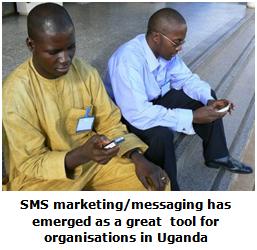
SMS marketing/messaging has emerged as a great tool for organizations. It is one of the fastest growing niches of social media in Uganda. This tool is not only rewarding, but demands less investment and cost. One such technique is to communicate with clients and potential clients through bulk SMS. This is considered as the most used and appreciated tool and is used by most fast consumer goods driven organizations. With this great technique, entities are able to target larger groups of people at the cost of one.
Apart from being a reliable marketing technique, bulk SMS also provides quick accessibility to individuals. Organizations require a source with which consumers can be reached in quickest possible way, so a great way to inform the public about the products of an organization and to reduce overhead and marketing expenses, is to send bulk SMS. In addition to this, it also helps in reaching out to people in shortest time possible.
Sending voice SMS is another innovative communication technique currently being used extensively in Uganda. With this approach, identified people can be sent voice messages which they are able to listen to on mobile phones. After listening to the full message, individuals can make a decision accordingly.
It is really difficult to get individuals attracted to a particular commodity and, for this reason, it requires lots of creative potential and convincing power in a message. SMS techniques have become highly important. Organizations should hire bulk SMS resellers as carrying out such an activity is simple but involves a lot of time. However, like any good thing if it is overused the impact reduces considerably.
With the entry of social media, marketing in Uganda is increasingly getting more innovative. This affords business players in the Diaspora with an opportunity to use these tools and more in ensuring that any businesses that they introduce create the desired positive buzz in Uganda's market.



