


Connecting Africa’s Skilled Professionals

 ReConnect Africa is a unique website and online magazine for the African professional in the Diaspora. Packed with
essential information about careers, business and jobs, ReConnect Africa keeps you connected to the best of Africa.
ReConnect Africa is a unique website and online magazine for the African professional in the Diaspora. Packed with
essential information about careers, business and jobs, ReConnect Africa keeps you connected to the best of Africa.













.jpg)

 In May 2006 we launched ReConnect Africa.com as the ‘go to’ place for professionals of African origin overseas

 To be sustainable, says Landé Belo, businesses operating in Africa must convert Africa’s vast human capital into a skilled workforce.
“A company is only as good as the people it keeps.” I wish I could claim ownership of this pithy statement, but alas, Mary Kay Ash got there before me and, since then, countless others have also given their variation of the same theme.
The underlying principle is the same: ‘staff’ is absolutely fundamental to the success of a business. ‘Staff’ also happens to be one of the biggest outlays for most businesses. Therefore, there has to be a balancing act of investing in the right people and keeping within the bottom line, and this can be a major challenge for businesses operating in Africa.
Many African economies have achieved growth rates which would turn the heads of any EU Chancellor (and might earn them a knighthood in the bargain!). Unfortunately, impressive growth has not translated into job creation for the domestic labour workforce, with unemployment rates as high as 25% in some African countries.
South Africa, forecast to achieve 1.9% growth in 2013 (Patrick McGroarty, Wall Street Journal, 21 November 2013), has an unemployment rate of 24.7%, including the highest youth unemployment rate in Africa. Nigeria has an increasing youth population; however, according to its National Bureau of Statistics, 54% of these youths are unemployed. Yet Nigerian businesses are complaining that they can’t get the staff!
Many companies have responded to this challenge by turning to the overseas markets, paying astronomical salaries to expats who eventually return home taking their expertise with them. One has to query whether this is a sustainable long-term strategy.
A long-term approach has to be adopted. Businesses should invest in staff training; a skilled and experienced workforce will not be created overnight. Developed economies have all faced the same problems, the main difference being that they have experienced industrial revolutions and have had several decades to get things right (and still don’t always get things right), whereas African countries have to cover a lot of ground quickly in order to catch up.
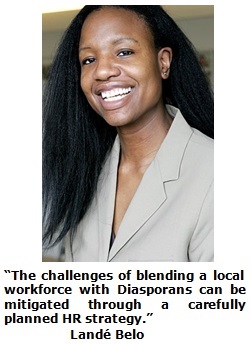
Recruitment of expats is costly and should be applied in a strategic way; whereby the function of expats is to train the local staff, so that the local staff will eventually replace the expats in key roles (think Malaysia post-independence). A valuable resource is the so-called Diaspora market. Challenges faced by businesses blending a local workforce with Diasporans can be mitigated through a carefully planned HR strategy, which capitalises on the value add that both groups would bring to the business.
Of paramount importance is a business’s management style. Authoritarian leadership with minimal employee participation is quite common across Africa; however, leadership that is too draconian could demoralise and demotivate the workforce, rendering it unproductive and inefficient. A balance must be found between delivering results and maintaining good staff relations.
Managing a workforce of mixed abilities is a common challenge for African businesses, which is why a management style adapted to the person being managed and not the other way round will be more effective. Employee empowerment, engagement and participation may sound unrealistic and unworkable in the African business context. However, they are much more than ideals and are necessary for businesses to get the best out their staff. Without the staff, the company is nothing.



