


Connecting Africa’s Skilled Professionals

 ReConnect Africa is a unique website and online magazine for the African professional in the Diaspora. Packed with
essential information about careers, business and jobs, ReConnect Africa keeps you connected to the best of Africa.
ReConnect Africa is a unique website and online magazine for the African professional in the Diaspora. Packed with
essential information about careers, business and jobs, ReConnect Africa keeps you connected to the best of Africa.













.jpg)

 In May 2006 we launched ReConnect Africa.com as the ‘go to’ place for professionals of African origin overseas

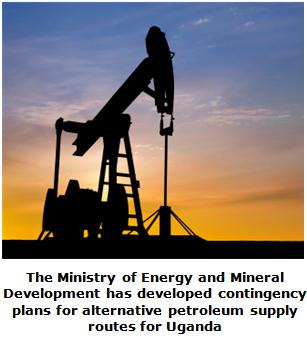 Safeguarding the quality and supply of Uganda's petroleum is critical to the country's development, says Collison Lore
The year 2007 and early 2008 were dark days for Kenya and the East Africa region. Besides the unfortunate loss of lives and the wanton destruction of property, one unexpected negative outcome was clear. The well-established and ever reliable Northern Corridor (the Mombasa, Nairobi, Kampala, Kigali, DR Congo route) suddenly ceased functioning.
Cargo from Mombasa to Kampala stopped flowing altogether and the most important form of supplies was halted abruptly, leading to hardship in the hinterland countries. The shortfall in the supply of petroleum products to landlocked countries like Uganda, Rwanda and the Eastern DR Congo had a significant knock-on effect on Uganda's economy.
Kenya is set for another round of general elections in early 2013. It is assumed largely that the lessons of 2007/08 have been learnt and that the occurrence of that sad episode will be a thing of the past. This notwithstanding, the Ministry of Energy and Mineral Development has developed contingency plans for alternative petroleum supply routes for Uganda in case of challenges such as the 2007/08 occurrence in Kenya. Furthermore, it is only good business practice to have an alternative petroleum products supply route, while making sure supply goes hand in hand with quality.
It is essential that two critical aspects be addressed, these are as follows:
The Petroleum Supply Department is the central player in ensuring these stated two goals and more. The Department under the Ministry of Energy and Mineral Development is mandated to regulate the supply of petroleum products in Uganda. It derives its authority from the Petroleum Supply Act (PSA), 2003 which was enacted to put into operation the downstream petroleum subsector policy objectives, as spelt out in the Energy Policy, of 2002.
The central policy objective of the downstream petroleum subsector is ensuring an adequate, reliable and affordable supply of quality petroleum products for all sectors of the economy at internationally competitive and fair prices within appropriate health, safety and environmental standards. In a number of countries in the region, the challenge of petroleum adulteration has consistently undermined the sector over a long duration of time. The Petroleum Supply Department in Uganda is at the forefront of quality assurance.
The 1990s witnessed Uganda adopting the twin policies of liberalization and privatization of underperforming parastatals. The petroleum supply subsector was consequently deregulated in 1994 to benefit from the key merits of opening up the petroleum market. This was to be through the complete interplay of supply and demand forces. The key priorities areas considered in the downstream petroleum sub-sector presently are: -
The Petroleum Supply Department is undertaking crucial measures to ensure that the setout priorities are achieved. These measures include; securing of dedicated space in the Kenya Pipeline System for Uganda-bound petroleum products, composing an Interim Supply Coordination Committee comprising of industry players and Government to improve supply of petroleum products, promotion of extension of petroleum products' pipeline from Eldoret-Kenya to Kampala-Uganda (this though may require a review in light of Uganda's planned construction of an oil refinery), the approval of a tax re-bate by cabinet on petroleum products imported through the Central Corridor, procurement of a private operator for Jinja storage tanks through international competitive bidding to ensure that the facility serves its purpose.
Other measures include; the initiation and implementation of the fuel marking and quality monitoring program to curb products' adulteration and smuggling, development of petroleum standards for facilities and products including bio-fuels, re-licensing all petroleum operators in the country in accordance with the Petroleum Supply Act, of 2003 and Petroleum Supply Regulations, of 2009, continuous monitoring of the Petroleum supply industry and significantly, training staff in short term and long term courses in downstream related courses.
These measures have yielded positive results and today, over eighty nine companies have been issued with petroleum operating licenses, while more than twenty petroleum construction permits were issued. The department is cognizant of the importance of environmental conservation to this effect, Environmental Impact Statement reports for proposed petroleum facilities have been reviewed and forwarded to National Environmental Authority (NEMA) for approval. It is noteworthy that the department sustained the Fuel Marking and Quality Monitoring programme for product quality. Consequently, petroleum products' quality failure rate has undergone a major reduction over the last two years.
In promoting an alternative route, the Government of Uganda approved at tax re-bate of shs.150 per liter on products through Tanzania. Furthermore, the procurement process of a private partner to operate Jinja storage facilities under Private Public Partnership is making good progress. Indeed, the Ministry of Energy and Mineral Development is working towards the commissioning of a feasibility study on storage and distribution of petroleum products in Uganda.
Despite these major strides, the department faces major drawbacks. It is important to state that the critical challenge in the petroleum supply chain in the region lies in adequate importation, storage, and transportation and distribution infrastructure to cope with rising demand. This, if addressed, would cover for any short term or medium term shortfalls occasioned by factors beyond the hinterland countries' control.
The traditional challenge of resource constraint also features prominently. The petroleum supply subsector is faced with the challenge of insufficient resources for construction of the requisite capacity of petroleum supply department staff. It is also difficult to undertake, concurrent monitoring activities of the industry countrywide, while supporting the development of necessary petroleum related infrastructure.



