


Connecting Africa’s Skilled Professionals

 ReConnect Africa is a unique website and online magazine for the African professional in the Diaspora. Packed with
essential information about careers, business and jobs, ReConnect Africa keeps you connected to the best of Africa.
ReConnect Africa is a unique website and online magazine for the African professional in the Diaspora. Packed with
essential information about careers, business and jobs, ReConnect Africa keeps you connected to the best of Africa.











.jpg)

 In May 2006 we launched ReConnect Africa.com as the ‘go to’ place for professionals of African origin overseas

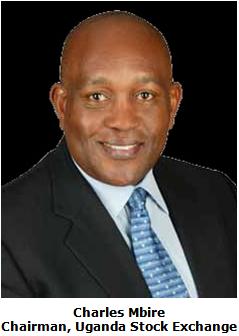 The last two decades have witnessed a pivotal transformation of the Ugandan economy, civil service reform, a divesture programme, and the liberalization of the telecommunication and broadcasting sectors. Uganda was one of the pioneers in liberalization and privatization.
Today, the Bank of Uganda remains one of the most respected central banks in sub-Saharan Africa for its success in keeping markets open, the shilling stable, and inflation contained (with the exception of the second half of 2011).
The opening up of the economy was crowned with the launch of the Uganda Securities Exchange (USE), the primary stock exchange in the country, in June 1997. It functions under the control of Uganda's Capital Markets Authority. A stock exchange is often the most important component of a stock market. Supply and demand in stock markets is driven by various factors that, as in all free markets, affect the price of stocks. This is why the stock exchange and the free market are intertwined.
Market surveillance is central in promoting fair, efficient and transparent operations on the bourse, which in turn goes a long way in fostering investor confidence. As part of the market surveillance role, the Legal Department of the Uganda Securities Exchange has enhanced its onsite inspection instruments and procedures to ensure a robust system of surveillance.
In many regional and international stock exchanges, services for stock brokers and traders to trade stocks, bonds, and other securities are provided. Stock exchanges also provide facilities for issue and redemption of securities and other financial instruments, and capital events including the payment of income and dividends. Securities traded on a stock exchange include shares issued by companies, unit trusts, derivatives, pooled investment products and bonds.
In order to trade a security on a stock exchange, it must be listed there. Usually, there is a central location at least for record keeping, but trade is increasingly less linked to such a physical place, as modern markets are electronic networks, which gives those merits of increased speed and reduced cost of transactions.
The USE commenced trading in 1998, with just one listing, a bond issued by the East African Development Bank. Foreign-owned companies are allowed to trade on the stock exchange subject to some share issuance requirements, and the Kampala exchange contains cross listings of five Kenyan companies: Kenya Airways, East African Breweries, Jubilee Holdings Ltd., Kenyan Commercial Bank, and National Media Group.
The East African Development Bank also lists bonds on the USE. In early 2010, the National Insurance Corporation went through an IPO which was oversubscribed by 33% and is now listed in the USE. National Insurance Corporation is the second insurance firm and the seventh local company to list on the bourse. In 2010, market capitalization of the USE increased by 51% from $3.76 billion to $5.67 billion due to the National Insurance Corporation IPO and the new cross-listing of the National Media Group.
As of June 2011, the USE trades fourteen listed local and East African companies and has started the trading of fixed income instruments.
The Uganda Securities Exchange has consistently reformed its operations to meet the ever changing demands of stakeholders. Some of the reforms include allowing a member to deal in the securities of a listed company to which such member is a subsidiary company. This rule was relaxed on the back of an enhanced inspection regime aimed at curbing and detecting insider dealing and market manipulation. Today, the USE offers preferential treatment for East Africa countries cross listing on the USE by prescribing lower fees for this category in comparison to companies from outside the region. This rule enforces the regional integration objectives of the East African Community.
The year 2010 witnessed a slow recovery in the global financial markets. This, in turn, undermined the speedy return in investor confidence, resulting in a notable shift from equity to the relative safety of fixed income securities. Financial service counters recorded stable activity, while other counters remained unstable or subdued.
2010 saw a gradual rebound in prices across various counters which bottomed out from the all time lows registered during the economic crisis. The price increases experienced throughout the year across the various stocks were a direct effect of supply and demand factors; demand consistently outstripped supply making it a seller's market throughout the year 2010.
Capital markets are open to foreign investors. This makes it even better for Ugandans in the Diaspora. It is important to state from the outset that the Government of Uganda imposes a 15% withholding tax on interest and dividends. Credit is allocated on market terms, but lending to the private sector is relatively limited, and rates are high.
Since 2004, the Bank of Uganda successfully issued two-, three-, five-, and ten-year government bonds. The government hopes that by creating a benchmark yield curve it will encourage private companies to access the debt markets. These longer-term government bonds absorb excess liquidity from the market, and help bring down short-term interest rates. In 2009/2010 fiscal year commercial bank lending to the private sector grew by 25.3%. However, interest rates remain high.
Over the years, the Government of Uganda has progressively continued to issue treasury bonds for purposes of implementing monetary policy. Today the composition of Government debt ranges between short term, medium term and long term borrowing. In 2010, the total stock of treasury bills stood at UGX 1,960 billion whereas Treasury bond stock stood at UGX 1,607 billion accounting for 54.95 percent and 45.05 percent, respectively against the domestic debt strategy desired instrument mix of bills-to-bonds ratio of 40:60.
Some large local businesses are reluctant to list on the stock exchange for fear that the disclosure requirements could expose them to greater tax liabilities. Additionally, some of Uganda's largest firms are family-owned operations reluctant to open up to outsider control. Seven companies currently provide brokerage services, including one American-owned firm, Crested Stocks and Securities.
In efforts to attract SME & MSME listings USE has worked with stakeholders to sensitize Small and Medium Scale Enterprises (SMEs). This is through workshops that mainly focus on opportunities, requirements and benefits of listing on the SME Segment of the USE. This programme is also known as the Alternative Market Segment (AIMS). Close to 20 companies from the SME sector have been sensitized. The USE is a member of the African Stock Exchanges Association. Two new listings are expected by the end of the first quarter of 2012. Participating in the USE is a fascinating prospect for Ugandans in the Diaspora.
Written by Collison Lore, ReConnect Africa Uganda



