


Connecting Africa’s Skilled Professionals

 ReConnect Africa is a unique website and online magazine for the African professional in the Diaspora. Packed with
essential information about careers, business and jobs, ReConnect Africa keeps you connected to the best of Africa.
ReConnect Africa is a unique website and online magazine for the African professional in the Diaspora. Packed with
essential information about careers, business and jobs, ReConnect Africa keeps you connected to the best of Africa.














.jpg)

 In May 2006 we launched ReConnect Africa.com as the ‘go to’ place for professionals of African origin overseas

 Collison Lore reviews the apparel and horticulture sectors in Uganda
Uganda is one of the fastest growing economies and one of the most liberal countries for foreign investment in Africa. Its strategic location near the centre of sub-Saharan Africa presents the country with the ability to become a hub in the East and Central African regions.
This is facilitated by its membership of the EAC, a market of 93 million people, and COMESA, which includes 20 countries and 380 million people and preferential access to the EU through the EBA initiative. A pro-business operating environment, with a government committed to promoting and empowering the private sector, has made Uganda a primary attractor of FDI into Africa.
Modern day investors are a choosy lot; they do not place equal value on all cost and quality factors. A textile mill, for example, might place premium value on locating near a source of raw cotton, while a call center might value access to inexpensive and reliable telecommunications above all else.
Uganda offers unique investment opportunities for key players in apparel and horticulture. This boils down to three factors:
For over twenty years, one third of Uganda was adversely affected by the Lord's Resistance Army insurgency and fertile cotton growing areas lay fallow. Today the war is over and the North of Uganda is open for investment and business. The traditional cotton growing areas of Lango and Acholi are set to begin producing significant quantities of organic cotton and this will contribute to improved livelihoods in the former war torn areas. This will also provide the much needed raw material for the production of apparel for local consumption and export.
The Government of Uganda specifically, and the East Africa Community, generally have embarked on a massive infrastructure improvement programme that covers national roads and regional railways, among a host of other improvements. These improvements will ease the transport of equipment, raw materials and finished products within Uganda and beyond.
Uganda's climate is favourable for not only cotton but also horticulture production. Through the Uganda Flower Exporters Association (UFEA), the government and donors have acknowledged the importance of export led growth for the Ugandan economy, through strengthening of non-traditional agricultural export projects and have agreed to continue supporting the industry primarily in the areas of policy, research and training.
The rapid growth of floriculture offers opportunities for investment in horticulture and other areas such as the production of propagation materials, manufacture of packaging materials, establishment of soil analysis laboratories and services and, significantly, the manufacture of greenhouse plastics. It is evident therefore that the climate will play a significant role in supporting the cotton and horticulture sectors respectively.
During the last two decades, trade in apparel has grown significantly and developing countries have made a considerable contribution to this growth. In this period, apparel exports from developing countries increased sevenfold. According to UNCTAD, developing countries accounted for 76 percent of total world clothing exports in 2003, compared with a 1985 figure of only 8 percent.
Most apparel investors in Uganda are local entrepreneurs that manufacture clothing and uniforms for the local and regional East African markets. Many have considered or tried to take advantage of AGOA, but have not found it to be profitable, unlike the markets they already serve. Within Uganda, companies prefer to locate in serviced industrial areas with utilities, garbage collection, and road networks, or in buildings previously occupied by industrial tenants. Fabrics are sourced from both local textile operations and Asian importers.
Traditional African printed apparel are also a niche market that could be targeted. Uganda possesses a good supply of cotton and growth in the textile industry shows that there remains a potential for the development of value-added apparel products.
The horticulture sector is defined as the production and marketing of highly perishable products destined for fresh consumption, with relatively high-value per unit. Average annual worldwide production and trade in horticultural goods (fresh fruits, leguminous vegetables, cut flowers, nuts, and spices) have grown steadily. Production has risen steadily in most regions of the world, with an increasing share of this production growth occurring in developing countries.
Among developing regions, Africa has shown relatively higher growth not only in the export growth of fruits and vegetables, but also in terms of the share of fruits and vegetables in the region's total agricultural exports.
In Uganda, horticulture exports have become a bright spot with vegetable and fruit exports now ranking first in total sub-Saharan Africa agricultural exports. A number of other countries across Africa have moved aggressively in recent years in efforts to duplicate Kenya's success story and several have achieved some notable success in diversifying their production and accessing export markets. Uganda is one such country.
In export markets such as Europe, North America and Canada, supermarkets are increasingly playing an important role in the horticulture industry, particularly in the retail of fruits and vegetables. This trend, combined with the increased concern for food safety issues, is the force shaping the new supply chain structure in the horticulture sector.
For potential investors, in addition to the climatic requirements, good logistics are critical in order to comply with just-in-time-and-shape delivery required by buyers. Equally important is the availability of inputs such as pesticides, fertilizers, and packaging materials. Market access questions will be determined by the ability to comply with trade standards rather than tariff levels.
Horticulture in Uganda has a short but successful history. Floriculture itself is still a fairly new industry and began in 1993. Most growers in Uganda export to wholesale markets in the Netherlands or the UK.
Air transport is utilized to transport 90 percent of Uganda's horticultural exports. Ugandan horticulture firms typically hire foreign agronomists from the Netherlands, South Africa, or other countries in order to increase the efficiency of farming techniques, especially on out-grower farms.
Currently, there are over 170 hectares of greenhouses that are producing flowers and about 15 companies producing roses. All roses are grown by large scale commercial farms that have made significant investments.
The horticulture industry is small, but has good potential considering the climate and abundance of water in the country. It currently consists of bananas, passion fruit, pineapple, watermelon, hot peppers, okra, chilli and beans. Opportunities also exist to supply the local population and for tourism. There is a great deal of interest in horticulture from the international donor community.
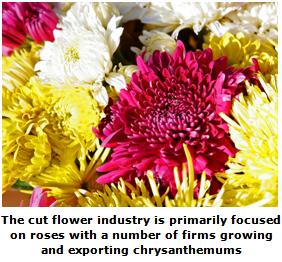
The cut flower industry is primarily focused on roses with a number of firms growing and exporting chrysanthemums. The three major varieties of roses currently promoted in Uganda include: sweethearts, T-hybrids and floribundas, though 27 varieties are being commercially grown. The horticulture industry is small, but has good potential considering the favourable climate and abundance of water in the country.
Uganda currently grows bananas, passion fruit, pineapple, watermelon, hot peppers, okra, chilli and beans. Opportunities also exist to supply hotels. A recent study shows that Ugandan suppliers of vegetables and tourism operators receive a large amount of their fruits and vegetables locally. This offers a great opportunity for investment in a rapidly growing sector of Uganda's economy.
Written by Collison Lore, ReConnect Africa Uganda



