


Connecting Africa’s Skilled Professionals

 ReConnect Africa is a unique website and online magazine for the African professional in the Diaspora. Packed with
essential information about careers, business and jobs, ReConnect Africa keeps you connected to the best of Africa.
ReConnect Africa is a unique website and online magazine for the African professional in the Diaspora. Packed with
essential information about careers, business and jobs, ReConnect Africa keeps you connected to the best of Africa.













.jpg)

 In May 2006 we launched ReConnect Africa.com as the ‘go to’ place for professionals of African origin overseas

 The investment opportunities in Uganda have grown rapidly since the twin processes of privatization and liberalization were adopted in the mid 1990s.
This was buttressed by the divesture programme instituted by the state and implemented by the Privatization Unit. Liberalization of current and capital accounts, removal of export taxes, replacing state monopolies with free markets, removal of price controls and ending controls on interest rates. Between the first and the second half of the 1990s, Uganda reported the fourth largest improvement in its FDI position, and the 11th largest inflows, in Africa.
Today, as a result of consistent pursuance of market friendly policies, investment opportunities abound. Uganda has a wealth of investment prospects, in real estate, tourism, agriculture, fisheries, forestry, manufacturing and IT.
Uganda's strategic location in the heart of Africa gives the country a distinct advantage. The country's market of 24.7million gives investors a head start, while being a leading member of the East African Community's Common Market allows access to a whopping 120 million market. Investors looking beyond East Africa and the Great Lakes Region can eye COMESA's -20member countries-380 million markets, from a vantage point of a business friendly environment offered by Uganda.
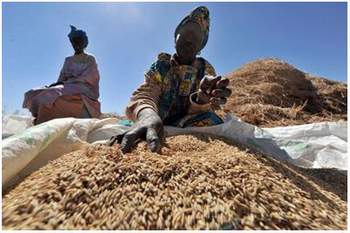
Agriculture and agro-industry Uganda's economy is dominated by agriculture. It accounts for 41% of GDP and 85% of exports, and employs 80% of the workforce. Agriculture provides most of the raw materials for the agro based industries (coffee hulling, cotton ginning, tea processing, grain milling, sugar production, textile factories, etc). Agriculture is dominated by about three million smallholders. Only tea and sugar cane are grown on large estates. Food crops account for 71% of agricultural GDP, while livestock products account for 17%, export crops 5%, fisheries 4% and forestry 3%. Only one third of the food crop produced is marketed compared with two thirds of the livestock. About 42% of agricultural GDP consists of subsistence crops for domestic consumption and is non-monetized.
In recent years, largely in response to liberalization measures, new products have gained economic importance. These include cut flowers, fruits, vegetables and spices, which are increasingly being produced for export markets. Private investment is encouraged in all areas of agricultural production and processing. Such investment can be very rewarding.
Why invest in agriculture?
Investment opportunities in this sector range from forestry to food-processing and the manufacture of inputs. Specific agriculture-related industries with attractive opportunities include food products and oil seeds, fruits and vegetables, floriculture, fish and fish products, livestock and dairy products, and commercial coffee and tea farming.
In the 1990s, Uganda was the first country in the Great Lakes region and East Africa to appreciate the importance of ICT. In this regard, the Government's liberalization and privatization policies led to the entry of mobile telephony and the spread of FM stations. Today Uganda has a strong base for ICT as a result of the policies adopted.
The vibrant mobile telephony sector has key international players such as Airtel, MTN, Warid, UTL among others. This vibrancy has led to the emergence of industries that support the telecommunications industry. Investment in these areas offers premium returns to current and future entrants.
In human resources development, Makerere University Kampala has led a host of other government and private institutions in training manpower for key services such as outsourcing and telecommunication engineering.
Today graduates of Makerere University and other institutions in the country are at the forefront of quality professional services to the ICT sector in Uganda, including the design of computer applications that are supporting key sectors of the economy.
Areas of Investment
The outline below offers an insight into areas of investment in Uganda's ICT sector.
Why Invest in ICT?
Uganda's Information and Communication Technology (ICT) sector is one of the most vibrant within the region, as good legal and regulatory frameworks exist. The newly developed and highly qualitative ICT infrastructure is also ready to accommodate more future investments. Opportunities in ICT include establishment of information and communication infrastructure and broadband services, business process outsourcing services, computer and related equipment hardware assembly, high level ICT training facilities on international standards, ICT business services incubation, hardware repair training facilities, software development niches, setting up information technology virtual zones (ITVZ), and setting up Internet service provider facilities in other parts of Uganda.
Over the years, Uganda's travel and tourism has basically been focused on wildlife, especially on the promotion of gorillas. The industry has become a major foreign exchange earner thanks to gorilla trekking, which attracts a large number of tourists each year to the country.
The rapidly changing nature of tourism trends and behavior however has made the Ugandan government and stakeholders look for ways to diversify its tourist products through advocating alternative forms of tourism. Tourism diversification is expected to further boost travel and tourism revenue and also strengthen Uganda's economy. This is where opportunities for investment abound.
Uganda for instance is diversifying its attractions to include amongst others avitourism. The country is urging investors to focus on this potentially lucrative area owing to the wide variety of bird species and water sports both on the Nile and Lake Victoria. New circuits that involve both geo and eco tourism have been developed to further enhance Uganda as a competitive tourist destination.
Areas of Investment
Why Invest in Tourism?
The versatility of Uganda's tourism sector has had far reaching consequences for the private sector hotel owners too, since the Government of Uganda has divested from most of the hotel industry. The public sector however is focusing increasingly on policy guidelines and regulatory functions.
The Sheraton Group, Serena Group of Hotels, Mada Group, the Imperial Group, the Speke Group and soon to be unveiled Hilton group are some of the key investors in the hospitality industry. Other players include regional and international tour and travel companies.
Uganda's rapidly expanding economy has faced the critical challenge of power. The generation of electricity is an integral part of economic development and industrialization. Uganda's energy sector faces the key challenge of being unable to meet demand. This deficit has been growing at an average of 8 percent annually.
The Government of Uganda is cognizant of this fact and has formulated a Power Sector Strategic Plan with a mission to strengthen and enlarge the power sector so that it is able to provide adequate and reliable energy to meet the country's growing social economic needs. The deficit in the power sector is also being addressed in line with international and national environmental concern.
Uganda appreciates the importance of generating clean energy to cap on emissions of green house gases and hence curb its effect on the environment. This presents potential investors with an array of opportunities.
Clean Development Mechanism
Clean Development Mechanism (CDM)–The global purpose of the 10 year ERT programme is to contribute to global environment protection by reducing GHG emissions–It will benefit from the Global Environment Facility and the Prototype Carbon Fund
The proposed investment opportunities in the energy sector include undertaking one or a combination of the following:
Market for biogas
Uganda's population is estimated at 30 million people and is growing at a rate of 3.5 percent per annum. Most of the population is educated and economically active. This is a sizable market to depend on. The Ugandan economy has been one of the fastest growing economies in Africa, at an average rate of 6.4 percent for the last eight years. The potential for private sector participation in the provision of these services is quite significant in both rural and urban electrification. The level of electrification is very low with only 5 percent of the populations connected to the national grid. This is an investment opportunity to seize with both hands.
Uganda is endowed with favorable geological conditions associated with a rich and diverse mineral resource base. Notable mined mineral resources include: Bismuth, Columbite–Tantalite, Copper, Clay, Glass sands, Gold, Limestone, Marble, Mica, Phosphates, Uranium, Iron Ore, Tin, Salt, Vermiculite, Oil etc. The Government of Uganda has established a clear Regulatory Framework of Mining Sector through; Updated transparent and consistent Mining Laws and Regulations, Established Mining Authorities to avoid bureaucratic delays, Strict observation of Environmental Concerns- EIA approved by the respective NEMAs are required for all mining activities.
Opportunities in Value-Addition to Minerals
Petroleum Investment Opportunities
Incentives
Uganda's economy continues to grow. This growth will be further boosted by the discovery of oil. It is essential to keep in mind that the service sector will continue to offer great opportunities for investment. Service sector investment avenues include;



